
The sympathetic and parasympathetic nervous system: how you manage stress
The autonomic nervous system is a complex and fascinating mechanism that regulates the involuntary functions of our body, such as heart rate.

The autonomic nervous system is a complex and fascinating mechanism, responsible for regulating the involuntary functions of our body, such as heart rate, breathing and digestion. From deadlines to personal and social responsibilities, our body is often placed in situations where it has to react quickly and efficiently, and this system plays an essential role in the way we respond to stress.
In what follows, we will explore how the two main components of the autonomic nervous system - the sympathetic and the parasympathetic nervous system - influence our reactions to tense situations. By understanding how these systems work and how they interact with each other, we can learn to manage our emotional and physical reactions better, thus building a state of balance and resilience in the face of daily challenges.
What the autonomic nervous system is
The autonomic nervous system (ANS) is an essential component of the nervous system that controls the involuntary functions of the body, that is, those processes that take place without the conscious intervention of our will. Among them are heart rate, breathing, digestion, blood pressure and many others. In practice, the ANS is responsible for maintaining homeostasis (the internal balance of the body) even when the external environment changes constantly.
This system works continuously, monitoring and adjusting the activity of the internal organs in order to respond to the needs of the body. For example, when you make a physical effort, the autonomic nervous system increases the heart rate and the blood flow to the muscles. Conversely, in moments of relaxation, it reduces these functions in order to conserve energy and allow recovery. This capacity for rapid adaptation is vital for survival.
The autonomic nervous system is divided into two main branches: the sympathetic nervous system and the parasympathetic nervous system. They act in a complementary way, sometimes even in opposition, in order to maintain balance in the body. If the sympathetic system is associated with activation and with the reaction to stress, the parasympathetic one is responsible for calming down and recovery. Together, they create a dynamic system that allows us to react appropriately to any situation.
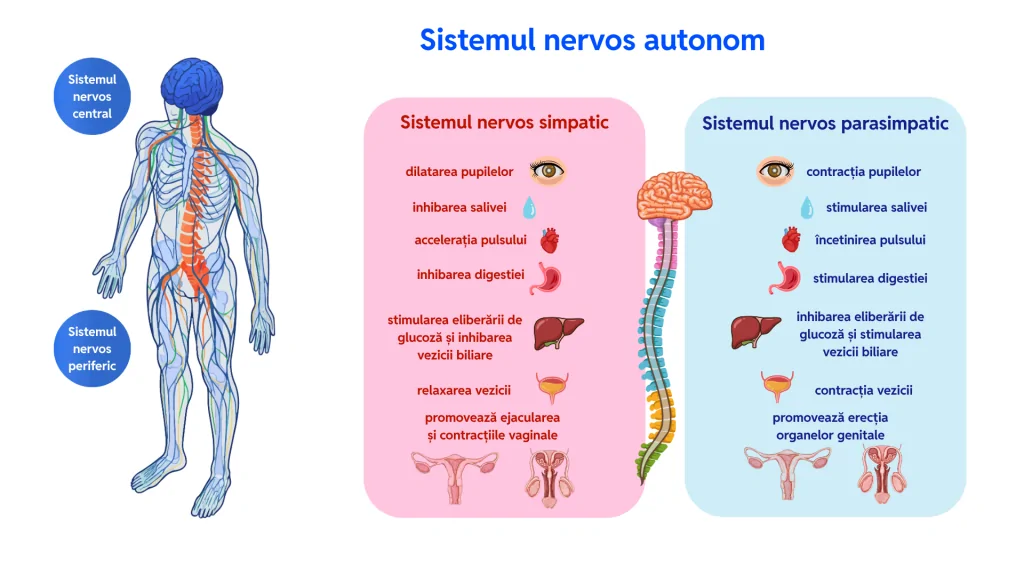
The sympathetic nervous system - fight or flight
The sympathetic nervous system is responsible for activating the body in situations of stress or danger. When we perceive a threat, real or imagined, this system triggers a series of rapid reactions: an increase in heart rate, dilated pupils, faster breathing and the release of stress hormones such as adrenaline and cortisol. The purpose of these changes is to prepare the body for immediate action.
This reaction is known as “fight or flight” and is an evolutionary mechanism that helped us survive in the face of danger. Although in the past it was activated mainly in the face of physical, tangible dangers (such as the presence of predators), today it can be triggered by contextual psychological factors, such as stress at work or social anxiety. The problem appears when this system stays activated over the long term, which can lead to exhaustion and to various health problems.
Alongside the classic reactions of “fight” or “flight”, modern research has also identified two other responses: “freeze” and “submission” or “excessive adaptation” (fawn). The terms come from studies of animal behaviour and were extended into psychology in order to describe human reactions to stress. The original concept of “fight or flight” was popularised by the physiologist Walter Cannon at the beginning of the 20th century, and the other responses were added later in order to reflect the complexity of human reactions.
The 4 main reactions to stress:
Fight: confronting the threat directly
The “fight” reaction appears when the body perceives that it has the resources needed to face the danger. In this state, energy is mobilised rapidly, and the person can become more alert, more determined and sometimes even aggressive. It is a response oriented towards action, in which the individual tries to eliminate or to dominate the threat. In modern life, this reaction can show up as verbal conflicts, irritability or the desire to control the situation.
Flight: avoiding or withdrawing from the situation
The “flight” reaction is activated when the danger is perceived as too great to be confronted directly. Instead of fighting, the body chooses to withdraw in order to protect itself. This can mean physically abandoning a situation, but also emotional or mental avoidance, such as postponing (or procrastination), distraction or the refusal to face a problem. Although useful in the short term, constant avoidance can lead to the accumulation of stress and to difficulties in resolving important situations.
Freeze: blockage, the inability to act
The “freeze” reaction appears when the body cannot decide quickly between fight and flight, or can neither defend itself nor move away from the situation (for example, in the case of a child abused by their family, where the child's safety depends on the parents), and the nervous system enters a state of temporary blockage. The person can feel that they “freeze”, that they become still, unable to react, to speak or to make decisions. It is a state of overload in which the body tries to protect itself through immobility, similar to the behaviour of some animals that play dead in order to avoid predators. In a human context, it can be felt as emotional or mental paralysis.
Submission / Fawn: excessive adaptation in order to avoid conflict
Similar to the freeze reaction, the “fawn” response usually appears when the person feels that they can neither act (fight) nor leave (flight) a situation perceived as threatening. The “submission” reaction involves exactly what it suggests, namely an exaggerated adaptation to the needs and wishes of others, with the aim of avoiding conflict or rejection. The person can become excessively cooperative, submissive or eager to please, even to the detriment of their own needs. This response often appears in tense relational contexts and can have its roots in previous experiences in which safety depended on maintaining harmony. Although it can reduce tension in the moment, in the long term it can lead to the loss of personal identity and to emotional exhaustion.
The parasympathetic nervous system - rest and digest
The parasympathetic nervous system has the role of calming the body and of bringing it back to a state of balance after it has been through a period of stress. It is often described as the “rest and digest” system, because it supports the processes of recovery, regeneration and energy conservation. When this system is active, the heart rate drops, breathing becomes slower and digestion is stimulated.
This branch of the autonomic nervous system is essential for long-term health. Without sufficient periods of parasympathetic activation, the body remains in a constant state of alert, which can lead to chronic fatigue, sleep disorders and digestive problems. The activation of the parasympathetic system is associated with states of deep relaxation, safety and social connection.
An important aspect of the parasympathetic system is the involvement of the vagus nerve, one of the most important nerves in the body. It plays a crucial role in regulating internal functions and in the emotional response. Practices such as deep breathing, meditation, time spent in nature or positive social interactions can stimulate parasympathetic activity, contributing to a general state of wellbeing.
The sympathetic-parasympathetic balance
Optimal health does not depend on the exclusive activation of one of these systems, but on the balance between them. The sympathetic and the parasympathetic nervous system work as two complementary forces: one accelerates, the other slows down. When this balance is maintained, the body can respond efficiently to stress and can recover quickly afterwards.
Problems appear when one of the systems dominates for long periods. For example, chronic activation of the sympathetic system can lead to anxiety and exhaustion, while excessive parasympathetic activity can be associated with a lack of energy or of motivation. This is why becoming aware of your own reactions and adopting self-regulation practices are essential for maintaining balance and general health.
The link between the autonomic system, stress and trauma
The autonomic nervous system plays a central role in the way the body perceives and responds to stress, and this relationship becomes even deeper when we talk about trauma. In situations of danger, the sympathetic system activates in order to protect us, but when the experiences are intense or repeated, the body can remain “stuck” in a state of alert. Thus, instead of returning to balance through the activation of the parasympathetic system, the body continues to function as if the threat were still present.
Trauma is not defined only by the event itself, but above all by the way the nervous system processes it. When an experience exceeds our capacity to integrate it emotionally, it remains “unprocessed” and continues to influence our later reactions. The autonomic nervous system records these experiences and turns them into automatic patterns of reaction, which explains why we sometimes react disproportionately to certain seemingly ordinary situations.
One aspect to take into account is that stress and trauma do not remain only at a mental level, they are also stored in the body. Chronic muscle tension, digestive problems, unexplained pain or persistent fatigue can be manifestations of an unbalanced nervous system. The body “retains” difficult experiences through physiological reactions that are reactivated in similar contexts, even if there is no longer any real danger.
In time, this state of activation or blockage can deeply affect quality of life. The nervous system becomes hypersensitive or, on the contrary, numb, and the capacity to feel safety, relaxation or pleasure decreases. This is why the healing process does not only involve a cognitive understanding of the trauma, but also the regulation of the nervous system and reconnection with your own body.
How you can support the parasympathetic system and the return to balance
Rest
Real rest does not only mean sleep, but also moments of quiet in which the nervous system can come out of the state of alert. When you allow yourself to slow down, without constant stimulation or pressure, the body begins to activate its recovery mechanisms. Regular sleep routines, reducing exposure to screens and creating a calm environment contribute significantly to the activation of the parasympathetic system and to the regeneration of the body.
Breathing
Breathing is one of the fastest and most efficient ways of influencing the autonomic nervous system. Slow, deep and conscious breathing sends the brain the signal that you are safe, activating the parasympathetic response. Simple practices, such as breathing in through the nose and breathing out for longer, can reduce the heart rate and internal tension, helping the body to come out of the state of stress.
Breaks
In a busy day, breaks can seem like a luxury, but they are essential for the regulation of the nervous system. Without moments of calm, the body remains in constant activation, which leads to exhaustion. Short but frequent breaks, in which you disconnect from your tasks and turn your attention towards your body or your breathing, can have a major impact on your inner balance.
The prefrontal cortex and neurofeedback
The prefrontal cortex is the part of the brain responsible for functions such as decision-making, emotional regulation, attention and self-control. In conditions of chronic stress or trauma, this area can reduce its activity, while the structures involved in survival reactions become dominant. This imbalance makes it more difficult to manage emotions and to return to a state of calm, because the body reacts automatically before the rational part can intervene.
Neurofeedback is a modern method that helps regulate brain activity by training the brain to work more efficiently. By monitoring brain waves and offering feedback in real time, this technique allows the brain to learn how to come out of patterns of hyperactivation or blockage. In practice, it is a process through which the nervous system is retrained to return to balance.
One of the major benefits of neurofeedback is that it acts directly on the physiological mechanisms involved in stress and trauma, without depending exclusively on verbal processing. This is particularly useful for people who feel that they “understand” what is happening to them, but do not manage to change their reactions. By strengthening the connections in the prefrontal cortex, the capacity for self-regulation and for returning to calm increases.
In time, this approach can contribute to better sleep, reduced anxiety, emotional regulation and even to the improvement of the physical symptoms associated with stress. Neurofeedback is not an instant solution, but it can be a valuable instrument in the process of reconnecting with your own body and of restoring the balance of the nervous system.
Do you need support?
If you find yourself in constant states of stress, anxiety or fatigue, or if you are facing physical symptoms such as digestive problems, tension or pain without a clear cause, it is possible that your nervous system is out of balance. You do not have to manage these things on your own - there are solutions and specialists who can guide you through the process of regulation and healing.
Fill in the contact form and you will be called by a specialist who can offer you personalised guidance, adapted to your needs. It is a simple but important first step towards a state of balance, safety and wellbeing in your own body.
Do you want to understand what is happening in your brain?
Book a call with the BrainMap Institute's specialists and find out how a BrainMap and brain training can help you.