
Adrenaline: what it is and how it acts in the body
Adrenaline, also known as epinephrine, is a hormone and neurotransmitter that is fundamental for survival.

What adrenaline is and where it is produced
Adrenaline, also known as epinephrine, is a hormone and neurotransmitter that is fundamental for survival, with a central role in the body’s reaction to stress, danger or intense emotions. It belongs to the category of “emergency” hormones and is responsible for triggering the response known as “fight or flight” (the acute stress response). When the body perceives a threat, whether real or imaginary, adrenaline prepares it for rapid action, increasing energy levels, alertness and the capacity to react. Although it is often associated with extreme situations, adrenaline is also involved in everyday processes, such as the regulation of blood pressure, blood sugar and the cardiovascular response.
Adrenaline is produced mainly by the adrenal glands, two small glands located above each kidney. More precisely, it is secreted by the adrenal medulla, the inner part of the adrenal glands, in response to stimulation of the sympathetic nervous system. When the brain, through the hypothalamus, detects a stressful or potentially dangerous situation, it sends signals to the adrenal glands to release adrenaline directly into the bloodstream. In smaller amounts, adrenaline is also produced by certain neurons in the central nervous system, where it acts as a neurotransmitter, influencing alertness, attention and emotional responses.
The role of adrenaline in the response to stress
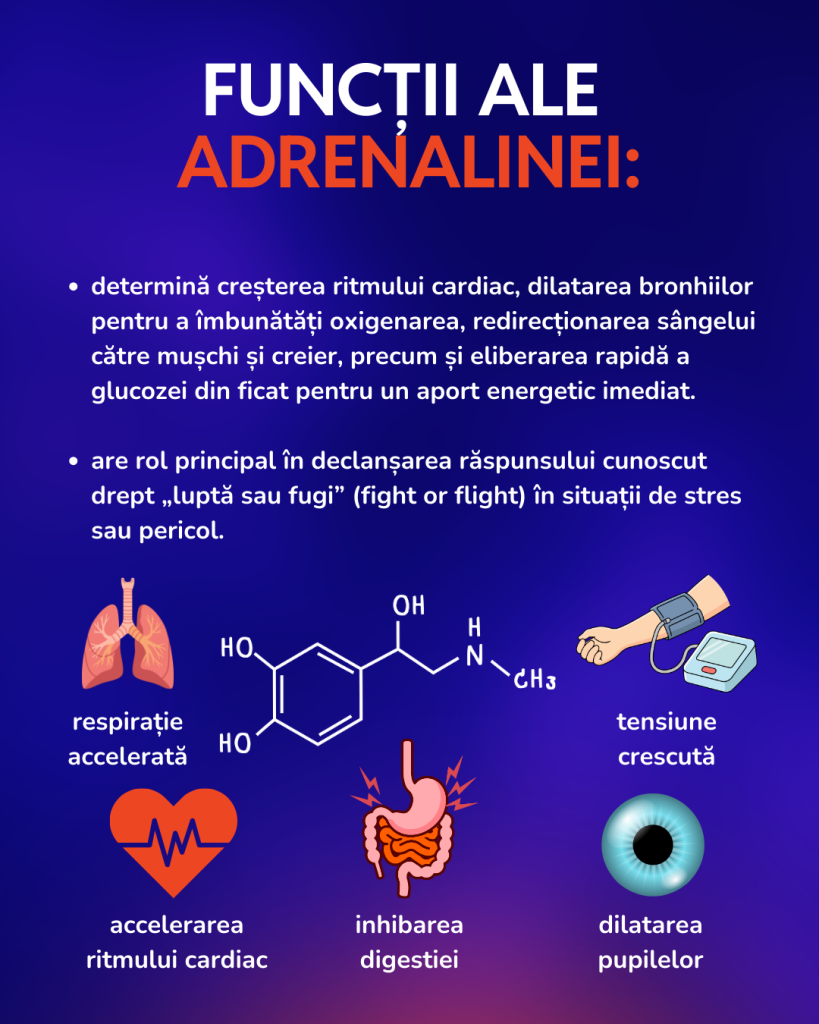
Once released into the blood, adrenaline acts rapidly on several organs and systems in the body. It causes an increase in heart rate, the dilation of the bronchi in order to improve oxygenation, the redirection of blood towards the muscles and the brain, as well as the rapid release of glucose from the liver for an immediate (“emergency”) supply of energy. These effects are extremely useful in the short term, but frequent or prolonged exposure to high levels of adrenaline, as happens in chronic stress, can have negative effects on health, contributing to exhaustion, anxiety, sleep disorders and imbalances of the nervous system. So, although adrenaline is vital for adaptation and survival, a balance in its secretion is essential for the healthy functioning of the body.
Ideally, once the stress factor disappears, the level of adrenaline falls and the body returns to a state of calm and recovery. This balance between activation and relaxation is essential for long-term health. Understanding the role of adrenaline in the stress response helps us realize that it is not occasional stress that is necessarily harmful, but persistent stress, which keeps the body locked into a mode of functioning meant for emergencies, not for everyday life.
The effects of adrenaline in the body and the brain
At cardiovascular level, adrenaline increases the heart rate and the force of the heart’s contraction, causing a faster circulation of blood towards the muscles and the brain. This prepares the body for rapid reactions, but it can produce palpitations when it happens frequently or without a real danger.
At respiratory level, adrenaline causes the dilation of the bronchi, allowing a more efficient oxygenation of the blood. The brain and the muscles thus receive more oxygen, which increases alertness and the capacity for effort.
At metabolic level, adrenaline stimulates the release of glucose from the liver and the mobilization of fats, providing rapidly available energy. In the short term this is beneficial, but in the long term it can contribute to metabolic imbalances.
At digestive level, adrenaline temporarily inhibits digestion, redirecting energy towards the functions considered a priority for survival. That is why frequent stress can lead to gastric discomfort or digestive disorders.
At brain level, adrenaline increases alertness, attention and reaction speed. In excess, however, it can affect clarity of thought and the ability to make decisions.
“Good” adrenaline vs. chronic stress
Adrenaline is essential for adaptation and performance when it is released occasionally and for a short time. This is the beneficial adrenaline, in the sense that it helps us to react quickly, to focus better, to have extra energy and to cope with demanding situations such as an exam, a sports competition or an important event. Once the situation is over, the level of adrenaline falls and the body returns to balance, entering a phase of recovery.
In the context of chronic stress, adrenaline and cortisol act together, but their combined effects can become harmful when they are constantly activated. When the stress does not stop, the levels of these hormones remain high, and this imbalance can lead to physical and mental exhaustion, sleep disturbances, lowered immunity, metabolic disorders and impaired emotional regulation, because the nervous system no longer has the opportunity to return to the state of calm and recovery that is necessary for long-term health.
Adrenaline, anxiety and panic attacks
Adrenaline has a central role in the appearance of anxiety, because it activates the same biological mechanisms involved in the “fight or flight” reaction. In anxious people, the brain more readily interprets certain situations as dangerous, triggering the release of adrenaline even in safe contexts. This reaction leads to physical symptoms such as palpitations, sweating, muscle tension and a feeling of restlessness, which can reinforce the state of anxiety even further.
In panic attacks, the release of adrenaline is sudden and intense, without an immediate real danger. The body reacts as if it were in an extreme emergency, which explains the strong sensations of suffocation, dizziness, rapid heartbeat and the fear of losing control. Although these symptoms are extremely unpleasant, they are not dangerous in themselves; they represent an exaggerated response of the nervous system.
The problem appears when the person starts to fear the appearance of the symptoms themselves. This fear of fear keeps a vicious circle going: anticipating a new attack once again stimulates the release of adrenaline, increasing the probability of a new episode. Over time the nervous system remains hyper-reactive and the threshold at which adrenaline is triggered drops. Understanding the link between adrenaline, anxiety and panic attacks is an important step towards regaining control and regulating the body’s reactions.
When adrenaline becomes a medical instrument
Adrenaline is not only a stress hormone, but also a medicine in critical medical situations, where it can make the difference between life and death. In medicine, adrenaline is used for its rapid effects on the cardiovascular and respiratory systems, being able to restore circulation, open the airways and counter severe reactions of the body. Because of its intense and rapid action, the administration of adrenaline is reserved for medical emergencies, under strict supervision, and is not intended for routine use.
Adrenaline is administered mainly in cases such as anaphylactic shock, cardiac arrest, severe allergic reactions, acute asthma attacks or certain forms of severe hypotension. In anaphylactic shock, for example, adrenaline is the first-line treatment because it rapidly reduces the swelling of the airways, dilates the bronchi and raises blood pressure, preventing circulatory collapse. In cardiac arrest, adrenaline helps to restore circulation by increasing coronary perfusion pressure. It is also used locally, in some surgical procedures, to reduce bleeding, thanks to its vasoconstrictor effect.
The way adrenaline is administered depends on the clinical situation and on the urgency of the case. Most frequently it is given intramuscularly (for example, in anaphylactic shock), intravenously in strictly controlled settings, or subcutaneously, depending on the indication. The dose and the route of administration are carefully calculated in order to obtain the desired effect while minimizing the risks. Because adrenaline has a strong impact on the heart and on the nervous system, it is administered only by trained medical staff or, in special situations, through auto-injector devices prescribed to patients at high risk of severe allergic reactions.
How you can support the regulation of the adrenaline response
Regulating the adrenaline response starts with understanding the way the nervous system reacts to stress. When the body is frequently exposed to emotional or mental pressure, the brain can remain locked into an “alert” mode of functioning, releasing adrenaline even in the absence of a real danger. Supporting this regulation means creating conditions that help the nervous system to alternate correctly between activation and relaxation: quality sleep, conscious breathing, a reduction of excessive stimuli and more balanced daily rhythms. These interventions support the body’s natural capacity to self-regulate, but they are not always enough when the stress is chronic.
An effective approach, based on neuroscience, is neurofeedback, a non-invasive therapy that helps the brain learn to regulate its reactions to stress better. By monitoring brain activity in real time, neurofeedback gives the brain information about its own way of functioning, allowing it to adjust the patterns associated with over-activation and with an excessive adrenaline response. Over time, this process can contribute to reducing the state of constant alert, to lowering the intensity of symptoms such as anxiety, palpitations or inner tension and to restoring a general state of calm and balance.For this intervention to be truly effective, it is important that it is personalized, according to the particularities of each person. That is why the initial BrainMap evaluation is essential. If you feel that your body reacts disproportionately to stress or that adrenaline constantly influences your well-being, we encourage you to talk to a specialist who can explain the options that are right for you and the concrete steps to follow.
🧠 How does your brain work?
Download the guide for FREE and find out what your brain map shows.
📖 Our books - Real case studies with brain maps
📖 Vindecarea Depresiei (Healing Depression, in Romanian) - 29.00 RON
📖 Vindecarea Anxietatii (Healing Anxiety, in Romanian) - 29.00 RON
📖 Eliminarea Atacurilor de Panica (Ending Panic Attacks, in Romanian) - 29.00 RON
Do you want to understand what is happening in your brain?
Book a call with the BrainMap Institute’s specialists and find out how a BrainMap and brain training can help you.