
Motivation: 7 strategies to move from stuck to action
Motivation is the internal or external force that drives a person to act, to reach goals and to overcome obstacles.

What is motivation
Motivation is the internal or external force that drives a person to act, to reach goals and to overcome obstacles. It explains “why” we do certain things, whether it is a matter of learning, work, sport or personal development. Motivation can influence the intensity of the effort, perseverance and the satisfaction felt after an achievement. Without motivation, even the simplest tasks can seem difficult or meaningless.
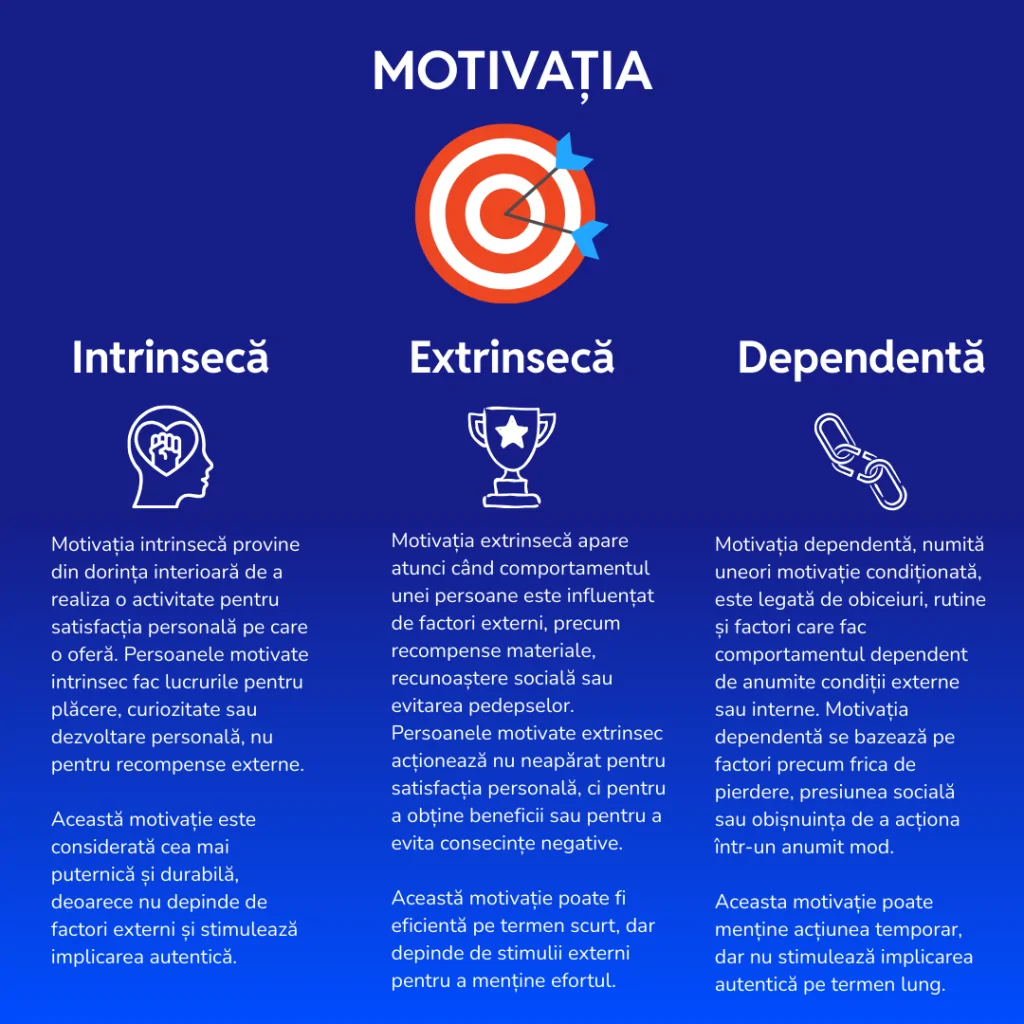
Types of motivation
1. Intrinsic motivation:
Intrinsic motivation comes from the inner desire to carry out an activity for the personal satisfaction it provides. Intrinsically motivated people do things for pleasure, curiosity or personal growth, not for external rewards. For example, someone who paints, learns a foreign language or plays a sport simply because it feels good and helps them grow personally is intrinsically motivated. This type of motivation is considered the strongest and most lasting, because it does not depend on external factors and encourages genuine involvement.
2. Extrinsic motivation:
Extrinsic motivation appears when a person's behaviour is influenced by external factors, such as material rewards, social recognition or avoiding punishment. Extrinsically motivated people act not necessarily for personal satisfaction, but in order to obtain benefits or to avoid negative consequences. Examples include studying for high grades, working for a bonus or making an effort in order to receive the manager's appreciation. This type of motivation can be effective in the short term, but it depends on external stimuli to sustain the effort.
3. Dependent (or conditioned) motivation:
Dependent motivation, sometimes called conditioned motivation, is linked to habits, routines and factors that make behaviour dependent on certain external or internal conditions. Unlike intrinsic motivation, which comes from within, and extrinsic motivation, which depends on visible rewards, dependent motivation rests on factors such as fear of loss, social pressure or the habit of acting in a certain way. For example, a person may keep working on a task simply because “that is how they have always done it” or because they feel the pressure of their environment, without feeling real pleasure or a concrete reward. This type of motivation can sustain action temporarily, but it does not encourage genuine long-term involvement.
What happens in the brain when motivation drops
When motivation drops, brain activity in the areas responsible for reward and pleasure, such as the nucleus accumbens and the prefrontal cortex, is reduced. These areas are involved in processing dopamine, the neurotransmitter associated with the sensation of satisfaction and the anticipation of reward. When dopamine levels fall, or when the brain perceives that the effort required to reach a goal is too great compared with the reward, a feeling of apathy or lack of interest appears. In practice, the brain “weighs up” the ratio between effort and benefit and, if this seems unfavourable, the impulse to act decreases.
At the same time, a drop in motivation is also associated with increased activity in the amygdala, the region of the brain responsible for emotions such as fear, anxiety or stress. This makes any task feel more difficult or even threatening. Cortisol, the stress hormone, can also inhibit the optimal functioning of the prefrontal cortex, the area responsible for planning, self-control and decision-making. So when motivation drops, the brain does not only “lose interest”, it actually feels that the effort is tiring and risky, which makes it even harder to overcome inertia.
Another aspect concerns the learning systems based on reward and anticipation. Our brain learns by associating actions with positive or negative outcomes. If previous experiences showed that the effort was not rewarded or that the results were not significant, dopaminergic activation automatically decreases when similar tasks arise. As a result, a drop in motivation is not merely a matter of willpower, but a physiological and psychological response of the brain, which prioritises energy and resources for the activities it considers “profitable” or safe.
Why willpower is not enough
Willpower is often seen as a mental “muscle” that allows us to force ourselves into action, but it has clear limits. The brain does not work solely on the conscious desire to achieve something; it depends on emotional stimulation, on dopamine levels and on hormonal balance in order to sustain action. Even if a person very much wants to complete a task, the lack of motivation or of an anticipated reward can make the effort feel excessive, causing procrastination or rapid exhaustion. Willpower alone therefore cannot override the entire reward system and cannot “force” the brain to feel satisfaction where there is none.
In addition, willpower cannot cancel out factors such as fatigue, stress or previous negative experiences, which directly affect motivation and the ability to concentrate. The brain has automatic protective mechanisms that prioritise conserving energy and avoiding failure, even if the conscious will wants the opposite. That is why effective strategies do not rely only on “forcing” action, but on stimulating intrinsic motivation, setting clear goals and concrete rewards, as well as on managing emotions and stress. Willpower can support the process, but it cannot be the only engine of performance.
How neurofeedback works in relation to motivation
Neurofeedback is a brain training technique through which a person receives real-time information about their brain activity, usually by electroencephalogram (EEG). In relation to motivation, the purpose of neurofeedback is to regulate and optimise the functioning of certain brain areas involved in reward, attention and self-control, such as the prefrontal cortex and the nucleus accumbens. By monitoring activity and providing visual or auditory feedback, the brain “learns” to maintain an optimal level of activity that favours focus, engagement and intrinsic motivation.
The mechanism of neurofeedback is based on the principle of neuronal plasticity: the brain can change its patterns of activity on the basis of experience and repetition. When the person manages to reach a certain pattern of activity associated with a state of motivation and alertness, the system offers an immediate reward, such as a positive sound or visual signal. Over time, the brain learns to reproduce this pattern even without external feedback, which can lead to more constant motivation and a better ability to focus efforts on goals.
Another important aspect is that neurofeedback not only stimulates motivation, but can also help reduce the factors that inhibit it, such as anxiety, procrastination or falling mental energy. By training the brain to remain in optimal states of alertness and reward, the person becomes more aware of their own mental processes and better able to manage their emotions and their effort. In practice, neurofeedback works like an “internal coach” for the brain: it teaches it to prioritise important tasks, to engage actively and to maintain motivation over the long term.
7 practical strategies for increasing motivation
Motivation is essential for reaching goals, maintaining discipline and developing personally. Sometimes, however, we can feel that our energy or our desire to act is fading, even for important activities. Fortunately, there are practical strategies that help stimulate motivation and create a lasting internal drive. Applying these methods consistently can turn difficult tasks into manageable and even enjoyable challenges.
1. Setting clear, concrete goals:
An effective way of increasing motivation is to set specific, measurable and achievable goals. When you know exactly what you want to obtain and can track your progress, the brain receives a clear reward signal, which stimulates the desire to act. Large goals can be broken down into smaller steps, in order to maintain a constant sense of achievement and progress.
2. Creating an action plan:
Motivation increases when there is a detailed plan showing what has to be done and in what order. Plans reduce anxiety and indecision, offering clarity and structure. When you know the concrete steps to follow, the brain perceives the task as easier to manage and less overwhelming.
3. Using rewards:
Rewards, whether small or large, stimulate the brain's reward system and increase motivation. They can be external, such as a small pleasure after finishing a task, or internal, such as the feeling of satisfaction and achievement. The key is for them to be proportional to the effort made and to arrive immediately after a goal is reached.
4. Breaking tasks into small steps:
Large or complex tasks can discourage motivation if they seem impossible to complete. Breaking them into smaller, manageable steps allows frequent small successes, which supply the brain with dopamine and keep interest alive. This strategy helps reduce procrastination and increases confidence in your own abilities.
5. Creating a stimulating environment:
The environment we are in has a major impact on motivation. Removing distractions, keeping the workspace tidy and surrounding yourself with positive stimuli (such as motivational quotes or objects that inspire you) can encourage focus and the desire to act. A suitable environment reduces the fears and the stress that inhibit motivation.
6. Maintaining a routine and discipline:
Motivation fluctuates from day to day, but discipline and habits can sustain action even when the desire fades. Setting a daily routine and keeping fixed hours for important activities helps the brain work more efficiently and turns action into a reflex, reducing dependence on the motivation of the moment.
7. Practising mindfulness and managing emotions:
The mental state directly influences motivation. Mindfulness techniques, conscious breathing or meditation help reduce the stress and the anxiety that inhibit the desire to act. Better awareness of your own emotions makes it possible to identify internal obstacles and to create a mental context that favours engagement in motivating activities.
Motivation is not a static concept, but a dynamic process influenced by goals, environment, emotions and habits. Applying the practical strategies presented here - from setting clear goals and planning actions to creating a stimulating environment and managing emotions - can transform the way we engage in activities and helps us reach higher performance. With consistent practice, motivation can become a constant ally, not just a temporary state.Do you feel that your energy and your desire to act are fading? Neurofeedback can help you train your brain for more focus, concentration and lasting motivation. Book a free call with a specialist now and take the first step towards achieving your goals!
🧠 How does your brain work?
Download the guide for FREE and find out what your brain map shows.
📖 Our books - Real case studies with brain maps
📖 Vindecarea Depresiei (Healing Depression, in Romanian) - 29.00 RON
📖 Vindecarea Anxietatii (Healing Anxiety, in Romanian) - 29.00 RON
📖 Eliminarea Atacurilor de Panica (Ending Panic Attacks, in Romanian) - 29.00 RON
Do you want to understand what is happening in your brain?
Book a call with the BrainMap Institute's specialists and find out how a BrainMap and brain training can help you.