
Specific learning disorders: signs, causes and how they can be supported
Specific learning disorders are persistent difficulties that affect a person’s ability to acquire and use fundamental academic skills.

Learning disorders are an increasingly discussed reality in the context of modern education, as education systems become more attentive to the diversity of pupils’ needs. Far from reflecting a lack of intelligence or of motivation, these difficulties indicate differences in the way the brain processes information. Understanding them correctly is essential in order to create inclusive and effective educational environments.
For many children and adults, the educational path can be marked by frustration, misunderstandings and wrong labels when learning difficulties are not identified in time. For this reason, correctly informing parents, teachers and society as a whole plays a crucial role in supporting those affected. With appropriate interventions, people with such disorders can achieve remarkable results and can make full use of their own potential.
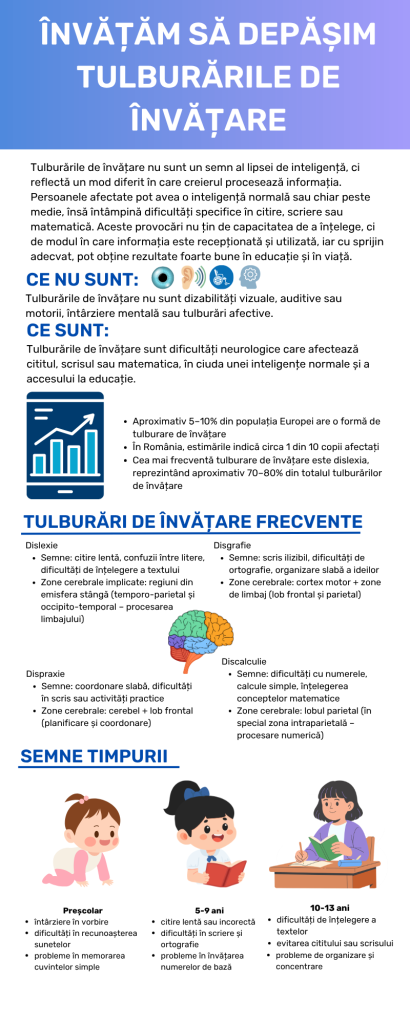
What specific learning disorders are
Specific learning disorders are persistent difficulties that affect a person’s ability to acquire and use fundamental academic skills, such as reading, writing or mathematical calculation. They appear despite normal or above-average intelligence and they are not caused by external factors such as a lack of education, vision or hearing problems or a disadvantaged socio-economic environment. Among the best known forms are dyslexia (reading difficulties), dysgraphia (writing difficulties) and dyscalculia (difficulties with mathematics). These disorders have a neurological basis and they influence the way the brain processes, stores and retrieves information.
It is important to underline that specific learning disorders do not go away on their own, but they can be managed effectively through personalised interventions, adapted educational strategies and constant support. Early diagnosis plays an essential role in reducing the negative impact on school performance and on self-esteem. Awareness of these disorders also contributes to reducing stigma and to promoting an approach based on empathy and understanding, instead of judgement or wrong labels.
How learning difficulties show themselves
Learning difficulties can show themselves in various ways, depending on the type of disorder and on the particularities of each person. These manifestations can become visible from the first years of school and can affect different areas of academic and cognitive development. Identifying them correctly is the first step towards effective intervention.
Reading difficulties (dyslexia)
People with reading difficulties have problems recognising words, with reading fluency and with understanding the text they read. Reading can be slow, fragmented and often accompanied by frequent errors, such as reversing letters or leaving out parts of words. These difficulties can lead to avoiding reading activities and to a drop in school performance, especially in the subjects that require the understanding of written text. Frustration and anxiety related to academic tasks can also appear.
Writing difficulties (dysgraphia)
Dysgraphia shows itself through problems with written expression, both at a mechanical level and at the level of organising ideas. The handwriting can be illegible, untidy or inconsistent, and the person can have difficulty following grammar and spelling rules. Formulating ideas in writing can also be a slow and difficult process, even if verbal expression is adequate. This can create discrepancies between actual knowledge and assessed performance.
Difficulties with mathematics (dyscalculia)
People with dyscalculia have difficulty understanding numerical concepts, carrying out calculations and solving mathematical problems. Confusion can appear in recognising numbers, in ordering them or in memorising basic operations. These difficulties affect not only school performance, but also everyday activities, such as managing money or keeping track of time. Without appropriate support, they can generate frustration and avoidance.
Difficulties with attention and organisation (dyspraxia)
Although they are not always classified strictly as learning disorders, difficulties with attention and organisation are frequently associated with them. Those affected can have problems maintaining concentration, completing tasks or managing time. Difficulties can also appear in planning activities and in following complex instructions. These manifestations negatively influence school performance and can be wrongly interpreted as a lack of interest or of discipline.
The manifestations of learning difficulties are diverse and can have a significant impact on a person’s educational and emotional path. Early recognition and appropriate intervention can make a major difference, offering the chance of harmonious development and of making use of individual potential. Understanding these difficulties is the first step towards inclusion and educational success.
Why specific learning disorders appear
Specific learning disorders have, above all, a neurobiological basis, which means that they are linked to the way the brain works and develops. Studies show that certain areas involved in processing language, memory or mathematical reasoning can work differently in those affected. These differences do not indicate an intellectual deficiency, but rather an alternative way of processing information, which can make traditional academic tasks more difficult.
Another important factor is the genetic component. Learning disorders tend to appear more frequently in families, which suggests a hereditary predisposition. For example, if one of the parents had reading or writing difficulties, there is a higher probability that the child will face similar challenges as well. Genetics, however, does not absolutely determine the appearance of these disorders, but rather increases susceptibility, in interaction with other factors.
Prenatal and perinatal development can also influence the appearance of learning disorders. Factors such as exposure to toxic substances during pregnancy, premature birth, low birth weight or complications during birth can affect the development of the central nervous system. These early influences can have long-term effects on the child’s ability to process information and to acquire academic skills.
The environment in which the child grows up also plays a role, although it is not a direct cause of specific learning disorders. A lack of cognitive stimulation, limited access to education or unsuitable teaching methods can amplify existing difficulties or can delay their identification. It is important to distinguish between difficulties caused by the environment and those of a neurological nature, because the interventions needed are different.
Not least, emotional and psychological factors can contribute to intensifying the symptoms. Although they are not the main cause, stress, anxiety or repeated negative experiences in the school environment can worsen learning difficulties. A child who constantly faces failure can develop a negative attitude towards learning, which creates a vicious circle between low performance and falling motivation.
The impact on everyday life
School performance
Learning disorders have a direct impact on academic results, even when the pupil makes considerable efforts. Difficulties with reading, writing or mathematics can lead to low marks and to a fragmented understanding of the subject matter. In time, this can affect the educational path, limiting access to certain opportunities and generating frustration both for the pupil and for the family.
Self-esteem
Repeated experiences of failure or comparisons with classmates can deeply affect self-confidence. People with learning disorders can come to see themselves as “less capable”, even if they have valuable abilities in other areas. This drop in self-esteem can influence motivation, social relationships and the wish to take part in educational activities.
Social relationships
Learning difficulties can affect social interactions, especially in the school environment. Children can become withdrawn, can avoid situations in which they have to read or answer in front of the class, or can be at risk of marginalisation. In some cases, a lack of understanding from classmates or teachers can lead to labelling or bullying.
Professional life
In the long term, learning disorders can influence career choices and professional performance. Those affected can avoid fields that involve difficult academic tasks or can need compensatory strategies in order to cope with the demands. With appropriate support, however, many adults develop remarkable skills and succeed in various careers.
Everyday activities
The impact is not limited to the educational or professional environment, but extends into everyday life as well. Managing time, organising tasks, reading instructions or carrying out simple calculations can become challenges. These difficulties can affect autonomy and can require the development of practical strategies for coping with daily demands.
Emotional health
In the long term, the accumulation of difficulties can lead to stress, anxiety or even depressive symptoms. The feeling of being misunderstood or the constant pressure to perform can affect emotional balance. This is why psychological support and an empathetic environment are essential for maintaining wellbeing and for developing a positive perspective on oneself.
How they differ from learning difficulties
Although the terms are often used interchangeably, specific learning disorders and learning difficulties are not the same thing. Specific learning disorders have a clear neurological basis and are diagnosed according to standardised criteria, being considered persistent conditions that affect the processing of information. Learning difficulties, on the other hand, can be temporary and can appear as a result of external factors, such as inadequate teaching methods, a lack of educational support or changes in the family environment.
Another important distinguishing element is the duration and the consistency of the manifestations. Specific learning disorders persist over time, regardless of the effort made or of the context, and they require specialised interventions in order to be managed effectively. Learning difficulties, on the other hand, can be overcome more easily once the factors that generated them are corrected. For example, a child who did not benefit from a suitable teaching method can catch up quickly when they are given appropriate support.
The assessment and the intervention also differ significantly between the two situations. Specific learning disorders require a complex assessment carried out by specialists (psychologists, speech therapists, educational psychologists), who can establish a personalised intervention plan. In the case of learning difficulties, the interventions are often simpler and can involve educational adaptations, additional support from teachers or the involvement of parents in the learning process. Understanding this difference is essential in order to avoid wrong labels and to offer the right support to each child.
How neurofeedback can help in learning disorders
Neurofeedback is a modern method of brain training based on monitoring brain activity and providing feedback in real time. Through this technique, the person learns to regulate their patterns of brain activity, which can contribute to improving attention, concentration and the processing of information. In the case of learning disorders, neurofeedback can support the development of essential cognitive functions, reducing the difficulties encountered in academic activities.
One of the major benefits of neurofeedback is that it is non-invasive and personalised. The sessions are adapted to the needs of each person, based on an initial assessment of brain activity. Through repeated exercises, the brain is “trained” to work more efficiently, which can lead to visible improvements in reading, writing or problem solving. This method can also contribute to reducing the associated symptoms, such as anxiety or concentration difficulties, which often accompany learning disorders.
It is important to mention that neurofeedback is not a miracle solution, but a component of a broader intervention plan. Its effectiveness increases when it is combined with other methods, such as educational therapy, speech therapy or psychological counselling. In addition, constant involvement and patience are essential, because the results appear gradually, over time. Even so, for many people neurofeedback can become a valuable instrument in overcoming the obstacles related to learning and in developing personal potential.
If you have noticed signs of learning difficulties or you want to find out more about the solutions available, do not put off asking for specialised help. Early intervention can make a major difference in a child’s development or even in your own personal path.
Fill in the contact form, and a specialist will contact you for an initial assessment and in order to discuss the most suitable intervention options. Every case is unique, and the right support starts with a conversation.
Do you want to understand what is happening in your brain?
Book a conversation with the specialists of the BrainMap Institute and find out how a BrainMap and brain training can help you.