
What empathy is and how you can train it with neurofeedback
Empathy is the ability to understand and feel what others are going through, to put yourself, even for a moment, in their place.

What empathy is and where healthy care for others ends
Empathy is the ability to understand and to feel what others are going through, to put yourself, at least for a moment, in their place. It is a complex process that involves both cognitive components, such as understanding another person’s perspective, and emotional ones, such as taking part affectively in their state. From a neurobiological point of view, empathy is supported by the so-called mirror neurons, discovered in the early 1990s, which are activated both when a person performs an action and when they observe it in someone else. These neurons allow us to “feel” the emotions of others indirectly and are the basis of deep human connections.
Healthy care for others is a balanced expression of empathy. It involves compassion and the wish to help, without losing yourself in another person’s suffering. This kind of care is based on clear boundaries, mutual respect and the awareness that we cannot save anyone in place of their own will. In this form, empathy becomes a valuable resource for harmonious relationships, cooperation and genuine support.
However, when empathy goes beyond healthy limits, it can turn into a burden. People with high emotional sensitivity can end up taking on the pain and the stress of others as if they were their own, developing what is called empathic fatigue or compassion burnout. In these cases, care for others becomes self-destructive, leading to anxiety, emotional exhaustion and difficulties in maintaining inner balance.
Empathy is therefore an essential force of humanity, but one that requires emotional maturity and self-understanding. Being empathic does not mean dissolving into other people’s emotions, but understanding them and accompanying them with discernment. True care begins when you can be present for others without losing yourself.
Types of empathy
1. Cognitive empathy
Cognitive empathy is the ability to understand the thoughts, perspectives and intentions of other people. It involves a form of “mind reading” - not in a mystical sense, but as an ability to sense what someone feels or thinks based on the context, on their expressions or on their behavior. This type of empathy is essential in communication, negotiation and professional relationships, because it makes it possible to anticipate other people’s reactions without becoming emotionally involved in their suffering.
2. Emotional (affective) empathy
Emotional empathy means genuinely feeling what another person is going through - joy, pain, fear or enthusiasm. It is a spontaneous reaction, sometimes even a physical one, to the emotions of others, mediated by the mirror neurons. This type of empathy creates deep bonds between people and encourages solidarity, but it can become overwhelming if it is not accompanied by emotional self-regulation.
3. Compassionate empathy (or empathy that is concerned for others)
Compassionate empathy goes beyond understanding and feeling the emotions of others - it involves the active wish to help and to relieve suffering. It is the most balanced form of empathy, because it includes both the emotion and the conscious action. A person with compassionate empathy stays connected to another’s pain, but without taking it on, offering support from a place of stability and generosity.
4. Somatic (physical) empathy
Somatic empathy shows itself when our body reacts to the states of others - for example, when we feel a lump in the throat on seeing someone cry or when we instinctively tense up in the face of another’s pain. It is the most instinctive form of empathy and is based on deep biological mechanisms. Although it is natural, somatic empathy can become difficult for those who constantly work with people who are suffering, because their body “feels” the observed pain intensely.
The benefits of empathy
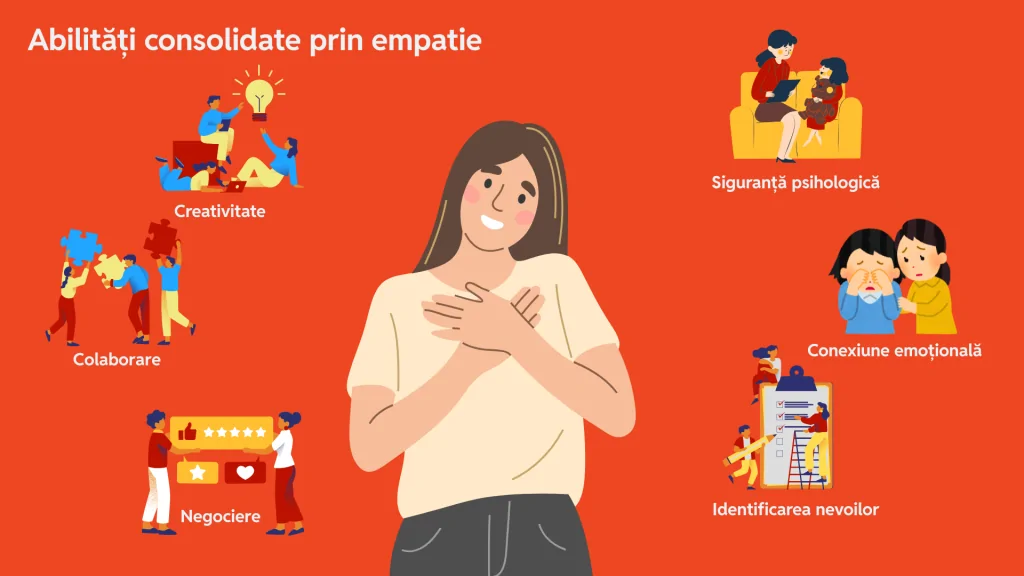
Empathy is one of the most valuable human qualities, with profound positive effects both personally and professionally. In personal life, empathy contributes to building authentic and stable relationships. When we can understand the emotions and needs of the people close to us, communication becomes more open, conflicts diminish and emotional bonds grow stronger. An empathic person offers support without judging, cultivating a climate of trust and emotional safety within the family and among friends.
From an inner point of view, empathy develops emotional intelligence and self-knowledge. By observing and understanding the emotions of others, we come to be more aware of our own reactions, limitations and needs as well. In this way, empathy helps us become more tolerant, more patient and more flexible. In addition, studies show that empathic people tend to be happier and more balanced, because they feel connected to others and have a deeper sense of belonging.
Professionally, empathy is an essential competence for successful working relationships. Empathic leaders manage to inspire trust, to understand the perspectives of the team and to take decisions that take into account the human needs behind performance. In fields such as education, medicine, psychology or services, empathy is the key to effective communication and to the satisfaction of the people being served. It increases cooperation, improves the organizational climate and reduces conflicts.
In the long run, empathy contributes to the development of a more supportive and more aware society. When people listen to one another with attention and understanding, the level of social trust rises and the tendency towards isolation or aggression is reduced. In essence, empathy is not just an emotion, but a form of relational wisdom, a bridge between people that makes both personal and professional life richer and more harmonious.
The characteristics of people with a high level of empathy
They listen actively and patiently – An empathic person does not just hear, but truly listens . They are present in the conversation, giving their full attention without interrupting or judging.
They understand the emotions of others without needing words – Empathic people can read nonverbal language subtly: the tone of voice, facial expressions or gestures, sensing what a person feels even when that person says nothing.
They show compassion and the wish to help – They do not remain indifferent to the suffering of others. They have a natural tendency to offer support, whether emotional or practical.
They have great emotional sensitivity – They experience emotions intensely, both their own and those of others. This sensitivity allows them to form deep connections, but it can also make them vulnerable to emotional stress.
They are tolerant and free of prejudice – Instead of judging, they seek to understand. They accept differences of opinion and experience, showing respect for human diversity.
They have well-developed intuition – Empathic people perceive “beyond appearances”. Their intuition helps them recognize unspoken tensions or needs in relationships between people.
They take emotional responsibility in relationships – They are aware of the impact of their own words and behavior on others, avoiding impulsive or unkind reactions.
They seek harmony and avoid pointless conflicts – Empathic people prefer peaceful solutions and open communication, because they feel tensions more intensely than others do.
They are good mediators and communicators – Thanks to their ability to understand different perspectives, they can facilitate dialogue and reconciliation between people who disagree.
They need time for emotional recharging – Precisely because they absorb the emotions around them, highly empathic people feel the need for periodic withdrawal, quiet and personal space in order to restore their inner balance.
Empathy vs compassion
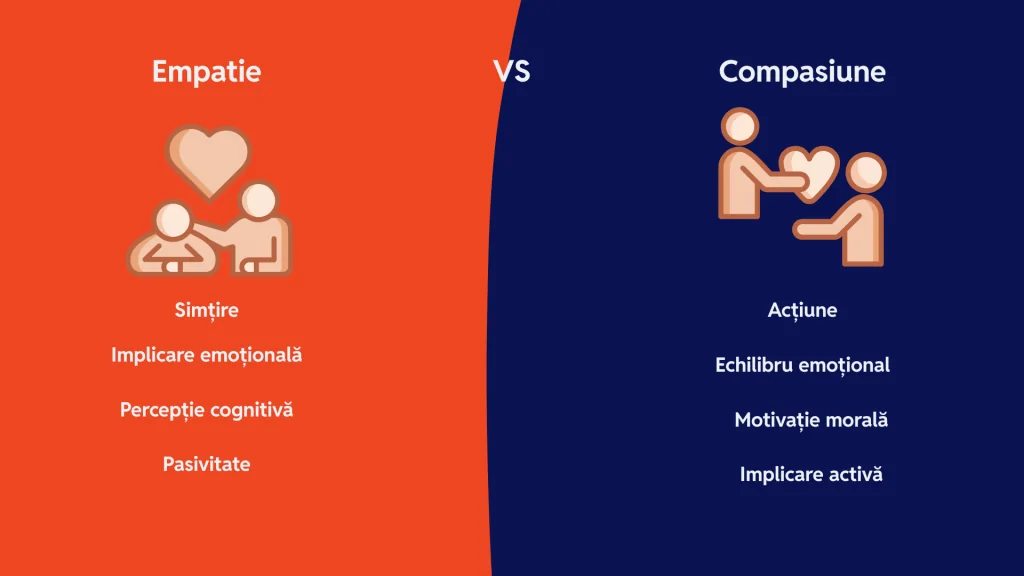
Empathy and compassion are closely linked, but they are not the same thing. Empathy means to feel or to understand the emotions of others, while compassion goes one step further - it involves the active wish to help them or to relieve their suffering. In other words, empathy is the recognition of pain, and compassion is the conscious response to it. A person can be empathic without acting, but compassion always involves a form of balanced involvement, one that does not exhaust but builds.
Can you have too much empathy?
Yes, empathy, when it is excessive and uncontrolled, can become a burden. People who absorb the emotions of others without emotional filters risk experiencing states of anxiety, exhaustion or borrowed sadness. This is sometimes called hyper-empathy and appears especially in those who feel responsible for the wellbeing of everyone around them. Instead of being a gift, empathy that is too intense can become a source of permanent stress.
In order to stay healthy, empathy needs clear boundaries and self-care. Learning to feel with others without living in their place is a sign of emotional maturity. By developing compassion - that is, a conscious and balanced form of empathy - we can keep our openness towards people without using up our inner resources.
How a lack of empathy shows itself and what impact it has
A lack of empathy shows itself through indifference to the emotions and needs of others, difficulty in recognizing human suffering and a predominantly selfish orientation. People with a low level of empathy tend to react coldly or rationally in situations that call for sensitivity, they can minimize other people’s problems or even take advantage of their vulnerabilities. In relationships, this often leads to conflicts, isolation and repeated misunderstandings.
The impact of a lack of empathy is profound. On a personal level, it leads to superficial relationships, a lack of emotional connection and difficulties in maintaining stable bonds. On a social or professional level, it can generate tension, mistrust and hostile working environments, in which people feel unvalidated or unappreciated.
In the long run, a society with an empathy deficit becomes more fragmented and colder. Without the capacity to understand one another, cooperation decreases, polarization grows and human solidarity is eroded. This is why empathy is not just an individual virtue, but an essential condition for the health of relationships and communities.
Empathy as mental training
Empathy is not only an innate trait, but also a skill that can be cultivated through conscious practice. Like a mental muscle, it develops when we train our attention, our awareness of our own emotions and our capacity to perceive the states of others without judging them. Practices such as mindfulness, reflecting on our own emotional reactions or exposure to diverse perspectives can significantly improve empathy. Over time, the brain learns to recognize emotional signals more quickly and more clearly, to process them in a balanced way and to respond with understanding rather than with reactivity.
How neurofeedback helps in developing empathy
Neurofeedback is a modern brain training method that uses technology to help us regulate brain activity in real time. In the case of empathy, neurofeedback contributes to balancing the brain areas involved in emotional regulation, attention and social connection - especially the prefrontal cortex and the limbic system. By monitoring brain waves and providing immediate feedback, a person learns to maintain the mental state that is optimal for empathic connection: calm, presence and clarity. In this way, neurofeedback not only increases the capacity for empathy, but also emotional resilience, preventing empathic fatigue.
Neurofeedback for balanced empathyIf you want to develop your empathy in a healthy and conscious way, neurofeedback can be an excellent tool. Through personalized sessions, you can learn to regulate your emotional responses, to stay present without letting yourself be overwhelmed and to build more authentic and deeper relationships. Book a call with a specialist now to take the first step.
🧠 How does your brain work?
Download the guide for FREE and find out what your brain map shows.
📖 Our books - Real case studies with brain maps
📖 Vindecarea Depresiei (Healing Depression, in Romanian) - 29.00 RON
📖 Vindecarea Anxietatii (Healing Anxiety, in Romanian) - 29.00 RON
📖 Eliminarea Atacurilor de Panica (Ending Panic Attacks, in Romanian) - 29.00 RON
Do you want to understand what is happening in your brain?
Book a call with the BrainMap Institute's specialists and find out how a BrainMap and brain training can help you.