
What assertiveness is. 10 tips for effective communication
Assertiveness is a balanced communication style in which a person expresses opinions, needs and emotions clearly, directly and respectfully.

What is assertiveness
Assertiveness is a balanced communication style in which a person expresses their opinions, needs and emotions in a clear, direct and respectful way, without infringing the rights of others. From a psychological perspective, assertive behavior reflects sound self-awareness and healthy self-esteem. It is an essential skill in interpersonal relationships, because it allows authentic expression, free from the fear of rejection or conflict, yet without resorting to aggression or passivity.
Unlike assertiveness, so-called people-pleasing (or passive-agreeable) behavior is characterized by an excessive need for external approval and by avoiding conflict at any cost, often at one's own expense. People who communicate this way tend to suppress their own wishes and boundaries in order to please others. At the opposite pole, dominant or aggressive communication involves imposing one's point of view coercively, through a raised voice, criticism or intimidation. In psychological terms, this can reflect a defense mechanism or a learned dysfunctional pattern of relating. Assertiveness, then, we could say, is the neutral point between passivity and aggression, and it is the key to healthy relationships and authentic communication.
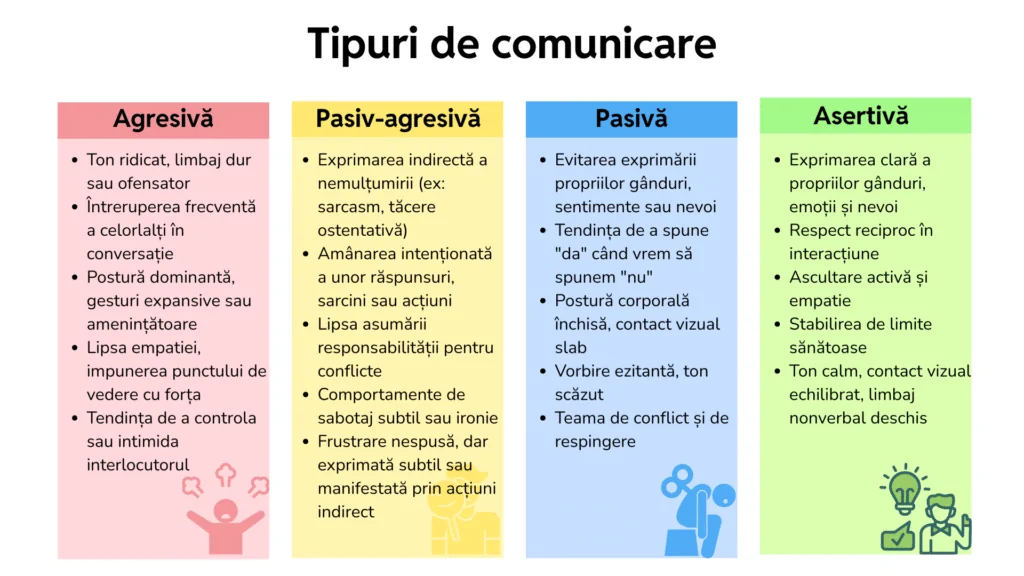
Types of communication
1. Passive communication
Typical features:
- Avoiding the expression of one's own thoughts, feelings or needs
- The tendency to say “yes” when one wants to say “no”
- Closed body posture, poor eye contact
- Hesitant speech, low tone of voice
- Fear of conflict and of rejection
Passive communication involves silencing your own voice out of a wish to avoid conflict or keep the peace, even at the cost of your own well-being or by giving up on voicing your own needs. Assertiveness, by contrast, involves self-respect and authentic expression, while still preserving respect for the other person.
2. Aggressive communication
Typical features:
- Raised voice, harsh or offensive language
- Frequently interrupting others during conversation
- Dominant posture, expansive or threatening gestures
- Lack of empathy, forcing one's point of view on others
- The tendency to control or intimidate the other person
Aggressive communication rests on dominance and on disregarding other people's needs. By contrast, assertive communication conveys firmness, yet it does not infringe the other person's rights and it encourages collaboration rather than confrontation.
3. Passive-aggressive communication
Typical features:
- Indirect expression of dissatisfaction (e.g. sarcasm, demonstrative silence)
- Deliberately delaying answers, tasks or actions
- Failure to take responsibility for conflicts
- Subtle sabotage or irony
- Unspoken frustration, expressed subtly or acted out through indirect behavior
The passive-aggressive style masks grievances behind behavior that looks cooperative but is hostile at its core. Assertiveness means expressing emotions clearly, directly and honestly, with no detours or ambiguous messages.
4. Assertive communication
Typical features:
- Clear expression of one's own thoughts, emotions and needs
- Mutual respect throughout the interaction
- Active listening and empathy
- Setting healthy boundaries
- Calm tone, balanced eye contact, open body language
Assertive communication is considered ideal for relational health and personal balance. It is the middle ground between passivity and aggression, promoting both self-respect and respect for others.
The benefits of assertive behavior
Adopting an assertive communication style brings many benefits, both personally and professionally. Assertive people state their needs and limits clearly and honestly, which helps them build relationships based on trust, mutual respect and cooperation. Assertiveness helps reduce chronic conflict and prevents frustration from building up, because messages are delivered directly, with no ambiguity or hidden tension.
Inwardly, assertive behavior is closely linked to healthy self-esteem. Those who communicate assertively feel more in control of their own lives, experience less social anxiety and less often struggle with feelings of guilt or inferiority. What is more, in professional settings assertiveness supports clear decision-making, effective delegation and balanced negotiation - qualities that are essential for leadership and teamwork.
10 tips for becoming more assertive
1. State your needs and wishes clearly, in the first person (“I feel that…”, “I need…”)
Using first-person statements (“I feel…”, “I think…”) is a fundamental technique in assertive communication, because it makes the speaker responsible for their own emotions and avoids blaming the other person. Instead of saying “You annoy me when you are late”, you can say “I feel frustrated when we do not arrive on time, because punctuality matters to me.” This way of speaking lowers defensiveness and opens up dialogue.
2. Use a calm, firm tone, without raising your voice
A calm tone conveys confidence, emotional balance and respect. Even the firmest messages can be received well if they are delivered in a quiet yet resolute manner. Raising your voice can signal aggression or loss of control, which may trigger a defensive reaction.
3. Keep eye contact and an open, relaxed posture
Nonverbal communication plays an essential role in getting the message across. Balanced eye contact shows that you are present in the conversation, while an open posture (relaxed shoulders, body turned toward the other person) reflects sincerity and openness. Looking away or folding your arms can convey insecurity, passivity or, on the contrary, hostility.
4. Learn to say “no”
The ability to say “no” is a clear sign of assertiveness. Saying “no” is not selfishness, it is respect for your own limits. There is no need to give detailed explanations or elaborate excuses. A simple “I cannot right now, thank you for asking” is enough. A firm but polite refusal shows that you respect yourself and your time.
5. Be direct but respectful - avoid sarcasm or passive-aggressive irony
Assertive communication means saying exactly what you think, clearly and without beating around the bush. Sarcasm, irony or ambiguous remarks can create confusion and, over time, they can erode trust in the relationship. Speaking directly yet respectfully helps the other person understand the message without feeling attacked.
6. Listen actively and validate what the other person expresses
Being assertive is not only about speaking, it is also about knowing how to listen. Active listening means paying attention to what the other person says, without interrupting or judging. Validation does not necessarily mean that you agree, but that you understand and respect the other person's perspective. Replies such as “I understand how you feel” or “Thank you for sharing that” foster an empathetic climate.
7. Set clear boundaries and hold to them, without giving in to pressure
Assertiveness means knowing what is acceptable to you and what is not. Setting clear boundaries (physical, emotional, time-related and so on) is essential for protecting your well-being. For example: “I cannot discuss this right now, I need a break” is a healthy way to protect yourself, even if others would prefer otherwise. Respecting your own limits is a form of self-knowledge and courage.
8. Practice empathy - state your point of view without belittling the other person's emotions
Empathy is not the opposite of assertiveness, it is an essential ingredient of it. You can be firm in expressing your opinion and, at the same time, open to what the other person feels. For example: “I understand that you feel under pressure, and at the same time I want to tell you that I need support too.” This approach builds a bridge between emotion and reason.
9. Do not avoid constructive conflict - it can lead to healthy solutions
Conflict avoidance is often associated with the passive style. Still, some conflicts are necessary and beneficial if they are approached with maturity. A conflict handled assertively can bring clarity, healthy boundaries and growth in the relationship. What matters is how you relate to conflict, not whether you enter into conflict at all.
10. Practice in small settings, then gradually in more difficult situations
Assertiveness is a skill that develops through practice. You can start with simple situations - stating a preference or a minor refusal, for instance - and move on gradually to more emotionally charged settings. The more often you practice, the more confident you become in your ability to express yourself authentically and in a balanced way.
Rediscover the power to say what you feel, with no fear and no guilt.
Assertiveness is not only about communicating better - it is about being seen, heard and respected for real. When you communicate clearly and calmly, you not only honor your own needs, you also give other people the chance to know the real you, to understand what matters to you and where your limits lie.
With the help of neurofeedback, you can train your brain to stay calm, present and centered in tense situations, so that you can voice what is inside you with no fear and no aggression. Begin the process of saying “yes” to your own worth and “no” to guilt, anxiety and forced silence.
👉 Book a call with a specialist and take the first step toward assertive communication!
🧠 How does your brain work?
Download the guide for FREE and discover what your brain map reveals.
📖 Our books - Real case studies with brain maps
📖 Vindecarea Depresiei (Healing Depression, in Romanian) - 29.00 RON
📖 Vindecarea Anxietatii (Healing Anxiety, in Romanian) - 29.00 RON
📖 Eliminarea Atacurilor de Panica (Ending Panic Attacks, in Romanian) - 29.00 RON
Do you want to understand what is happening in your brain?
Book a call with the specialists of the BrainMap Institute and find out how a BrainMap and brain training can help you.