
Post-traumatic stress disorder (PTSD): causes, symptoms and treatment
PTSD (Post-Traumatic Stress Disorder) is a mental health condition that follows exposure to a traumatic event perceived as threatening.

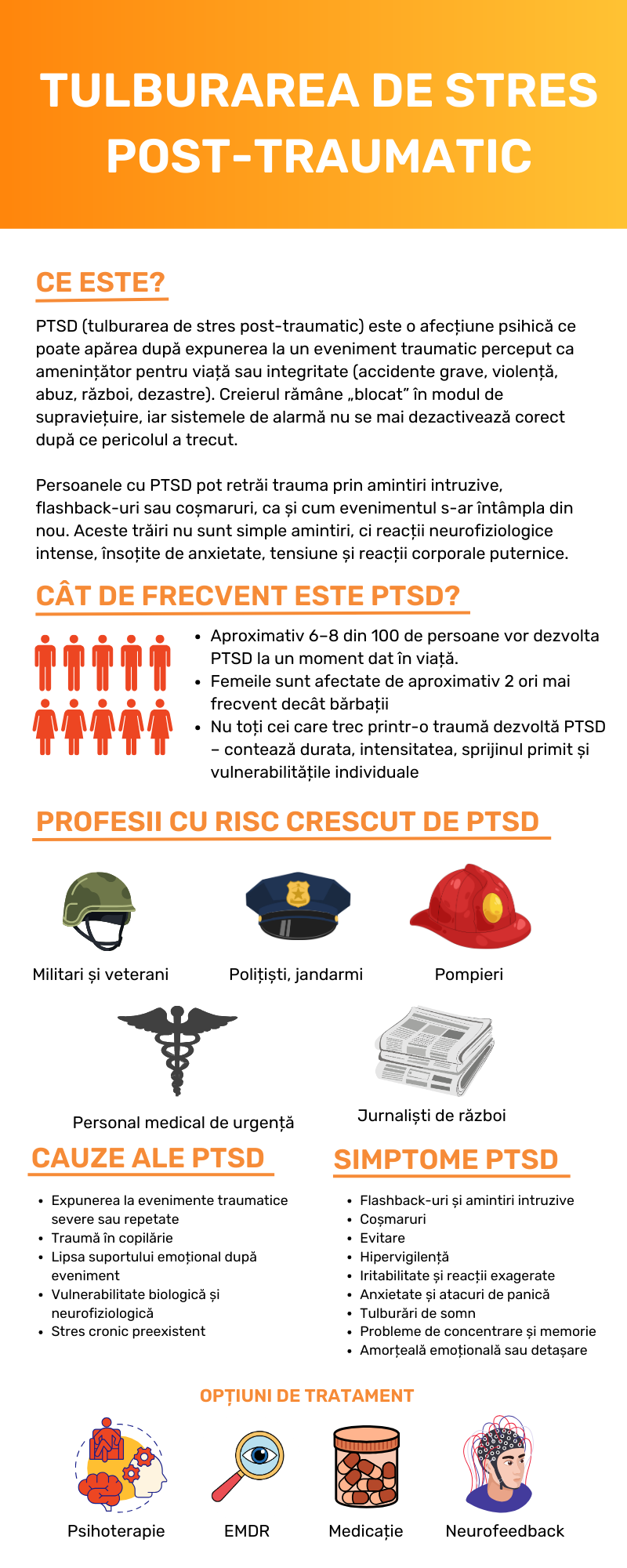
What is PTSD
PTSD (post-traumatic stress disorder) is a mental health disorder that develops following exposure to a traumatic event perceived as threatening to life, physical integrity or emotional safety. This event can be a single one (a serious accident, an attack, an assault) or repeated and prolonged (abuse, domestic violence, severe neglect, continuous exposure to danger). PTSD is the result of changes in the way the brain processes danger, memory and emotions, particularly at the level of the amygdala, the hippocampus and the prefrontal cortex.
In PTSD the brain remains stuck in a survival mode, as if the danger were still present, even when the threat has passed. The nervous system stays hyperactive, on alert, and the capacity for emotional regulation and for integrating the experience is impaired. The person does not manage to “settle” the trauma in the past, and body and mind react as if they had to defend themselves. This is why PTSD also affects sleep, attention, relationships, mood and everyday life.
The main symptoms of PTSD
Re-experiencing the trauma
A core symptom of PTSD is the involuntary re-experiencing of the traumatic event in the form of intrusive memories, flashbacks or nightmares. These experiences are extremely vivid and can be accompanied by intense physiological reactions such as palpitations, sweating, muscle tension or a sensation of suffocation. The brain does not clearly distinguish between past and present, so the person feels the trauma as if it were happening again, not as a simple memory.
Avoidance of stimuli associated with the trauma
People with PTSD actively avoid situations, places, people, conversations or emotions that may remind them of the traumatic experience. On the surface this avoidance may look like a protective strategy, but in the long run it narrows the person's life and maintains the disorder. Avoidance can become so extensive that it affects relationships, professional activity and the ability to have normal, pleasant or meaningful experiences.
Negative changes in thoughts and emotions
PTSD is associated with persistent changes in the way a person perceives themselves, other people and the world. Intense feelings of guilt, shame or helplessness may appear, along with beliefs such as “I am not safe anywhere” or “I cannot trust anyone”. Positive emotions are diminished, and the person may experience emotional numbing, detachment or difficulty in feeling joy, closeness or meaning.
Hyperarousal and hypervigilance
The nervous system remains in a constant state of alert, as if danger were imminent. This shows up as irritability, exaggerated startle reactions, difficulty concentrating, bodily tension and sleep problems. The person may feel they have to be permanently “on guard”, which leads to physical and mental exhaustion and to major difficulties in daily life.
Causes and risk factors for post-traumatic stress disorder
Exposure to a severe traumatic event
Traumas that involve a direct threat to life, physical or sexual violence, serious accidents, natural disasters or war experiences significantly increase the risk of PTSD, especially when the person feels deprived of control or of support.
Repeated or prolonged traumas
Chronic exposure to traumatic stress, such as childhood abuse, domestic violence or emotional neglect, increases the risk of developing more complex and persistent forms of PTSD, because the nervous system is affected repeatedly over the long term.
Lack of emotional support after the trauma
The absence of social support or the invalidation of the experience (“you are exaggerating”, “it should have passed by now”) makes processing the trauma harder and increases the likelihood that the symptoms will persist or worsen.
Individual biological and psychological factors
The sensitivity of the nervous system, a history of anxiety or depression, previous traumas and the capacity for emotional regulation influence the way the brain responds to trauma and the risk of developing PTSD.
How the brain of a person with PTSD works
The brain of a person with PTSD works differently not because it “cannot cope”, but because it has learned to survive in a context perceived as extremely dangerous. Trauma changes the way the brain processes information, danger, memory and emotions. At the centre of these changes are the brain's alarm systems, which stay switched on long after the real threat has disappeared. In practice, the brain remains stuck in a survival mode in which safety takes absolute priority over rest, connection and reflection.
An essential role is played by the amygdala, the brain structure responsible for detecting danger. In PTSD the amygdala becomes hyperreactive and “sees” threats even in neutral or ambiguous stimuli. Sounds, smells, facial expressions or apparently trivial situations can trigger intense reactions of fear or panic. This hyperactivation makes the body release stress hormones such as adrenaline and cortisol constantly, keeping it in a state of continuous tension, as if it had to run away or fight.
In parallel, the hippocampus, the region involved in memory and temporal orientation, partly loses its ability to organize experiences coherently. This is why traumatic memories are not stored as events “from the past”, but remain fragmented, sensory and intrusive. The brain does not manage to say clearly “this is over”, and the person relives the trauma through flashbacks, images or intense bodily sensations. This dysfunction explains why PTSD is not merely an emotional problem, but one deeply tied to memory and to the perception of time.
The prefrontal cortex, responsible for reasoning, emotional self-regulation and decision-making, is often underactive in PTSD. This area should “calm” the amygdala and assess situations realistically, but under traumatic stress it can no longer carry out its role effectively. As a result, the person may rationally know that they are safe, while body and emotions do not respond to this information. A deep gap appears between what the conscious mind “knows” and what the nervous system feels.
Overall, the brain of a person with PTSD works like a system permanently on alert, with high energy consumption and a reduced capacity for recovery. Sleep is disturbed, attention is fragmented and emotional regulation becomes difficult. These changes are not permanent, but they require interventions that directly target the regulation of the nervous system and the functional reorganization of the brain. Healing does not mean “forgetting” the trauma, but helping the brain learn once again that the present is safe and that survival is no longer the only priority.
The impact of PTSD on everyday life
PTSD has a profound impact on everyday life, affecting not only a person's emotional state but also the way they function day by day. Apparently simple activities such as going shopping, driving, taking part in social events or even leaving the house can become overwhelming. A brain in a state of hyperalertness constantly interprets the environment as potentially dangerous, which leads to avoiding situations, places or people associated, even vaguely, with the trauma. Although this avoidance offers a short-term sense of control, it gradually narrows the person's life and reduces their autonomy and quality of life.
At the relational level, PTSD can create emotional distance and major difficulties in connecting. The people affected may seem cold, withdrawn or irritable, not because they do not care about those around them, but because their nervous system is constantly overloaded. Hypersensitivity to stimuli, difficulty in regulating emotions and a tendency to misread other people's intentions can lead to frequent conflicts, misunderstandings and isolation. Often the person with PTSD feels misunderstood or guilty about their own reactions, which amplifies the sense of loneliness and shame.
Occupational functioning is also significantly affected. Concentration problems, fluctuating memory, chronic fatigue and difficulty in making decisions reduce performance at work. Exaggerated reactions to stress, noise or pressure can make it hard to keep a steady pace or to adapt to new demands. In some cases the person may change jobs frequently or avoid the professional environment altogether, not for lack of competence, but because of the neurobiological impact of the trauma on their capacity to function.
In the long term, PTSD deeply influences physical health and the overall balance of life. Chronic stress keeps the body in a state of continuous tension, increasing the risk of insomnia, chronic pain, digestive disorders, cardiovascular problems and exhaustion. Lack of sleep and the constant expenditure of energy needed to cope with the symptoms reduce the capacity for recovery and for joy. Without adequate support, PTSD can become an invisible burden that affects every aspect of daily life; with the right interventions, adapted to the nervous system, these effects can be significantly reduced and daily functioning can gradually be regained.
5 treatment methods for post-traumatic stress disorder
Treatment for PTSD is effective when it targets both the psychological experience of the trauma and the neurobiological changes it produces.
1. Trauma-focused psychotherapy (CBT, EMDR, cognitive processing therapy)
Psychotherapy is one of the first lines of intervention in PTSD, in particular trauma-focused therapies. Cognitive behavioural therapy (CBT) helps the person identify and restructure the dysfunctional thoughts linked to the trauma, such as excessive guilt, the feeling of constant danger or helplessness. EMDR (Eye Movement Desensitization and Reprocessing) makes it easier to process traumatic memories in a more adaptive way, reducing the emotional intensity attached to them. These therapies help the brain “place” the trauma back in the past, but their effectiveness depends on the nervous system's ability to tolerate emotional activation without going into overload.
2. Drug treatment
Psychiatric medication can be useful in reducing severe PTSD symptoms such as intense anxiety, insomnia, depression or irritability. Antidepressants (especially SSRIs) are the most frequently prescribed, with the role of modulating the neurotransmitters involved in emotional regulation. In certain cases mood stabilizers or sleep medication may be used. It is important to point out that medication does not heal the trauma; it reduces the intensity of the symptoms, sometimes creating a more stable context for other forms of therapy.
3. Techniques for regulating the nervous system (breathing, somatic work, mindfulness)
Interventions that directly target the regulation of the autonomic nervous system are extremely useful in PTSD. Controlled breathing exercises, somatic techniques, mindfulness and work with bodily sensations help reduce sympathetic hyperactivation and stimulate the safety response. These methods increase body awareness and the ability to stay present without being overwhelmed by automatic “fight or flight” reactions. Although they do not process the trauma directly, they are essential for stabilization and for regaining a sense of internal control.
4. Support interventions and lifestyle restructuring
Social support, routine, regular sleep, movement and nutrition play an important part in recovery after PTSD. Trauma deeply affects biological rhythms, and re-establishing a daily structure helps the brain regain predictability and safety. Support groups, psychological education and family involvement can reduce isolation and shame, two central elements in PTSD. These interventions are not sufficient on their own, but they sustain the effectiveness of the main treatments.
5. Neurofeedback: direct regulation of the traumatized brain
Neurofeedback is one of the most promising treatment methods for PTSD because it acts directly on the neurobiological cause of the symptoms: the dysregulation of brain activity. In PTSD, certain brain areas (such as the amygdala, the prefrontal cortex and the regulatory networks) work in a persistent imbalance that maintains the state of hyperalertness and reactivity. Neurofeedback gives the brain real-time feedback about its own electrical activity, allowing it to learn, step by step, to regulate itself. This process is non-invasive and does not involve reliving the trauma.
Unlike purely cognitive therapies, neurofeedback does not depend on the person's ability to verbalize, analyse or confront traumatic memories. This is essential, because in PTSD the emotional brain reacts faster than the rational one. Through repeated training, brain activity stabilizes, hyperactivity decreases and the networks of calm and integration become more efficient. The results translate into better sleep, reduced anxiety, greater capacity for concentration and better emotional regulation. For this reason neurofeedback is considered one of the most effective methods for PTSD, especially in chronic forms or in forms resistant to other interventions
FAQ - Frequently asked questions about PTSD
What is the difference between stress that is normal after a trauma and PTSD?
After a traumatic event it is normal for reactions such as anxiety, insomnia, sadness, irritability or intrusive thoughts to appear. These reactions are part of the brain's natural adaptation process and, in most cases, they gradually subside within a few weeks. PTSD appears when these symptoms persist for more than a month, intensify or begin to significantly affect daily life. The essential difference is that in PTSD the nervous system remains “stuck” in the state of danger, even though the threat is no longer present.
Can PTSD appear long after the traumatic event?
Yes. PTSD can have a delayed onset, sometimes months or even years after the traumatic event. This happens when the brain manages to “compensate” temporarily, but certain life events, cumulative stress or a lack of regulatory resources trigger the symptoms. Trauma does not disappear if it is not processed; it can stay latent and be reactivated later.
How do I know whether I have PTSD or am “just” very stressed?
Intense stress is usually linked to current situations and improves once the stressors are reduced. In PTSD the symptoms are frequently triggered by memories, sensations, smells or situations that recall the trauma, and they include re-experiencing, avoidance, hypervigilance and disproportionate emotional reactions. If you feel that your reactions are automatic, hard to control and out of proportion to any real present danger, a specialist assessment is recommended.
Why do some people develop PTSD and others do not, even though they have been through similar experiences?
The response to trauma is influenced by several factors: personal history, previous traumas, the level of social support, genetics, the way the nervous system works and the emotional regulation resources available before the event. PTSD is not a sign of weakness; it is the result of the way the brain had to adapt in order to survive.
Does PTSD heal completely or does it stay for life?
PTSD can be treated effectively, and many people reach a significant reduction or even the disappearance of the symptoms. The brain has the capacity for neuroplasticity, that is, to reorganize and regulate itself. Without treatment the symptoms can become chronic, but with appropriate interventions - psychotherapy, neurofeedback, regulation of the nervous system - recovery is possible. Trauma can become an integrated experience rather than one that controls the person's life.
Can children develop post-traumatic stress disorder (PTSD)?
Yes, children can develop PTSD, and the symptoms may look different from those of adults. Behavioural regressions, sleep problems, separation anxiety, irritability, difficulty concentrating or repetitive play linked to the trauma may appear. Early intervention is essential, because a child's brain is still developing and is highly responsive to treatment.
Do I have to remember or relive the trauma in order to heal?
Not always. Some modern intervention methods, such as neurofeedback or therapies focused on regulating the nervous system, do not require reliving the trauma in detail. The emphasis is on stabilizing and regulating the brain, so that traumatic memories lose their emotional charge.
Can PTSD affect the body, not just the mind?
Yes. PTSD is frequently associated with chronic pain, gastrointestinal disorders, cardiovascular problems, persistent fatigue and sleep disorders. Trauma is stored at the bodily level too, not only cognitively, which is why treatment must also address the neurophysiological component.
If you recognize yourself in these descriptions or have questions about your own experience, the first step is to talk to a specialist. An initial conversation can bring clarity and direction. Healing from trauma is possible, and the right support can make the difference.
🧠 How does your brain work?
Download the guide for FREE and find out what your brain map shows.
📖 Our books - Real case studies with brain maps
📖 Vindecarea Depresiei (Healing Depression, in Romanian) - 29.00 RON
📖 Vindecarea Anxietatii (Healing Anxiety, in Romanian) - 29.00 RON
📖 Eliminarea Atacurilor de Panica (Ending Panic Attacks, in Romanian) - 29.00 RON
Do you want to understand what is happening in your brain?
Book a call with the BrainMap Institute's specialists and find out how a BrainMap and brain training can help you.