
Mindfulness - what it is and 10 benefits of this practice
A simple guide to mindfulness: what happens in the brain when you practise it, 10 proven benefits and exercises you can do anywhere, in a few minutes.
In an increasingly hectic world, where stress, pressure and speed are becoming the norm, many people are looking for ways to regain their inner balance. The practice of mindfulness (or conscious attention) is one of the most effective and accessible ways of doing this. The roots of this practice lie in the Eastern meditative traditions, but over recent decades it has been validated and supported by numerous scientific studies. Mindfulness means being present in the current moment, with an open, calm and non-judgemental attitude, an ability that can be cultivated through practice and intention.
As more and more people discover the benefits of mindfulness, this practice is becoming an essential tool not only for mental well-being, but also for physical health. From reducing anxiety and depression, to improving focus and sleep, the positive effects are many and profound. In what follows, we will briefly explore what mindfulness means and detail 10 of the most important benefits this practice can bring to everyday life.
What is mindfulness
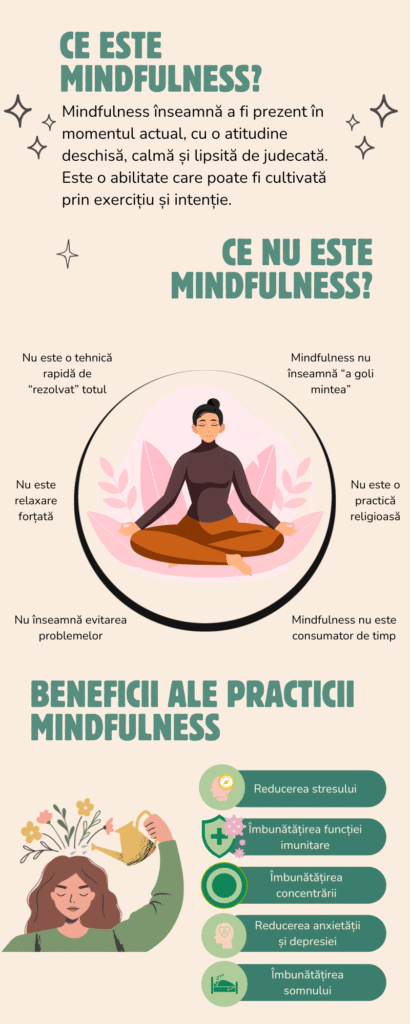
Mindfulness means being fully present in the current moment, aware of what we feel, think and do, without judging or reacting automatically. It is the ability to observe reality exactly as it is, with a calm, curious and open attitude. By practising mindfulness, we learn to step out of autopilot and to respond consciously to what we experience, instead of reacting impulsively or unconsciously.
Types of mindfulness
- Mindfulness through breathing
This form of mindfulness is based on observing the breath - the way air enters and leaves the body. The practitioner directs their attention to the sensations produced by breathing, without altering it. It is a simple but effective method of anchoring the mind in the present and reducing mental agitation. - Mindfulness in movement
This refers to bringing conscious attention into physical activities such as walking, yoga or even household chores. The idea is to pay attention to every movement, to the contact of the body with the ground, to the rhythm of the steps or to the way the muscles contract and relax. In this way, the body becomes a guide towards presence and mental balance. - Mindfulness of thoughts and emotions
This practice involves observing thoughts and emotions as they arise, without fighting or encouraging them. The aim is not to control them, but to become aware of how they appear, change and disappear. Through this detached observation, we learn to stop identifying completely with what we feel or think. - Mindfulness in relationships
This means presence and conscious attention during interactions with others. It involves active listening, conscious speech and openness towards one's own emotions and those of the other person. By cultivating this type of mindfulness, relationships become more authentic, more empathetic and more balanced. - Mindful eating
This is the practice of eating with full attention, noticing the tastes, textures and smells and the body's signals of hunger or fullness. Conscious eating helps not only towards better digestion, but also towards avoiding compulsive eating and developing a healthier relationship with food.
Mindfulness is not merely a relaxation practice, but a way of living more consciously and more present in every moment. As scientific research confirms more and more positive effects of conscious attention, people are starting to integrate it into their lives in order to improve their mental, emotional and physical health.
10 benefits of mindfulness
- Stress reduction
Mindfulness helps reduce stress by anchoring attention in the present, reducing mental rumination and worries about the past or the future. Practitioners learn to observe stressful thoughts without being overwhelmed by them, which leads to a calmer and more balanced mental state. - Improved focus
By training the mind to stay attentive to a single object (such as the breath), mindfulness develops the capacity for concentration. Over time, this exercise increases mental clarity and efficiency at work and reduces the distractions caused by multitasking or technology. - Greater emotional intelligence
Mindfulness teaches us to observe our emotions without repressing or amplifying them. In this way, we become more aware of our own reactions and better able to manage conflicts, to offer empathy and to respond consciously instead of reacting impulsively. - Reduced anxiety and depression
Regular mindfulness exercises help break the vicious circle of repetitive negative thoughts. Studies show that practising conscious attention can reduce anxiety symptoms and depression, offering a stable anchor in the present. - Better sleep
Mindfulness calms the agitated mind and reduces the insomnia caused by excessive thinking. Through relaxation and breathing exercises, the practitioner more easily enters a state of inner stillness that favours deep, restful sleep. - Support for physical health
The practice of mindfulness is associated with lower blood pressure, improved immune function and reduced inflammation. This has positive effects on the whole body, helping it respond better to physical and psychological stressors. - Greater patience and tolerance
Mindfulness cultivates an open, non-critical attitude towards life's experiences. Through practice, we become more patient with ourselves and with others, developing tolerance towards discomfort and difficulty. - Better relationships
When we are fully present in conversations, we listen more deeply and respond with more empathy. Mindfulness in relationships improves communication, reduces conflict and strengthens human connections. - Greater self-knowledge
By constantly observing our own thoughts and reactions, we develop a better understanding of ourselves. Mindfulness helps us become aware of our automatic patterns and make choices that are more authentic and aligned with our personal values. - Greater life satisfaction
Mindfulness increases the ability to savour simple moments, to feel grateful and to appreciate life as it is. This naturally leads to a deeper sense of well-being and a more meaningful life.
The practice of mindfulness does not have to be complicated or reserved only for moments of perfect quiet and order. On the contrary, it can easily be integrated into daily activities, from brushing your teeth to listening to a colleague. Below are 10 simple, effective tips for bringing more conscious attention into your daily routine, without changing your schedule.
10 tips for mindfulness in everyday life
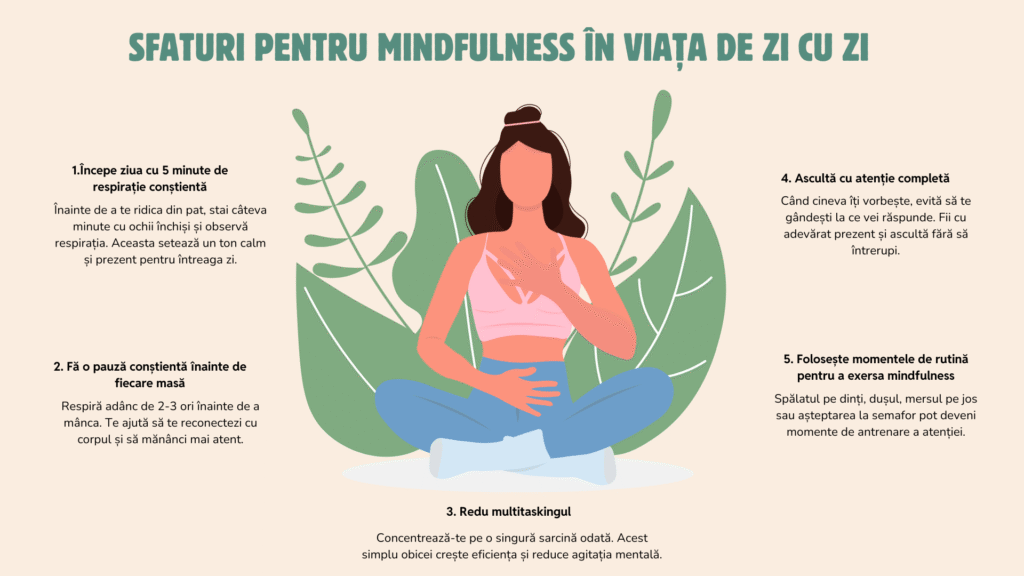
- Start the day with 5 minutes of conscious breathing
Before you get out of bed, sit for a few minutes with your eyes closed and observe your breathing. This sets a calm, present tone for the whole day.
- Take a conscious pause before every meal
Breathe deeply 2-3 times before eating. It helps you reconnect with your body and eat more attentively.
- Reduce multitasking
Focus on a single task at a time. This simple habit increases efficiency and reduces mental agitation.
- Listen attentively
When someone is talking to you, avoid thinking about what you will reply. Be truly present and listen without interrupting.
- Use routine moments to practise mindfulness
Brushing your teeth, showering, walking or waiting at a traffic light can all become moments for training attention.
- Turn off unnecessary notifications
Technology is a constant source of interruptions. Give yourself notification-free spaces in order to cultivate presence.
- Practise daily gratitude
At the end of the day, write down 3 things you are grateful for. This shifts your perspective and improves your well-being.
- Connect with nature
Spend time outdoors and notice the details around you - sounds, smells, colours. Nature is an ideal place to practise the state of presence.
- Breathe deeply in moments of tension
Whenever you feel overwhelmed, take 3 deep, conscious breaths. This can help you rebalance quickly.
- Be gentle with yourself
Mindfulness does not mean perfection. Accept with compassion the moments when your mind wanders and return gently to the present.
- Conscious breathing
Sit in a quiet place and close your eyes. Focus only on your breathing: feel the air entering through your nostrils, descending into your lungs, then leaving. When your mind wanders, gently bring your attention back to the breath. Practise 5-10 minutes daily. - Mindful walking
Take a slow walk, without a phone or music. Notice how the ground feels under your soles, the rhythm of your steps, the movement of your legs. If thoughts arise, look at them like clouds and return to the movements of your body. - Body scan
Lie on your back and bring your attention to each part of the body - starting with your toes and gradually moving up to your head. Notice the sensations, the tension or the relaxation, without judging. This exercise promotes deep relaxation. - Mindful eating
Take a small piece of food and study it attentively: the texture, the colour, the smell. Put it in your mouth and chew slowly, noticing every change in taste. In this way you become more aware of your relationship with food. - The mindful journal
Write down your thoughts and emotions without correcting or judging them. Let them flow freely, as a form of release and mental clarification. This helps with self-observation and emotional processing. - Sound meditation
Sit in silence and focus on all the sounds around you, whether near or far. Do not label them, simply observe them. This exercise trains your attention and your acceptance.
The practice of mindfulness with the help of neurofeedback
Mindfulness through Brain training is a modern combination of the traditional practice of conscious attention and advanced technology for monitoring brain activity. This method offers an effective and precise way of training the mind, through which the user learns to recognise and regulate their own mental patterns in real time. Neurofeedback uses sensors that measure brainwaves, providing instant feedback through sounds, images or graphics, in order to support the self-regulation of neuronal activity.
In the context of mindfulness, this technology works like a mirror of the mental state: when the mind drifts away from the present moment or enters states of agitation, the system provides a subtle signal that guides the user back to a state of calm and attention. In this way, brain training does not only encourage presence, it also helps the brain learn through repetition how to access states of stillness, focus and balance more easily.
Unlike classic mindfulness practice, which requires time and perseverance before significant results become visible, mindfulness through brain training accelerates the learning process. Many users report improvements in their emotional state, their sleep and their mental clarity after only a few sessions. The technology adds objectivity to the process, providing clear data about the progress made, which increases motivation and confidence in the effectiveness of the practice.
This approach is ideal for people who struggle to maintain attention, such as those suffering from anxiety, ADHD or chronic stress. It is also suitable for beginners who find it hard to tell whether they are “meditating correctly”, because the feedback offers a concrete, personalised form of guidance.
Mindfulness through brain training is increasingly used in psychology clinics, corporate wellness programmes and personal development centres. The combination of neuroscience and awareness offers a bridge between modern and contemplative approaches, adapting mindfulness practice to the demands and pace of contemporary life.
This innovative method offers an accessible and effective alternative for those who want to cultivate presence and inner balance with the help of technology. It is a clear example of how tradition and science can work together to support the mental and emotional health of modern people.
If you want to experience the benefits of mindfulness in a deep way, supported by cutting-edge technology, try a brain training session. It is a unique opportunity to train your mind to be calmer, clearer and more present, with the help of precise, personalised feedback. Book a call with a specialist and discover how science can help you reach an authentic state of inner balance.
🧠 How does your brain work?
Download the guide for FREE and find out what your brain map shows.
📖 Our books - Real case studies with brain maps
📖 Vindecarea Depresiei (Healing Depression, in Romanian) - 29.00 RON
📖 Vindecarea Anxietatii (Healing Anxiety, in Romanian) - 29.00 RON
📖 Eliminarea Atacurilor de Panica (Ending Panic Attacks, in Romanian) - 29.00 RON
Do you want to understand what is happening in your brain?
Book a call with the BrainMap Institute's specialists and find out how a BrainMap and brain training can help you.