
Abandonment trauma: how the fear of rejection controls your life without you knowing
Abandonment trauma: how the fear of rejection affects your relationships. Understand the emotional wound left by experiences of loss and what helps you manage it.

What abandonment trauma is
Abandonment trauma is a deep emotional wound that appears when a person has lived through, in reality or in their perception, experiences of rejection, loss or a lack of safety in close relationships. It is not only about physical abandonment, but also about subtle forms such as emotional neglect, the emotional unavailability of parents or the lack of validation. In time, these experiences shape the way a person perceives relationships, developing a constant fear of being left or rejected.
This fear does not stay at a conscious level, but becomes an internal pattern that influences behaviours, emotional reactions and relationship choices. People with abandonment trauma can swing between an intense need for closeness and the fear of being hurt, which leads to unstable relationships, anxiety and difficulty maintaining emotional balance. The reactions are often out of proportion with the present situation, being triggered instead by emotional memories from the past.
How abandonment trauma forms
Abandonment trauma forms, most of the time, in childhood, in the relationship with the attachment figures. When the child does not receive constant emotional safety, they learn that relationships are unpredictable. For example, a parent who is sometimes affectionate and sometimes distant can create confusion and insecurity, leading the child to develop emotional hypervigilance.
Another important factor is emotional neglect. Even if physical needs are met, the lack of emotional validation (“do not cry”, “it is not a big deal”) can send the message that emotions are not important or that the person does not deserve attention. This leads to internalising the idea of “I am not enough” or “I will be rejected if I show myself as I am”.
Experiences of loss, such as the parents’ divorce, a separation or the death of a close person, can also contribute to the development of this trauma. For a child, such events can be interpreted as a personal abandonment, even if that was not the real intention.
In some cases, abandonment trauma is also reinforced in later relationships, especially if the person ends up in contexts where the pattern repeats itself: unstable relationships, emotionally unavailable partners or repeated rejections. In this way, the brain strengthens the idea that abandonment is inevitable.
What happens in the brain in abandonment trauma
At the level of the brain, abandonment trauma is associated with an increased sensitivity of the danger detection system. Structures such as the amygdala become more reactive to signals of rejection or distancing, even when these are minimal or ambiguous. In practice, the brain starts to interpret any change in the other person’s behaviour as a possible threat.
At the same time, the prefrontal cortex, responsible for emotional regulation and for the rational interpretation of situations, can have difficulty “calming” these reactions. A discrepancy therefore appears between what the person feels and what is actually real in the present. Emotions become intense and hard to control.
Another important aspect is the involvement of the hippocampus, which stores emotional memories. Past experiences of abandonment are “reactivated” in similar situations, even if the current context is different. This is why reactions can seem exaggerated: they are not only about the present, but about the person’s whole emotional history.
The neural networks involved in attachment and reward can also become unbalanced. The person can associate closeness with safety, but also with the risk of loss, which leads to ambivalence: the wish for connection, but also the tendency to withdraw or to self-sabotage.
In time, these patterns become automatic. The brain “learns” that abandonment is likely and starts to react pre-emptively, either through hyper-attachment or through avoidance. This mechanism is not conscious, but represents an adaptation to previous experiences.
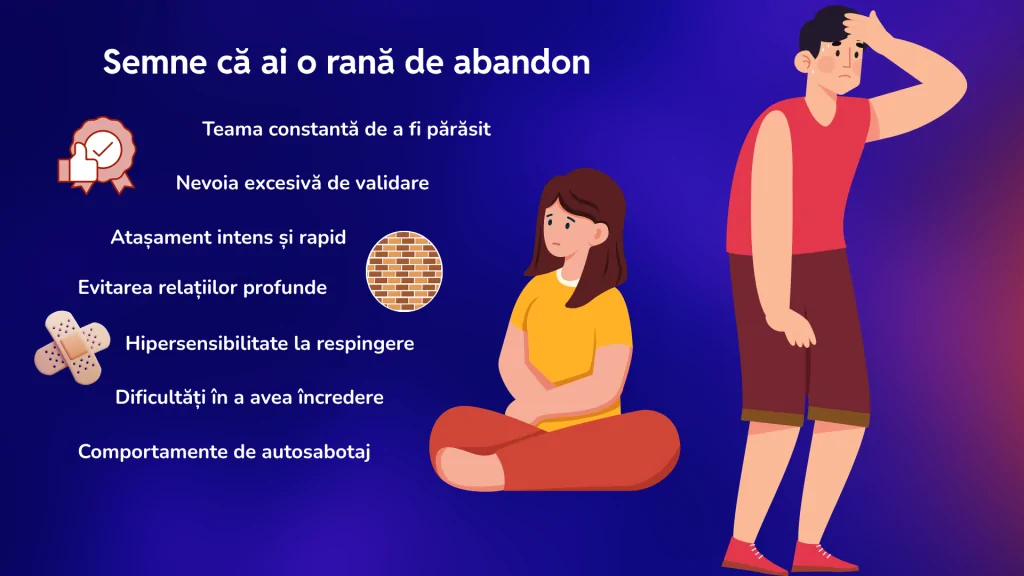
7 signs that you have an abandonment wound
1. The constant fear of being left
Even in stable relationships, there can be a persistent fear that the other person will leave or give up.
2. An excessive need for validation
You frequently feel the need for confirmation that you are loved, accepted or appreciated.
3. Hypersensitivity to rejection
Small or ambiguous gestures can be interpreted as clear signs of rejection.
4. Difficulty trusting
It is hard for you to believe that someone will stay or that the other person’s intentions are stable.
5. Behaviours of self-sabotage
You can create conflicts or withdraw before the other person does.
6. Intense and rapid attachment
You get emotionally involved very quickly and become dependent on the relationship.
7. Avoiding deep relationships
In some cases, you choose not to get close to people in order to avoid suffering.
Abandonment trauma vs. general anxiety
Although they can seem similar, abandonment trauma and general anxiety have different mechanisms. Generalised anxiety involves a diffuse worry, related to several aspects of life, without an exclusive focus on relationships. Abandonment trauma, on the other hand, is centred specifically on interpersonal relationships and on the fear of rejection or loss.
The major difference lies in the triggers and in the intensity. In abandonment trauma, emotional reactions are often activated by relational situations and are disproportionate to the current context, because they are influenced by past experiences. In general anxiety, the worry is more constant and less linked to a specific relational pattern. Understanding this difference is essential for choosing a suitable approach to management and intervention.
What abandonment trauma looks like in everyday behaviour
Abandonment trauma is often reflected in seemingly “normal” behaviours, which are nevertheless based on a deep fear of rejection. For example, a person can constantly seek reassurance in relationships, frequently asking whether they are loved or appreciated. This behaviour does not come from a lack of trust in the other person, but from an internal need for safety that was never stabilised in the past.
In other situations, a tendency to over-analyse interactions appears. A delayed message, a different tone or a minor change in the other person’s behaviour can trigger negative scenarios. The mind starts to look for explanations, most often oriented towards the idea of rejection or abandonment.
Some people develop avoidance behaviours. Even if they want connection, they choose not to get deeply involved or to keep an emotional distance, in order to avoid suffering. This strategy offers temporary protection, but it maintains the pattern in the long term.
A tendency to “please everyone” can also appear. The person neglects their own needs in order not to bother anyone, not to lose the relationship or not to be rejected. In time, this leads to emotional exhaustion and resentment.
Another frequent behaviour is the swing between intense closeness and withdrawal. The person can become very involved emotionally and then, when the fear of loss appears, withdraw suddenly. This pattern creates confusion both for themselves and for others.
The link with self-sabotage and perfectionism
Abandonment trauma is closely linked to self-sabotage, because the brain tries to prevent the suffering it anticipates. If a person believes, at a deep level, that they will be left, they can end up creating situations that confirm this belief. For example, they can provoke conflicts or withdraw before the relationship becomes too important.
Perfectionism often appears as a compensating strategy. The person tries to be “good enough” in order not to be rejected. They set themselves very high standards and criticise themselves harshly when they feel they are not meeting them, believing that this is the only way to keep their relationships.
These two mechanisms work together: perfectionism tries to prevent abandonment, and self-sabotage confirms it when the fear becomes too intense. Without awareness, this cycle can become repetitive and difficult to break.
The impact of abandonment trauma on the body
Chronic stress and the activation of the nervous system
Abandonment trauma keeps the body in a state of alert. The nervous system is frequently activated, which leads to the constant release of stress hormones. In time, this state can lead to tiredness, irritability and difficulty relaxing.
Digestive problems
The relationship between the brain and the gut is very close. Emotional stress can affect digestion, leading to symptoms such as bloating, abdominal discomfort or irritable bowel syndrome.
Sleep disturbances
People with abandonment trauma can have difficulty falling asleep or maintaining restful sleep. The mind stays active, analysing and anticipating possible negative situations.
Muscle tension and body pain
Emotional stress is also reflected at a physical level, through muscle tension, headaches or generalised discomfort in the body.
The impact on the cardiovascular system
The frequent activation of the stress response can influence blood pressure and heart rate, increasing the risk of cardiovascular problems in the long term.
Lowered immunity
A body that is constantly under stress has fewer resources for supporting the immune system, which can lead to an increased susceptibility to illness.
Abandonment trauma and neurofeedback
Neurofeedback is a modern, non-invasive method of brain training that helps the brain regulate its activity. In the case of abandonment trauma, we are often talking about a brain in a state of imbalance, with overactivated areas involved in fear, excessive analysis and intense emotional reactions. Neurofeedback offers the brain feedback in real time, helping it learn to work in a more balanced way.
Through this type of therapy, the automatic “fight or flight” reactions associated with the fear of rejection can be reduced. The brain starts to process relational stimuli differently, and the person no longer reacts with the same emotional intensity to situations that previously triggered anxiety or insecurity.
An important advantage is the fact that this process does not involve reliving the traumatic experiences in detail. Instead of focusing on the story, neurofeedback works directly with brain activity, facilitating the formation of healthier neural connections. In time, this can lead to better emotional regulation, greater inner safety and more balanced relationships.
Why it is hard to get out of abandonment trauma on your own
Abandonment trauma is not just a conscious belief, but a pattern deeply rooted at an emotional and neurological level. The person often understands rationally that they are not in danger, but the body and the emotional reactions say otherwise. This discrepancy makes change difficult through willpower or logic alone.
In addition, abandonment patterns tend to be reactivated precisely in important relationships, where the emotional stakes are highest. Without guidance, the person can repeat the same behaviours, even if they want change. This is why specialised support can make the difference, offering both understanding and concrete tools for regulation and transformation.
If you recognise yourself in these descriptions, it is important to know that there are solutions and that change is possible.
Fill in the contact form and a specialist will guide you in choosing the most suitable approach for you.
👉 Book an appointment and start the process of emotional balancing
We are here to support you.
🧠 How does your brain work?
Download the guide for FREE and find out what your brain map shows.
📖 Our books - Real case studies with brain maps
📖 Vindecarea Depresiei (Healing Depression, in Romanian) - 29.00 RON
📖 Vindecarea Anxietatii (Healing Anxiety, in Romanian) - 29.00 RON
📖 Eliminarea Atacurilor de Panica (Ending Panic Attacks, in Romanian) - 29.00 RON
Do you want to understand what is happening in your brain?
Book a conversation with the specialists of the BrainMap Institute and find out how a BrainMap and brain training can help you.