
Amygdala: the role of the brain's „alarm centre” and its link with anxiety and trauma
The amygdala is a small, almond-shaped structure deep in the temporal lobes of the brain, an essential part of the limbic system.

What is the amygdala and what is its role?
The amygdala is a small, almond-shaped structure located deep inside the temporal lobes of the brain, an essential part of the limbic system. Although it is small in size, its role is major: the amygdala is involved in processing emotions, especially fear, anxiety and defensive reactions. It acts as an “emotional filter” through which sensory information passes before it reaches the higher cortical areas. In practice, the amygdala rapidly decides whether a stimulus is safe, neutral or potentially dangerous, even before we become aware of it.
The importance of the amygdala lies in the fact that it is responsible for survival. In situations of real danger, the amygdala triggers automatic reactions that can save our lives: it raises the heart rate, activates the muscles, directs attention and prepares the body for the “fight, flight or freeze” response. These reactions are extremely fast and require no rational analysis, which makes them effective in emergencies. Without a functioning amygdala, the ability to recognize danger and to react appropriately would be severely impaired.
At the same time, the amygdala plays a part in forming emotional memory. Events associated with intense emotions - fear, shame, anger, but also joy - are stored more deeply and more durably precisely because the amygdala is activated. This mechanism helps us learn from experience and avoid dangerous situations in the future. However, when the amygdala becomes hyperactive, it can start to label as “threatening” situations that are not truly dangerous, contributing to anxiety, panic attacks, PTSD or chronic hypervigilance.
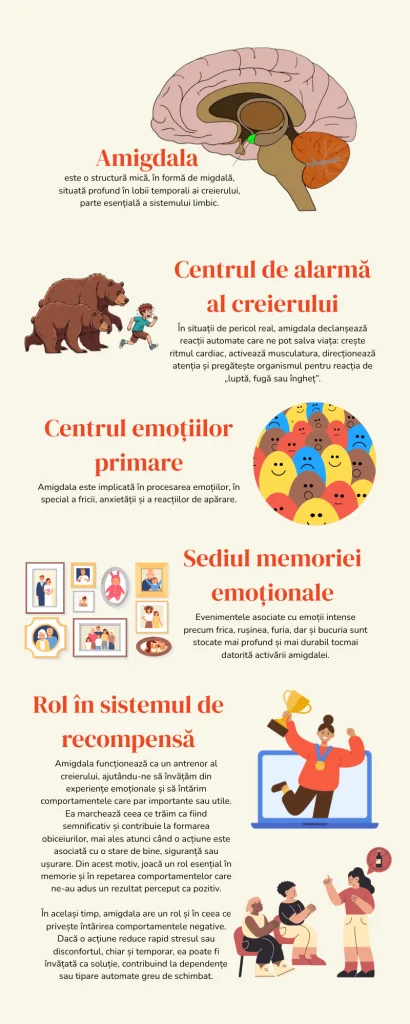
How the brain's “alarm centre” works
The amygdala works as an extremely sensitive alarm centre that is always on, scanning the internal and external environment for signs of danger. Sensory information (sounds, images, bodily sensations) reaches the amygdala along two pathways: a fast, direct one and a slower, cortical one. The fast pathway allows immediate reactions, before the stimulus is consciously analysed (“there was a noise - react now”), while the slow pathway involves the prefrontal cortex, which rationally assesses the situation (“it was only a door slamming”). This dual pathway explains why we sometimes react emotionally before we get the chance to think.
Once activated, the amygdala sends signals to the hypothalamus and the brainstem, triggering the physiological stress response. Hormones such as adrenaline and cortisolare released, blood pressure rises, breathing becomes faster, while digestion and the body's repair processes are temporarily inhibited. The body enters a state of maximum alert, optimized for short-term survival. This mechanism is adaptive in the face of real danger, but it becomes problematic when it is activated frequently or constantly.
Under chronic stress or trauma, the brain's “alarm centre” can remain stuck in the “on” position. The amygdala starts to overreact to neutral stimuli - someone's tone of voice, a facial expression, a thought or a memory - as if they were real threats. At the same time, the communication between the amygdala and the prefrontal cortex (the area responsible for reasoning, self-control and emotional regulation) weakens, which makes it harder to calm emotional reactions voluntarily.
In the long run, this over-activation of the alarm centre affects the person's entire functioning: persistent anxiety, irritability, sleep disturbances, difficulty concentrating and emotional exhaustion all set in. The brain stays in a state of “imminent danger”, even when there is no real risk. This is why many modern therapeutic interventions - including neurofeedback, regulation-focused psychotherapy and somatic techniques - have as their main goal the recalibration of the amygdala, so that the alarm system becomes proportionate, flexible and adapted to reality once again.
The amygdala, chronic stress and anxiety
The amygdala plays a central role in the way the brain responds to stress, and in the context of chronic stress this structure often becomes hyperactive. When a person is constantly exposed to pressure, conflict, uncertainty or emotional overload, the amygdala repeatedly receives signals that the environment is “unsafe”. As a result, it keeps the brain's alarm system switched on, even when there is no immediate danger. This prolonged activation leads to a constant release of cortisol and adrenaline, which keeps the body in a state of continuous tension, with a direct impact on sleep, digestion, immunity and emotional regulation.
In anxiety, the amygdala ends up overestimating threats and underestimating the person's ability to cope with situations. Neutral or ambiguous stimuli - an e-mail, a conversation, a minor bodily sensation - are interpreted as potentially dangerous. This faulty assessment happens quickly and automatically, before the rational areas of the brain can step in. Over time, the prefrontal cortex, which should calm the amygdala and offer a logical interpretation of situations, loses efficiency because it is overloaded. The result is a state of hypervigilance in which the mind is always “on guard” and the body lives as if danger were imminent.
In the long run, chronic stress genuinely changes the way the neural circuits involved in anxiety work and are structured. The amygdala becomes more reactive, more sensitive and easier to trigger, while its connections with the areas of emotional regulation weaken. This is why anxiety is not just “a state of mind”, but a real neurobiological condition. Through repetition, the brain learns that the world is dangerous, and this learning persists even when the external context changes. Effective interventions target precisely this over-activation of the amygdala and the restoration of the balance between emotional reaction and cognitive control.
The amygdala, trauma and PTSD
In trauma and PTSD, the role of the amygdala becomes even more pronounced, because it is deeply involved in encoding experiences of extreme danger. During a traumatic event, the amygdala is massively activated, marking the experience as one of survival. This intense activation means that the memory of the trauma is stored in a fragmented way, mainly emotional and sensory rather than narrative and logical. This is why people with PTSD can relive the trauma through flashbacks, images, sounds or bodily sensations, without having conscious control over these reactions.
After the trauma, the amygdala remains “stuck” in a defensive mode of functioning. It keeps scanning the environment for threats and overreacts to stimuli that are even vaguely reminiscent of the traumatic event. A smell, a facial expression, a noise or an apparently trivial situation can trigger an intense fear response, as if the trauma were happening again in the present. At the same time, the hippocampus - the structure responsible for placing memories in time and space - functions poorly, which makes it difficult to tell “then” from “now”.
In PTSD, the connection between the amygdala and the prefrontal cortex is deeply affected. The prefrontal cortex, which should inhibit excessive emotional reactions and reassure the body that the danger has passed, is no longer able to fulfil its role effectively. As a result, the person lives in a state of permanent alert, with intense emotional reactions, avoidance of situations perceived as dangerous and major difficulties in regulating emotions. From a neuroscientific point of view, PTSD is not a weakness or a lack of willpower, but the result of a dysregulated alarm system in the brain that keeps working as if the threat were still present.
The amygdala versus the prefrontal cortex
The prefrontal cortex is the most evolved part of the human brain, located at the front of the frontal lobe. It is responsible for the executive functions: reasoning, planning, self-control, decision-making, emotional regulation and the assessment of consequences. Unlike the amygdala, the prefrontal cortex works more slowly, deliberately and consciously. Its role is to analyse the context, to distinguish between real and perceived danger and to calm excessive emotional reactions when they are not justified.
Main differences between the amygdala and the prefrontal cortex
| Amygdala | Prefrontal cortex |
|---|---|
| Reacts quickly | Processes slowly and rationally |
| Works automatically | Works consciously |
| Detects danger | Assesses whether the danger is real |
| Activates the stress response | Inhibits and regulates the stress response |
| Prioritizes survival | Prioritizes long-term adaptation |
| Emotional | Cognitive |
In a balanced brain, the amygdala and the prefrontal cortex work together. The amygdala rapidly signals a possible danger, and the prefrontal cortex analyses the situation and decides whether a reaction is needed. If the threat is real, the stress response is maintained; if not, the prefrontal cortex “switches off the alarm”. This constant dialogue allows efficient adaptation to the environment and healthy emotional regulation.
In chronic stress, anxiety or PTSD, the balance tips in favour of the amygdala. It becomes hyperreactive and sends danger signals even in neutral situations. At the same time, the prefrontal cortex becomes less efficient, affected by the high levels of cortisol. The result is a “takeover” of control by the amygdala: impulsive reactions, persistent fear, catastrophic thoughts and difficulty concentrating or making decisions.
When the amygdala dominates, the person reacts more than they respond. Emotions become intense and hard to manage, and behaviour can be impulsive, avoidant or defensive. When the prefrontal cortex is active and functional, the person can observe their emotions without being overwhelmed by them, can make adaptive decisions and can regulate their emotional responses. The difference between the two states is often experienced as “I react automatically” versus “I can choose how I respond”.
The balance between the amygdala and the prefrontal cortex is essential for mental health, performance and relationships. An alarm system that is too sensitive leads to anxiety, irritability and exhaustion, while weakened cognitive control reduces the ability to adapt. Effective therapeutic interventions aim precisely at restoring this balance: calming the over-activity of the amygdala and strengthening the regulatory functions of the prefrontal cortex, so that the brain can assess reality correctly and respond appropriately.
How the activity of the amygdala can be regulated
1. Conscious, controlled breathing
Slow, deep, rhythmic breathing (especially a prolonged exhalation) activates the vagus nerve and the parasympathetic nervous system, signalling to the brain that the danger has passed. This reduces the activity of the amygdala and lowers cortisol and adrenaline levels. From a neurobiological point of view, conscious breathing creates a feedback loop between the brainstem, the heart and the prefrontal cortex, which “informs” the amygdala that the state of alarm no longer needs to be maintained. Practised consistently, breathing becomes a bottom-up regulation tool that is extremely effective in anxiety and chronic stress.
2. Mindfulness and meditation
Mindfulness practices train the ability to observe thoughts and emotions without reacting to them automatically. Neuroimaging studies show that mindfulness reduces the over-activity of the amygdala and increases the functional connectivity between the amygdala and the prefrontal cortex. In other words, the prefrontal cortex learns to “take over” more quickly when an intense emotional reaction appears. In the long run, this training changes brain plasticity, leading to lower emotional reactivity and a better capacity for self-regulation.
3. Quality sleep
Sleep is one of the most important factors in regulating the amygdala. Lack of sleep leads to a marked hyperreactivity of the amygdala and to a significant drop in prefrontal control. During deep sleep and REM sleep, the brain processes emotions and “resets” the alarm systems. Adequate sleep helps recalibrate the stress response, reducing the intensity of emotional reactions and improving tolerance to stressful stimuli.
4. Regular physical activity (without overdoing it)
Moderate, regular movement reduces the activity of the amygdala by lowering the level of stress hormones and increasing the secretion of endorphins, serotonin and BDNF (brain-derived neurotrophic factor). Physical exercise improves the communication between the amygdala and the prefrontal cortex, contributing to better emotional regulation. It is important to mention that excessive effort or compulsive exercise can have the opposite effect, keeping the stress system switched on.
5. Psychotherapy (especially trauma-focused therapies)
Psychotherapy, in particular cognitive behavioural therapy, EMDR or somatic therapies, helps reinterpret threatening experiences and reduce the conditioned fear response. Through the conscious processing of trauma and through cognitive restructuring, the prefrontal cortex becomes more effective at inhibiting the amygdala. In practice, the brain learns that certain stimuli no longer represent a real danger, which reduces the automatic activation of the “alarm centre”.
6. Safe relationships and attachment
Safe human connections have a direct effect on the regulation of the amygdala. Interactions based on safety, empathy and predictability reduce the activity of the amygdala and increase the secretion of oxytocin, a hormone involved in calm and attachment. From a neurobiological point of view, the human brain is built to regulate itself in relation to other people (co-regulation). A lack of safe relationships, or constant exposure to conflictual ones, keeps the amygdala in a state of chronic alert.
7. Neurofeedback
Neurofeedback is one of the most direct methods of regulating the activity of the amygdala, even though the amygdala is a deep structure. By training the brainwaves and the associated functional networks (especially the prefrontal and limbic ones), the brain learns to reduce its emotional hyperreactivity. Real-time feedback allows the brain to observe which patterns of activity are more efficient and to consolidate them through neuroplasticity. Neurofeedback is particularly useful in anxiety, PTSD, panic attacks and chronic stress, where the amygdala is excessively active and hard to control voluntarily.
8. Nutrition and metabolic regulation
Blood sugar imbalances, chronic inflammation and nutritional deficiencies can increase the excitability of the amygdala. A balanced diet, rich in omega-3 fatty acids, magnesium, B-complex vitamins and quality protein, supports the optimal functioning of the nervous system. Metabolic stability reduces internal “danger” signals, allowing the amygdala to stay calmer and more selective in triggering the stress response.
9. Cutting down on “alert” stimuli
Constant exposure to negative news, notifications, noise, excessive artificial light or cognitive overload keeps the amygdala activated. Limiting these stimuli allows the nervous system to come out of survival mode. From a neuroscientific point of view, the amygdala does not tell the difference between real threats and symbolic or informational ones - reducing the external “noise” is essential for internal regulation.
The amygdala and neurofeedback in a specialist clinic
The amygdala is one of the main structures involved in the response to stress, fear and threat, and when it is hyperactive the brain stays stuck in a “survival” mode. In a specialist clinic, neurofeedback is used precisely in order to regulate these maladaptive patterns of brain activity. Although the amygdala is a deep structure, it works as part of a network with other cortical areas - especially the prefrontal cortex and the cingulate - that can be trained directly through neurofeedback. Through real-time feedback, the brain learns to reduce excessive alarm signals and to restore a balance between emotional reaction and cognitive control.
In a clinical setting, neurofeedback is not applied generically, but on the basis of a neurofunctional assessment (such as Brain Mapping / qEEG), which identifies the specific patterns of over-activation or inhibition. In this way, the training is personalized according to the unique way in which each person's brain works. As the sessions progress, one often sees a decrease in emotional reactivity, better tolerance to stress, improved sleep and a greater capacity for self-regulation. Neurofeedback works through neuroplasticity, helping the brain “relearn” a safer and more efficient way of functioning.
When it is important to seek help
It is important to seek help when states of anxiety, fear, irritability or inner tension become persistent and affect your sleep, your relationships, your ability to concentrate or your daily functioning. If you feel that you react disproportionately to apparently minor stimuli, that you are always “on alert”, that you cannot relax or that you have panic episodes, these can be signs of a hyperreactive amygdala. Traumatic experiences, chronic stress or burnout are also frequent contexts in which regulating the amygdala becomes essential for recovery and emotional balance. If you want to understand what is happening in your brain and to work on regulating your stress response in a personalized, non-invasive way, neurofeedback can be a valuable first step. Fill in our form and book a free conversation with a specialist to find out whether this method is right for you.
🧠 How does your brain work?
Download the guide for FREE and find out what your brain map shows.
📖 Our books - Real case studies with brain maps
📖 Vindecarea Depresiei (Healing Depression, in Romanian) - 29.00 RON
📖 Vindecarea Anxietatii (Healing Anxiety, in Romanian) - 29.00 RON
📖 Eliminarea Atacurilor de Panica (Ending Panic Attacks, in Romanian) - 29.00 RON
Do you want to understand what is happening in your brain?
Book a call with the BrainMap Institute's specialists and find out how a BrainMap and brain training can help you.