
Addictions: how they develop and how neurofeedback can help
Addictions: how these disorders that affect brain function and self-control take hold, and how neurofeedback helps in the recovery process.

What addiction means and how it manifests itself
Addiction is a complex disorder that affects the way the brain works, behaviour and a person's ability to control certain actions or the use of certain substances. Although many people associate addiction exclusively with alcohol or drugs, it can also appear in the case of seemingly ordinary behaviours, such as gambling, excessive internet use, compulsive shopping, pornography, overworking or even certain interpersonal relationships. The central element of addiction is not necessarily the object of the addiction, but the loss of control over the behaviour and its continuation despite obvious negative consequences. The person ends up investing more and more time, energy and resources in that behaviour or substance, while other important aspects of life begin to be neglected.
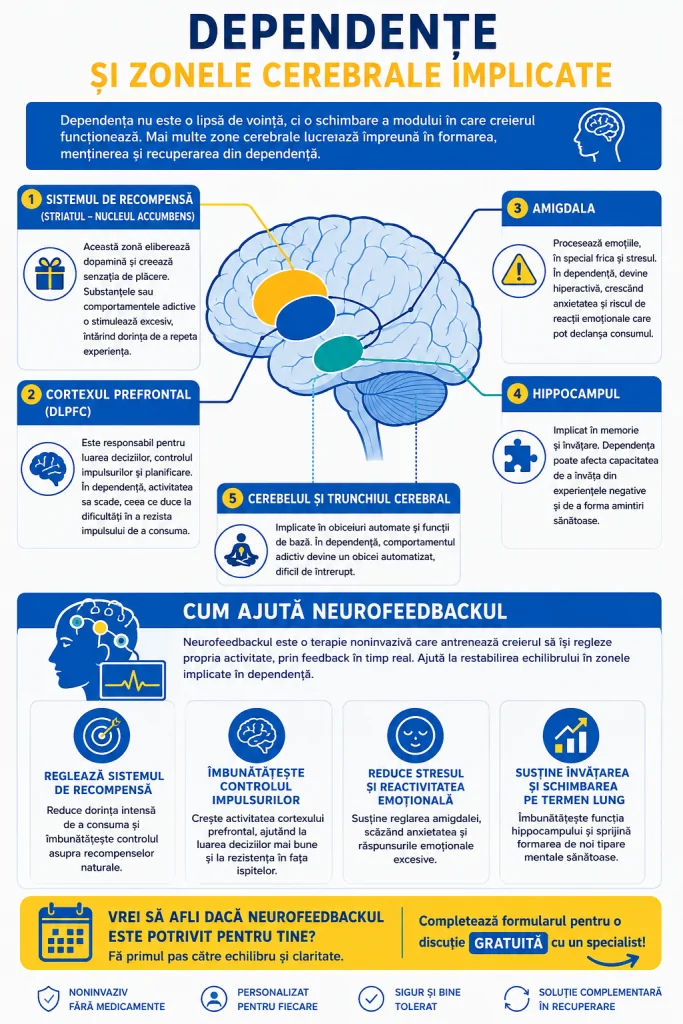
From a neuroscientific perspective, addiction is considered a disorder of the brain circuits involved in reward, motivation, learning, self-control and emotional regulation. When a person uses a substance or engages in a behaviour that produces pleasure, the brain releases neurotransmitters such as dopamine, involved in the sensation of reward and satisfaction. Over time, repeated exposure leads the brain to associate that experience with survival and well-being, even though in reality it can become harmful. Thus, the brain systems begin to prioritise the addictive behaviour, and the desire to repeat it becomes stronger and stronger. This is why addiction cannot be explained simply as a lack of willpower or a lack of character, but involves real changes in the way the brain functions.
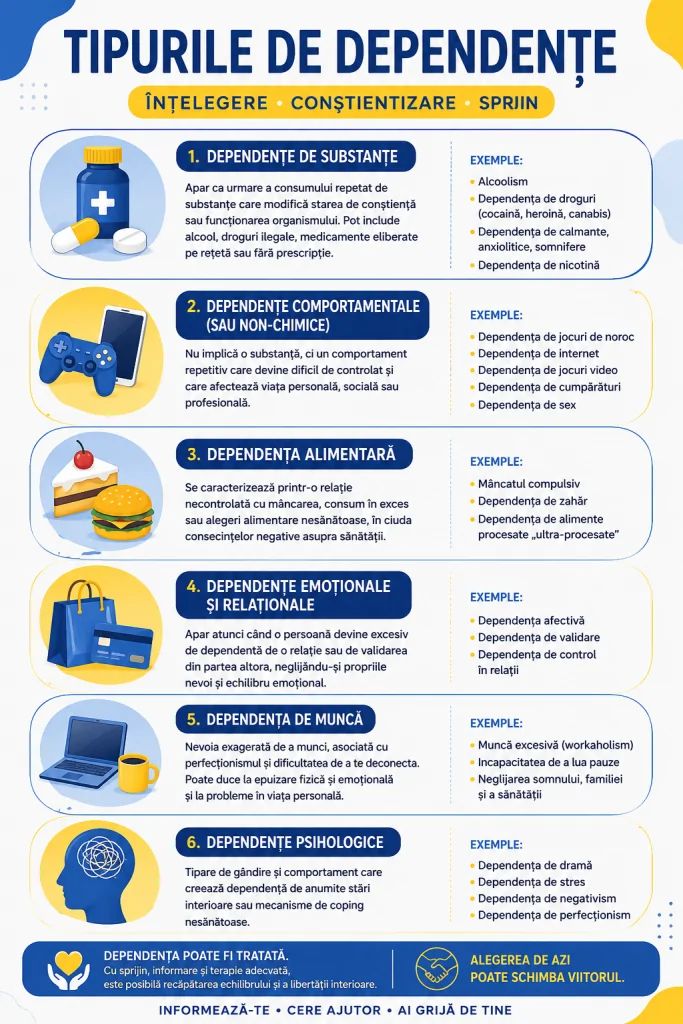
Substance addictions include the problematic use of alcohol, nicotine, recreational drugs, medication with abuse potential or other psychoactive substances. These can produce direct changes in the activity of the central nervous system, influencing mood, perception, energy, attention and behaviour. As the addiction progresses, the phenomenon of tolerance appears, which means that the person needs increasingly larger doses in order to obtain the same effect. At the same time, withdrawal symptoms can appear when use is reduced or interrupted, such as anxiety, irritability, insomnia, tremor, physical discomfort or intense emotional symptoms. These manifestations contribute to maintaining the vicious circle of addiction and make quitting much more difficult.
Behavioural addictions work through similar brain mechanisms, even if they do not involve introducing a substance into the body. Gambling, compulsive use of social networks, video games, excessive shopping or other repetitive behaviours can activate the same reward and anticipation circuits that are involved in substance addictions. The person may feel an intense need to repeat the behaviour in order to obtain a state of satisfaction, of escape or of temporary reduction of stress. Over time, the behaviour becomes more and more frequent, and voluntary control over it decreases. Even when financial, family, professional or social problems appear, the person may continue to repeat the behaviour, because the brain perceives it as an important source of reward.
One of the most important effects of addiction is its impact on motivation. Normally, the brain is motivated by a variety of natural experiences such as social relationships, personal achievements, physical activity, hobbies or professional activities. In addiction, however, the reward system begins to be dominated by a single source of stimulation. As a result, ordinary activities become less interesting and less satisfying. The person may experience a lack of energy, difficulty concentrating, loss of interest in activities that used to be enjoyable and a constant need to return to the behaviour or substance that produces the intense reward. This change in motivation contributes to progressive isolation and to the impairment of everyday functioning.
The manifestations of addiction can be emotional, cognitive, behavioural and physical. On an emotional level, there may be anxiety, irritability, guilt, shame, sudden mood swings and difficulties with emotional regulation. On a cognitive level, excessive preoccupation with the object of the addiction, difficulty concentrating, rigid thinking and reduced decision-making capacity are frequent. Behaviourally, the person may start to change their routine, to hide certain behaviours, to neglect responsibilities or to take increasingly greater risks. In the case of substance addictions, physical manifestations can also appear, such as sleep disturbances, changes in appetite, weight fluctuations, chronic fatigue or specific withdrawal symptoms. Overall, addiction does not affect just a single aspect of life, but can deeply influence physical health, psychological functioning, relationships and the general quality of life.
The signs that indicate an active addiction
Addiction does not mean only the repeated use of a substance or the excessive practice of a certain behaviour. From a neuroscientific perspective, addiction represents a progressive change in the way the brain processes reward, motivation, impulse control and decision making. As this change sets in, the person gradually begins to lose their freedom of choice in relation to the object of the addiction, even if they are aware of the negative consequences.
One of the aspects that make addiction difficult to recognise is the fact that it develops gradually. It rarely appears suddenly. Most of the time, the problematic behaviour is initially justified by stress, fatigue, the need to relax or the wish to cope with emotional difficulties. Over time, however, the relationship with that substance or behaviour begins to change, and the signs of an active addiction become more and more obvious.
Recognising these signs early is important because it allows intervention before the neurobiological and behavioural changes become more severe. Although each person may show addiction differently, there is a series of common indicators that appear frequently and that suggest the problem goes beyond the level of a simple habit.
1. Loss of control over use or behaviour
One of the most important signs of addiction is the difficulty of controlling the frequency, duration or intensity of the behaviour. The person may set out to use less, to spend less time online, to play less or to reduce certain activities, but repeatedly finds that they do not succeed. Promises made to oneself often appear, followed by breaking them. This loss of control does not reflect a lack of willpower, but changes in the brain circuits involved in self-control and behavioural inhibition.
2. Constant preoccupation with the object of the addiction
The person begins to think frequently about the use or about that activity even when they are involved in other tasks. A large part of their energy is directed towards planning, anticipating or recalling the experience associated with the addiction. Over time, these preoccupations take up more and more mental space, reducing the ability to focus on other important aspects of life.
3. Increased tolerance
The brain adapts progressively to repeated stimulation. As a result, the same amount of substance or the same intensity of the behaviour no longer produces the initial effects. The person needs larger doses, longer sessions or more intense experiences in order to obtain the same level of satisfaction. This phenomenon is known as tolerance and is one of the classic markers of active addiction.
4. The appearance of withdrawal symptoms
When access to the substance or behaviour is limited, unpleasant manifestations may appear, such as anxiety, irritability, restlessness, agitation, insomnia, sadness, difficulty concentrating or a strong feeling of discomfort. In the case of some substances, the symptoms can also be physical. Withdrawal indicates that the body and the brain have adapted to the constant presence of that stimulus and react negatively to its absence.
5. Continuing the behaviour despite negative consequences
An important sign of addiction is maintaining the use or the behaviour even when it produces obvious problems. Financial difficulties, family conflicts, damage to health, professional problems or a drop in academic performance may appear. Even so, the person continues to repeat the behaviour because the brain's reward system prioritises obtaining the stimulus over long-term consequences.
6. Neglecting responsibilities and relationships
As the addiction becomes more severe, important activities begin to be abandoned. Professional, school or family responsibilities are postponed or carried out superficially. Close relationships can suffer, and the person may become more socially isolated. In many cases, the object of the addiction begins to occupy the central place in the individual's life.
7. Using the behaviour for emotional regulation
Many people initially use certain behaviours or substances in order to cope with stress, anxiety, sadness, loneliness or frustration. In addiction, this mechanism becomes dominant. The person no longer seeks the stimulus only for pleasure, but also in order to avoid emotional discomfort. Thus, the addiction begins to function as an emotional regulation strategy, even if in the long run it worsens the existing problems.
8. Loss of interest in other activities
Activities that used to produce satisfaction gradually become less attractive. Hobbies, sport, time spent with the family or other natural sources of reward no longer offer the same pleasure. This phenomenon appears because the brain becomes more and more sensitised to the stimulus associated with the addiction and less receptive to the ordinary rewards of everyday life.
9. Minimising or denying the problem
Many people who develop an addiction tend to minimise its impact. Justifications may appear such as “I can stop any time”, “it is not that serious”, “everybody does this” or “I only need it for a while”. Denial is often a psychological protection mechanism that prevents the person from facing the real extent of the problem.
10. Craving, or the intense desire to use
Craving is one of the central features of addiction. It refers to an intense and hard to control need to use or to repeat that behaviour. This desire can be triggered by emotions, places, people, memories or situations associated with previous experiences. At brain level, craving reflects the strong activation of the reward and motivation circuits.
Active addiction is more than a bad habit or a lack of discipline. It involves real changes at brain level, which affect impulse control, motivation, decision making and emotional regulation. Signs such as loss of control, tolerance, withdrawal, excessive preoccupation with use or continuing the behaviour despite negative consequences indicate that the addiction has begun to influence the person's functioning significantly.
The earlier these signs are recognised, the greater the chances of effective intervention. Understanding the mechanisms underlying addiction is the first step towards recovery, because it allows the person to see the problem not as a personal flaw, but as a complex difficulty that can be addressed through assessment, specialised support and appropriate interventions.
The deeper causes of addictions
1. Biological and genetic factors
Some people have a greater genetic predisposition to developing addictions. Changes in the brain's reward system, especially in the dopamine circuit, can make certain substances or behaviours feel much more pleasant than usual. Over time, the brain comes to “ask for” the repetition of the experience, which increases the risk of addiction.
2. Psychological factors
Emotional disorders such as anxiety, depression or chronic stress can contribute significantly to the appearance of addictions. Affected people may use substances or behaviours (such as gambling or excessive internet use) as a form of escape or self-medication. Over time, this coping mechanism becomes dysfunctional and leads to addiction.
3. Trauma and childhood experiences
Early traumatic experiences, such as abuse, neglect or the loss of an important person, can increase vulnerability to addictions. These experiences can affect emotional development and the ability to regulate stress, leading the individual to look for external methods of “numbing” psychological pain.
4. Social and environmental factors
The environment in which a person lives plays a major role. Peer pressure, easy access to substances, the lack of family support or exposure to models of addictive behaviour can favour the development of addiction. Likewise, social marginalisation or the lack of opportunities can increase the risk of addictive behaviours.
5. Cultural and economic factors
In some cultural contexts, certain addictive behaviours can be normalised or even encouraged. In addition, poverty, unemployment and the lack of access to mental health services can contribute to increased vulnerability, because the people affected have fewer resources with which to cope with problems.
Addiction is the result of a complex combination of biological, psychological and social factors. There is no single universal cause, and each case is influenced by a unique set of circumstances. That is why prevention and treatment must be personalised and must include medical as well as psychological and social support.
How addiction influences health and daily functioning
Addiction has a deep impact on physical health, affecting the internal organs and the vital systems of the body. Depending on the substance or behaviour, cardiovascular, liver, respiratory or neurological problems can appear. Over time, the body deteriorates progressively, and the risk of chronic disease or even premature death increases significantly.
On a psychological level, addiction affects thinking, memory and decision-making capacity. The addicted person can become more impulsive, more irritable and less able to manage their emotions. Disorders such as depression or anxiety can also appear, which worsen the general state even further.
In everyday life, addiction interferes with personal and professional responsibilities. Performance at school or at work drops, and relationships with family and friends become tense or fall apart. Ordinary activities are neglected, because the priority becomes obtaining and using the substance or repeating the addictive behaviour.
Socially, addiction can lead to isolation and to the loss of support from those around. Stigma and frequent conflicts can accentuate the feeling of loneliness, which keeps the cycle of addiction going. In severe cases, legal or financial problems can appear, which complicate the situation of the affected person even further.
Treatment and recovery options in addictions
Treatment and recovery in addictions represent a complex and lengthy process, whose aim is not only to stop the use or the addictive behaviour, but also to rebuild the person's physical, psychological and social balance. Because addiction affects multiple aspects of life, effective intervention usually involves a combination of medical, psychological and social methods. Recovery is not a single event, but a gradual journey, which requires constant support adapted to each individual.
1. Detoxification (detox)
Detoxification is often the first step in the treatment of addiction, especially in the case of substances. It involves the gradual or controlled elimination of the substance from the body, under medical supervision. The process can be difficult, because withdrawal symptoms may appear, which is why monitoring in a specialised environment is recommended.
2. Individual psychotherapy
Psychotherapy helps the addicted person to understand the deeper causes of the addictive behaviour and to develop healthy strategies for managing emotions. Cognitive behavioural therapy is frequently used, because it helps to identify and change the thinking patterns that maintain the addiction. The relationship with the therapist also offers emotional support and stability.
3. Group therapy and support groups
Taking part in support groups gives addicted people the opportunity to share experiences and to receive support from others in similar situations. This type of therapy reduces the feeling of isolation and offers motivation through real examples of recovery. Groups such as the “12 steps” type are frequently used in this context.
4. Medication treatment
In certain cases, medication is used in order to reduce cravings for substances or to relieve withdrawal symptoms. It is prescribed by specialist doctors and is part of a wider therapeutic plan. Medication does not cure addiction, but it can support the recovery process and can prevent relapses.
5. Rehabilitation in specialised centres
Rehabilitation centres offer a structured and safe environment, where the addicted person can receive comprehensive treatment. These programmes usually include therapy, counselling, educational activities and medical support. Being away from the triggers in the usual environment can increase the chances of recovery.
6. Family support and social reintegration
The family plays an essential role in the recovery process, offering emotional support and stability. At the same time, social reintegration helps the person to rebuild their life, by going back to studies, to work and to healthy relationships. A positive environment reduces the risk of relapse.
The treatment of addictions requires a comprehensive and personalised approach, because there is no universal solution. Each person has different needs, and success depends on the correct combination of medical, psychological and social methods. The patient's active involvement is essential for achieving long-term results.
Recovery is a continuous process, not just an initial stage of treatment. Even after stopping the addictive behaviour, maintaining emotional balance and preventing relapses requires constant effort and support. With appropriate help, addicted people can rebuild a stable and healthy life.
The role of neurofeedback in supporting recovery
Neurofeedback is a modern, non-invasive form of therapeutic intervention, whose aim is to regulate brain activity by training the brain to change its own patterns of functioning. In the context of addictions, this method becomes relevant because many addictive behaviours are associated with imbalances in the brain circuits responsible for reward, attention and impulse control. Through the use of sensors that monitor the electrical activity of the brain (EEG), the patient receives real-time feedback in the form of visual or auditory signals, which helps them learn, gradually and unconsciously, to self-regulate their neural activity. This approach does not involve medication and does not require invasive procedures, which makes it a safe option that is well tolerated by most patients.
An essential aspect of neurofeedback is how personalised it is. Each person has a unique pattern of brain activity, and in the case of addictions these patterns can vary significantly depending on the substance, the duration of use and the associated psychological factors. For this reason, neurofeedback protocols are adapted individually, based on the initial assessments and on continuous monitoring of progress. Over time, patients can notice improvements in terms of the ability to concentrate, reduced impulsivity, emotional stabilisation and lower anxiety - factors that are often involved in maintaining the addiction. The process is gradual, but it contributes to the formation of new, healthier neural patterns that support long-term recovery.
In addition, neurofeedback can play an important role in reducing stress and in regulating the emotional response, two critical aspects in preventing relapses. People in recovery frequently face emotional or situational triggers that can reactivate the desire to use, and training the brain to respond in a more balanced way to stress can significantly increase psychological resilience. By strengthening self-control and emotional stability, neurofeedback acts not only on the symptoms, but also on the neurobiological mechanisms underlying the addiction.
Another important benefit is the fact that neurofeedback can be used as part of a long-term recovery process, without interfering with other forms of treatment. Because of its non-invasive nature, it can be integrated at different stages of recovery, including after detoxification or alongside psychotherapy, without the risk of pharmacological side effects. This flexibility makes it suitable for a wide range of patients, including those who do not respond optimally to conventional treatments.
How neurofeedback can be integrated into a therapeutic plan
Neurofeedback is most effective when it is integrated into a comprehensive therapeutic plan that combines medical, psychological and social interventions. Usually, it does not replace classic therapies, but complements them, offering additional support at a neurobiological level. For example, alongside cognitive behavioural psychotherapy, neurofeedback can help the patient to strengthen their emotional self-regulation and impulse control skills more quickly, which makes progress in therapy easier.
Integrating it into a therapeutic plan involves detailed initial assessments, setting clear objectives and constantly monitoring the patient's progress. Neurofeedback sessions are usually scheduled regularly, and the results are analysed together with the therapist in order to adjust the protocols. When it is used consistently, neurofeedback can support long-term stabilisation and can significantly reduce the risk of relapse, especially in combination with psychological and social support.
If you want to find out whether neurofeedback is right for you or for someone close to you, you can take the first step right now. Fill in the form for a free discussion with a specialist and you will receive an initial assessment and personalised recommendations, adapted to your situation.
Do you want to understand what is happening in your brain?
Book a discussion with the specialists of the BrainMap Institute and find out how a BrainMap and brain training can help you.