You didn't plan to stay for 2 hours. What is really happening in a brain that can't put the phone down
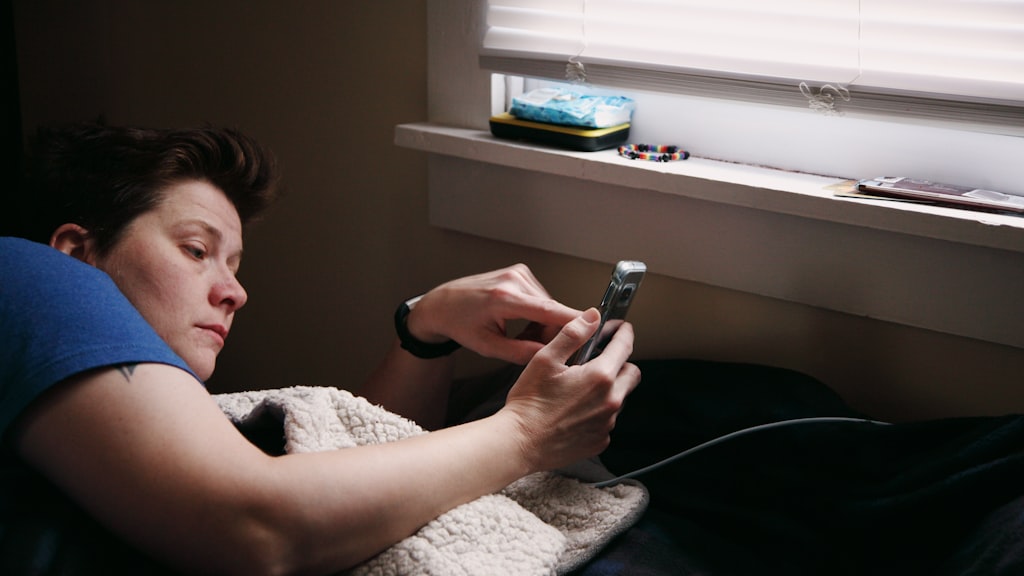
You only wanted to check a notification. Maybe to see what someone had posted, maybe to watch a few clips for “2 minutes”. You look up and 2 hours have gone by. Your eyes are dry, your neck is stiff and there is a discomfort you don't quite know how to name. The discomfort comes from how much you have seen, not from what, and from the fact that you couldn't stop.
In the morning you pick up the phone before your eyes are fully open. In the evening it is the last thing you touch. At the table, on the bus, in bed, in the middle of a conversation, your thumb swipes up like a reflex, and you don't even notice you are doing it anymore. The strangest part is that you don't even like what you see. You compare yourself, you get annoyed, you feel worse. And you still don't put the phone down.
Below we explain what mechanism keeps the scrolling going, why it resembles slot machines so much, what the signs are that it is no longer just a habit and what can be done in concrete terms, beyond the advice about willpower.
An addiction without a substance is still an addiction
Most people's first reaction is to blame themselves for a lack of willpower. It is convenient and it is wrong. In addictions, the piece that gives way is not willpower, but the system that decides what is worth pursuing, and that system works the same way whether at its end there is a substance, gambling or a screen.
What is happening to you is not a character flaw. It is a mechanism that has learned something it shouldn't have learned. And the environment was built specifically so that it would learn it. The difference from alcohol or drugs lies elsewhere. Here there is no clear moment when you can say you have crossed the line. Nobody wakes up in the morning determined to lose 2 hours, and the product is designed precisely so that this moment is never felt.
The apps weren't made to inform you
They were made to hold on to you, and this difference explains almost everything else. The main tool is called intermittent variable reward and it is the oldest lever in the behavior manual.
It works like this: you don't know when the reward comes, but you know it comes sometimes. A like, a comment, a clip that grabs you. It is precisely the uncertainty that keeps your finger moving. A brain that cannot predict the moment of the reward stays on alert and keeps searching. It is exactly the principle of slot machines, and the resemblance is not a metaphor: we have written about it at length in the article on gambling addiction.
Add on top of that a bottomless feed that never ends. On television there was an end to the episode, in the newspaper a last page. Here nothing ends. And the brain needs an end signal in order to stop.
Dopamine is not the pleasure molecule
This is where the most widespread confusion creeps in. Dopamine is not the substance that gives you joy, but the one of wanting and anticipation. It doesn't appear when you receive something good, but when the brain believes it is about to receive it.
This explains why the scrolling continues even when the content is mediocre. You look for it for the possibility of the next clip, not for the pleasure of the current one. And the algorithm learns, from one session to the next, exactly what keeps you there, and serves you more of the same.
Over time, habituation sets in too. What held your attention a year ago seems boring today. You need something faster, sharper, more intense. This is how a reward system recalibrates to what it receives often, and personal weakness has nothing to do with it.
What social media adds on top of slot machines
There is, however, a dimension that gambling doesn't have, and it is precisely what makes things harder. With slot machines you lose money, with social media you compare yourself with other people.
When you see someone else succeeding, when a post of yours gets no reactions, when you measure yourself, without meaning to, against an edited version of someone else's life, the brain reads the situation as a social threat. And social threat has a measurable physiological response, with raised cortisol, tension in the body and a diffuse restlessness that asks to be soothed somehow. And how do you get rid of the restlessness? You look for something to distract you, that is, exactly the app that produced it.
Wanting and discomfort, in a loop. Dozens of times an hour. Few things hook a brain so efficiently.
Signs that it is no longer just a habit
Almost everyone spends more time on their phone than they would like. That alone means nothing. The difference lies in the patterns below. They matter especially when they appear together and have stayed with you for a few months:
- You lose track of time: sessions consistently turn out much longer than you planned, and the surprise repeats day after day.
- You can't go without it: a few minutes without the phone bring real restlessness, and your hand heads for your pocket before you have made any decision.
- It steals your sleep: you put off going to bed for one more clip, and the morning starts with the screen too.
- It intrudes on what matters: you check during conversations, at the table, at work, sometimes in the middle of a task that requires concentration.
- You feel worse afterwards: you compare yourself, you get annoyed, and the way you feel afterwards is consistently worse than before.
- You have tried to cut back and it didn't last: you deleted the app, you set time limits, and you got around both within a few days.
The last point weighs the most. A habit gives way to a firm decision. An addiction doesn't, and that is exactly where the difference shows.
What happens to attention
A figure circulates widely according to which human attention has dropped below that of an aquarium fish. It sounds memorable, but it has no basis. The number comes from a 2015 marketing infographic, and the cited source was never able to back it up. We mention it precisely because you will come across it often.
What can be said seriously is something else, and it is unsettling enough without exaggeration. Sustained attention is trained through use, and a brain used to receiving a new stimulus every few seconds practices the state of long concentration less and less. Nothing breaks irreversibly. It is just that, like any other skill left aside, this capacity weakens when you no longer call on it.
The area that does the heavy lifting is called the prefrontal cortex, together with the anterior cingulate cortex. They decide what deserves your attention and stop the impulse to switch. They are also the first to tire in an environment built on constant switching.
The effect is clearest in the things that require patience. A book that used to be easy becomes hard to follow, a film seems long, a one-hour task breaks into 10 pieces. We have written separately about how this overload feels, in the article on digital trauma.
How you train a brain used to fast stimulation
At the BrainMap Institute we treat social media addiction with the same seriousness as any other, because at the neurological level that is exactly what it is. The plan is built after a brain map shows where exactly attention gets lost, and the usual components are these:
- Neurofeedback: it directly trains the attention network, especially the prefrontal cortex and the anterior cingulate cortex. The brain receives real-time feedback about its own activity and gradually learns to sustain attention on a single task.
- Binaural and isochronic stimulation: sessions of 20–30 minutes, listened to with headphones, that support attention, calm and sleep between the sessions at the clinic.
- Heart–brain coherence: through guided breathing and biofeedback, it synchronizes the activity of the heart with that of the brain. This is where the pause between impulse and action is built, that is, exactly the moment when your hand heads for the phone and you manage to notice it.
That pause seems like a small thing. It decides almost everything, because that is where choice fits in. Between impulse and action there is room, when needed, for a choice, and the training works precisely on widening that space. Whoever manages to notice the impulse before following it regains something that seemed lost.
None of these methods is a miracle solution, and the results differ from one person to another. All of them work with the mechanism, not with guilt. Simple things help too, from regular sleep to the relaxation techniques that lower the background level of tension.
A 7-day challenge, before anything else
The idea isn't to give up your phone. That would be unrealistic advice and, honestly, useless, because the phone is part of everyday life just like your wallet.
We are asking you for something else, much simpler. For 7 days, write down how many times you pick up your phone without a concrete reason. Without changing anything, without judging yourself, just counting. Most people stop counting around the middle of day 2. That is exactly where the information lies.
Why does simply counting help? Because it turns an automatic gesture into an observed one, and an observed gesture can be changed. It is the same principle that coherence training relies on, except that you do it on your own, with a pencil.
If the number surprises you, it is worth a conversation. An assessment shows whether your attention really has been affected or whether what you feel has to do with something else, with accumulated stress or with sleep. Both answers are useful. Each one tells you where to start.
References
- World Health Organization. Addictive behaviours: Gaming disorder. [online] Available at: who.int/news-room/questions-and-answers/item/addicti….
- National Institute on Drug Abuse. Drugs, Brains, and Behavior: The Science of Addiction. [online] Available at: nida.nih.gov/publications/drugs-brains-behavior-scie….
- World Health Organization. Mental health of adolescents. [online] Available at: who.int/news-room/fact-sheets/detail/adolescent-ment….
Do you want to understand what is happening in your brain?
Book a call with the BrainMap Institute’s specialists and find out how a BrainMap and brain training can help you.
Frequently asked questions
Is social media addiction a real addiction?
It does not appear as a standalone diagnosis in the classification manuals, but the mechanism behind it is that of behavioral addictions, the same as with gambling. The brain learns to seek an unpredictable reward, and the behavior continues even if the person wants to stop. A specialist can tell whether, in your case, it is a problem that needs help or a habit that can be corrected on your own.
Why do I keep scrolling even if I don't like what I see?
Because dopamine does not reward pleasure, but anticipation. It rises when the brain believes something good is coming, not when it actually receives it. In a feed where you can't predict what will appear, the expectation stays active regardless of the quality of the content. That explains the long sessions that leave no satisfaction behind.
Does social media really reduce attention?
The figure that circulates, with human attention dropping below that of a fish, comes from a marketing infographic and has no verifiable source. What can be said seriously is that sustained attention is trained through use, and a brain used to a new stimulus every few seconds practices long concentration less and less often. The effect is not irreversible.
How long until I feel a change?
It depends on the person, on how long the habit has been there and on what else is going on in your life, from sleep to your stress level. Brain training takes place in repeated sessions, and progress is tracked through measurements, not impressions. The plan and the pace are set together with a specialist, after the initial assessment.
I deleted the app and I still went back. What do I do?
Deleting the app removes the access, but leaves untouched the mechanism that asks for stimulation, so going back is the rule, not the exception. A plan that lasts starts from something else: you identify the moments when the impulse appears, you add a concrete alternative for those moments and you work on your ability to sustain attention. If you have already tried several times on your own and it didn't last, an assessment is worth it, because repeated results say something about the mechanism, not about you.
What does the assessment at the BrainMap Institute involve?
A map of brain activity, which shows how the networks involved in attention and impulse control work. Based on it, a personalized plan is built, which can combine neurofeedback, binaural stimulation and heart–brain coherence. The assessment does not replace a psychological or psychiatric consultation, but complements it with measured data.