
Cognitive bias: what it is and how it shapes your thinking
Cognitive bias: what this tendency of the brain to stray from objective logic is, how it affects your thinking and decisions, and how to recognise it.
Do you look after a loved one with memory problems?
“The Labyrinth of Memory” helps you understand where you stand as a carer and what your first step is. It takes 5 minutes and the result is free.
What cognitive bias is
Cognitive bias is a systematic tendency of the brain to interpret, process and evaluate information in a way that departs from objective logic or from factual reality. These thinking errors appear because the human mind tries to save time and energy, using mental shortcuts (heuristics) in order to make quick decisions in complex situations or when the information is incomplete. Although these mechanisms played an important role in the evolution of the species, helping people react promptly in the face of danger, they can also lead to wrong conclusions, biased judgements and less effective decisions.
Cognitive biases influence the way we perceive people, events, information in the media, our own experiences and even our memories. They often work unconsciously, without the person realising that the way they interpret reality is already filtered through their own beliefs, emotions, previous experiences and expectations. It is precisely for this reason that two people can interpret the same situation in completely different ways, each being convinced that their own perspective is the correct one. In psychology and in the behavioural sciences, cognitive biases are considered a normal phenomenon of how the brain works, not an exception, and research has identified hundreds of such mechanisms that influence thinking and decision-making in everyday life.
How the brain distorts reality
The brain does not work like a video camera that faithfully records everything happening around it. Instead, it selects the information it considers relevant, fills in the gaps using previous experiences and builds a coherent interpretation of reality. This process is extremely efficient, but it can also generate numerous distortions. For example, people tend to notice more easily the information that confirms their existing beliefs and to ignore the evidence that contradicts them. At the same time, strong emotions, stress, tiredness or time pressure can amplify these errors of interpretation, leading the person to jump to conclusions or to misjudge risks and probabilities.
Furthermore, memory is not a perfect archive, but a dynamic process of reconstruction. Every time we recall an event, the brain can subtly change it, influenced by new information, emotions or by the way we tell the story of that experience. In this way, our perceptions and memories can drift further and further away from what actually happened, without this being intentional. For this reason, people can hold very firm beliefs about certain situations, even when those beliefs are based on incomplete or distorted interpretations.
Cognitive biases do not change reality itself, but the way it is perceived, analysed and understood by each individual.
Why it does not mean “a weakness of character”
The presence of cognitive biases is not a sign of low intelligence, lack of willpower or weakness of character, but a natural feature of the way the human brain works. All people, regardless of their level of education, experience or profession, are influenced to some degree by these mental mechanisms. The difference lies in the ability to recognise them and to adopt strategies that can reduce their impact, such as critical thinking, checking information from multiple sources, examining opposing arguments and being aware of one's own cognitive limits.
Understanding that cognitive biases exist is not meant to label people, but to offer a useful tool for developing thinking that is more objective, more balanced and better grounded.
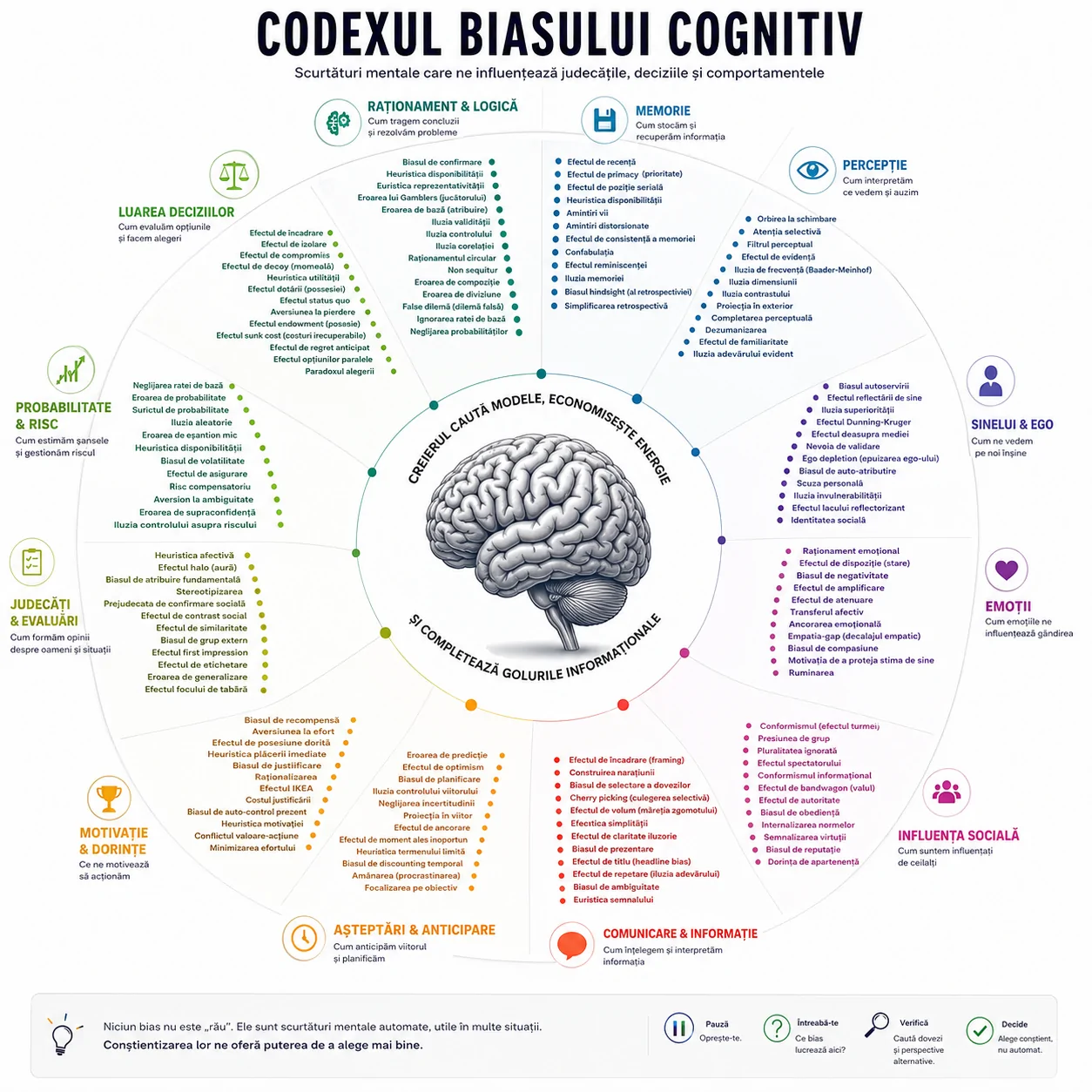
How cognitive bias shows itself
Cognitive bias can show itself in many everyday situations, influencing the way we interpret information, evaluate people and make decisions. Most of the time these mechanisms work unconsciously, which means we do not realise that our perception is influenced by mental shortcuts, previous experiences or emotions. Although cognitive biases are a natural part of how the brain works, recognising their signs is the first step towards developing more objective and more balanced thinking.
The signs of a distorted way of thinking
1. Jumping to conclusions
One of the most frequent signs of a distorted way of thinking is the tendency to reach conclusions quickly, without analysing all the available information. The person assumes they already know the explanation for a situation, even when the evidence is insufficient or contradictory. This habit can generate misunderstandings, conflicts and decisions based on assumptions rather than on facts.
2. Thinking in extremes
People who show this type of distortion tend to see things in black and white, without taking into account the shades between the two extremes. A success has to be perfect in order to count, and a small failure can be interpreted as a total failure. This rigid perspective can affect self-esteem and can create unrealistic expectations both of oneself and of others.
3. Looking only for information that confirms one's own beliefs
Another sign is the tendency to pay attention only to the information that supports already existing opinions and to ignore the arguments or evidence that contradict them. In this way, beliefs become ever stronger, even when they are not supported by reality. This phenomenon limits the capacity to learn and can prevent a change of perspective when new information appears.
4. Excessive generalisation
Generalisation appears when a single negative experience is used to formulate general rules about life or about oneself. For example, one specific failure can lead to the conclusion that “nothing ever works out for me” or that “I will always fail”. This way of thinking reduces objectivity and can feed pessimism or a lack of confidence.
5. The strong influence of emotions on conclusions
In many situations, people come to believe that what they feel automatically reflects reality. If a person feels insecure, they may conclude that they are incapable, and if they feel fear, they may consider that a real danger exists, even in the absence of evidence. Emotions are important, but they do not always represent an objective assessment of the situation.
6. Resistance to changing one's opinion
A distorted way of thinking can also be seen in the difficulty of accepting information that contradicts personal beliefs. Even in the face of solid evidence, the person may continue to defend their point of view in order to avoid the psychological discomfort associated with change. This rigidity can limit personal development and the ability to adapt to new situations.
How cognitive bias influences everyday decisions
Cognitive biases and thinking distortions influence many of the decisions we make every day, from the seemingly trivial ones to those with a major impact on our personal and professional lives. Choosing a product, interpreting another person's behaviour, the way we manage our time or assess a risk are just a few examples of situations in which the brain uses mental shortcuts. Most of the time these processes happen automatically and unconsciously, which makes it difficult to identify their influence on our decisions.
In our relationships with others, cognitive distortions can lead to wrong interpretations of the intentions, emotions or behaviours of those around us. A neutral remark can be perceived as criticism, and the lack of a reply to a message can be interpreted as disinterest or rejection. Such conclusions can generate unnecessary conflicts, misunderstandings and disproportionate emotional reactions, even though the real situation may have far simpler explanations.
In professional and financial matters, cognitive biases can influence the way opportunities are evaluated, the way risks are taken and the way information is analysed. A person may avoid a valuable opportunity because of a previous negative experience, or may continue an unprofitable project simply because they have already invested time and resources in it. Becoming aware of these mechanisms and developing critical thinking helps us make more balanced decisions, based on analysis and evidence rather than only on impressions or instinctive reactions.
Why cognitive biases appear
Cognitive biases appear as a result of the way the human brain processes information and makes decisions in the shortest possible time. Every day we are exposed to a very large volume of stimuli, and analysing each situation in detail would consume considerable cognitive resources. In order to cope with this amount of information, the brain uses mental shortcuts that simplify the process of interpretation and allow decisions to be made quickly. Although these mechanisms are useful in many contexts, they can also lead to systematic errors of judgement, especially when situations are complex or involve incomplete information.
The brain's role in saving energy
The brain is one of the most active organs in the body and consumes a significant amount of energy in order to sustain the processes of thinking, memorising and decision-making. To use these resources as efficiently as possible, it prefers to automate as many mental processes as it can. Thus, instead of analysing every situation from scratch, it relies on previous experiences, on patterns it has already learned and on simple rules of interpretation. This strategy allows for quick and efficient reactions in everyday activities.
Mental shortcuts, also known as heuristics, are useful because they reduce the time needed to evaluate a situation. In many cases they lead to decisions that are good enough to meet the demands of the moment. However, when the information is incomplete, when the context is new or when emotions are intense, these mechanisms can generate mistaken interpretations and biased conclusions. This is how the many cognitive biases that influence perception and judgement come about.
From an evolutionary perspective, speed of reaction was often more important than absolute accuracy. In dangerous situations, the ability to make a decision quickly could make the difference between survival and failure. Even though the modern environment is very different from the one in which these mechanisms developed, the brain continues to work on similar principles. That is why people are inclined to simplify information, to recognise patterns quickly and to draw conclusions before analysing all the available evidence.
The factors that intensify biases
- Stress – During periods of stress, the brain prioritises quick reactions at the expense of detailed analysis. This favours the use of mental shortcuts and increases the likelihood of errors of judgement.
- Fatigue – Lack of rest reduces the capacity for concentration, attention and critical analysis. As a result, people tend to rely more on quick impressions and on beliefs that are already formed.
- Strong emotions – Fear, anger, enthusiasm or anxiety can significantly influence the way information is interpreted. When emotions dominate the decision-making process, an objective assessment of the situation becomes more difficult.
- Information overload – The very large volume of information we are exposed to every day makes the brain select quickly what it considers relevant. In this process, some important information can be ignored or interpreted superficially.
- Previous experiences – The events we lived through in the past influence the way we perceive new situations. Although experience can be an advantage, it can also lead to generalisations or assumptions that do not fit the current context.
- Personal beliefs and values – Opinions that are already formed influence the way new information is analysed. People tend to give more credibility to the evidence that confirms their beliefs and to be more sceptical of the evidence that contradicts them.
- Time pressure – When decisions have to be made quickly, there is less time for analysis and for checking information. Under these conditions, the likelihood of resorting to cognitive biases increases considerably.
- The influence of the social group – Family, friends, colleagues and the communities we belong to can shape personal perceptions and opinions. The desire to belong and to be socially validated can lead people to adopt points of view without any in-depth critical analysis.
The impact of cognitive biases on everyday life
Cognitive biases influence numerous aspects of daily life, even when we are not aware that they exist. The way we interpret information, communicate with others, make decisions or react to different situations is often shaped by these mental shortcuts. Although they can speed up the process of thinking, in certain contexts they can lead to wrong conclusions, conflicts and less advantageous choices.
Effects on relationships
In personal and professional relationships, cognitive biases can influence the way we interpret the behaviour and the intentions of those around us. For example, a person may assume that the lack of a reply to a message is a sign of disinterest, without considering alternative explanations such as lack of time or other concerns. Similarly, one negative experience with someone can lead to generalisations about that person as a whole or even about an entire group of people.
Biases can lead people to pay more attention to the information that confirms their initial impressions and to ignore the evidence that contradicts it, which can feed prejudice and misunderstandings. In addition, the selective interpretation of gestures, words or facial expressions can generate unnecessary conflicts and can damage mutual trust.
Effective communication and a willingness to analyse situations objectively help to reduce the effects of these distortions and to build more balanced relationships.
Effects on work and on decisions
At work, cognitive biases can influence both individual decisions and those taken as a team. Assessing candidates for a job, appraising the performance of colleagues, choosing a strategy or estimating risks are all processes in which errors of judgement can occur. For example, the first impression of a person can influence later evaluations, even when new information ought to lead to a different conclusion. People may also continue to invest time and resources in a project that no longer delivers results, simply because they have already invested a great deal in it.
In a professional environment, such distortions can reduce the quality of decisions, can slow down innovation and can affect collaboration between team members.
Being aware that biases exist and adopting objective methods of analysis, such as checking the data and consulting several perspectives, can contribute to better grounded decisions.
Effects on the emotional state
Cognitive biases can also have a significant impact on emotional balance, because they influence the way we interpret everyday events and experiences. When a person focuses predominantly on the negative aspects or tends to anticipate the most unfavourable scenarios, they are more likely to experience stress, anxiety or discouragement. Likewise, generalising a single failure can affect self-confidence and motivation, while constantly comparing oneself with others can heighten feelings of dissatisfaction or inadequacy. Over time, these patterns of thinking can contribute to maintaining negative emotions and to difficulties in coping with everyday challenges.
Identifying and re-evaluating one's own interpretations, together with developing a more balanced perspective on situations, can reduce the influence of these distortions and can support a more stable and healthier emotional state.
Common types of cognitive bias
There are numerous types of cognitive bias that influence the way people perceive reality, interpret information and make decisions. Some of the most common appear in situations where emotions are strong, where information is incomplete or where certain beliefs have already been formed. These patterns of thinking do not appear intentionally; they represent the way in which the brain tries to simplify reality. However, when they become repetitive, they can affect the way we evaluate situations, relationships and our own abilities.
Confirmation bias
Confirmation bias is the tendency to seek out, notice and more readily accept the information that supports already existing beliefs, while ignoring or minimising the evidence that contradicts them. For example, a person who believes they are not appreciated at work may notice only the criticism they receive and may overlook the moments when they are praised or supported.
This type of bias can keep mistaken opinions alive for long periods of time, because people tend to give more importance to the information that confirms their perspective. In this way, the image they hold of themselves, of others or of certain situations can become less objective.
Catastrophising
Catastrophising is a way of thinking in which a person anticipates the worst possible consequences of a situation, even when there is not enough evidence that they will happen. A minor event can be interpreted as the beginning of an extremely negative outcome, and ordinary problems can seem impossible to manage. For example, a mistake on a project may be perceived not just as a learning experience, but as proof that everything will go wrong.
This pattern can amplify stress and anxiety, because the brain reacts to imaginary scenarios as if they were real dangers.
Black-and-white thinking
Black-and-white thinking means evaluating situations in extremes, without taking into account the intermediate options or the nuances. The person sees things as either a complete success or a total failure, either right or wrong, with no room for compromise or gradual progress. For example, someone may consider that if they did not obtain a perfect result, then all the work they put in was pointless.
This way of interpreting things can create unnecessary pressure and can affect motivation, because reality is most often far more complex than two opposite extremes.
Negative filtering
Negative filtering is the tendency to notice and retain mainly the negative aspects of a situation, while ignoring the positive or neutral elements. A person may receive several compliments and a single criticism, yet remain focused only on the negative remark. Over time, this type of bias can create a distorted image of oneself or of the environment one lives in, because positive experiences are pushed into the background.
Negative filtering can contribute to constant dissatisfaction and to a decline in confidence in one's own abilities.
Mind reading
Mind reading is the tendency to assume that we know what another person is thinking or what their intentions are, without clear evidence. For example, someone may interpret the absence of a compliment as a sign that others consider them incapable, or may assume that a person is upset even though there are no real indications of it.
This bias appears because the brain tries to explain the behaviour of those around us quickly, but these explanations can be influenced by our own fears, experiences or insecurities. As a result, people can react to assumptions about reality, and not necessarily to reality itself.
How to approach cognitive bias correctly
Approaching cognitive biases correctly starts with becoming aware that they are part of the normal way in which the brain works. The goal is not to eliminate these mechanisms completely, since they are useful in many situations, but to develop the ability to notice when they are influencing our thinking and to analyse information more objectively.
An important step is identifying repetitive patterns of thinking and noticing the moments when quick conclusions, assumptions or negative interpretations appear. Questions such as “What evidence do I have for this conclusion?”, “Is there another possible explanation?” or “Would I interpret the situation in the same way if it were about someone else?” can help reduce the influence of cognitive biases.
Developing critical thinking and accepting several perspectives also contribute to a more balanced assessment of situations. Talking to other people, checking information and being willing to adjust our own beliefs when new evidence appears are methods through which we can make more conscious decisions.
When certain patterns of thinking become very persistent and influence relationships, the emotional state or important decisions, the support of a specialist can be useful for understanding the mechanisms behind these processes and for developing more effective strategies for managing them.
Talk to a specialist
If you notice that certain patterns of thinking keep repeating, that they influence your emotions or that they affect your everyday choices, you can take the first step towards a better understanding of how your own thought process works. Fill in the contact form for a free discussion with a specialist and discover how you can identify and manage more effectively the cognitive biases that influence your life.
Do you want to understand what is happening in your brain?
Book a call with the BrainMap Institute's specialists and find out how a BrainMap and brain training can help you.