
ADHD in adults: symptoms, diagnosis and treatment
Chaos, procrastination, forgetfulness, focus only on what excites you? Adult ADHD looks different than in children. See the symptoms and how to get a diagnosis.

Do you look after a loved one with memory problems?
“The Labyrinth of Memory” helps you understand where you stand as a carer and what your first step is. It takes 5 minutes and the result is free.
What is ADHD in adults
ADHD in adults (Attention Deficit/Hyperactivity Disorder) is a neuropsychological condition characterized by a persistent pattern of inattention, impulsivity and/or hyperactivity that affects daily functioning. Although it is often perceived as a childhood disorder, modern research clearly shows that the symptoms persist in a significant proportion of those diagnosed in childhood, and in some cases the signs only become visible in adulthood. ADHD in adults can negatively influence a person’s career, interpersonal relationships, self-esteem and capacity for self-regulation.
Historically, ADHD was first recognized at the beginning of the 20th century, but it was considered an exclusively childhood problem. Terms such as “minimal brain dysfunction” or “hyperkinetic reaction of childhood” were used before the diagnosis was standardized in the psychiatric manuals. Only in the 1980s and 1990s, with the revised editions of the DSM (Diagnostic and Statistical Manual of Mental Disorders), was ADHD recognized as a disorder that can persist into adulthood. Today it is accepted internationally that ADHD does not disappear at the legal age of majority, but can manifest differently from one stage of life to another.
According to the DSM-5 criteria, for the diagnosis of ADHD in adults the presence of at least five symptoms of inattention and/or five symptoms of hyperactivity/impulsivity is required; these must persist for at least 6 months and must have been present before the age of 12. The symptoms must be evident in at least two different contexts (e.g. at home and at work) and must significantly affect social, academic or professional functioning. Examples of symptoms include difficulty sustaining attention, forgetting tasks, losing objects, motor restlessness or excessive talking.
It is important to mention that in adults hyperactivity can be less visible and often takes the form of inner restlessness or difficulty relaxing. Many adults with ADHD are diagnosed late, sometimes after years of professional or relational frustration, anxiety or depression. Recognizing and correctly diagnosing ADHD in adults opens the way to effective interventions - from cognitive behavioral therapy and neurofeedback to organizational strategies and, in some cases, medication.
Causes and risk factors for attention deficit disorder in adults
1. Genetic and hereditary factors
ADHD has a strong genetic component. Studies show that people with a parent or a sibling diagnosed with ADHD have an increased risk of developing the disorder themselves. It is estimated that between 70-80% of the variation in ADHD risk is explained by genetic factors. The genes involved are generally linked to the regulation of dopamine - the neurotransmitter associated with motivation, attention and pleasure.
2. Neurochemical imbalances
Neurotransmitters such as dopamine and noradrenaline play an essential role in regulating attention, motivation and self-control. In ADHD, research indicates an imbalance or a dysfunction in the dopaminergic and noradrenergic systems, which affects the brain’s ability to filter stimuli, sustain attention and regulate impulses.
3. Atypical brain development
Brain imaging has revealed that certain areas of the brain - especially the prefrontal cortex, the anterior cingulate gyrus, the caudate nucleus and the cerebellum - may be slightly smaller or may develop more slowly in people with ADHD. These regions are involved in executive functions such as organization, planning, behavior regulation and sustaining attention.
4. Prenatal exposure to toxins
Exposure to alcohol, nicotine or drugs during pregnancy can affect the development of the fetus’s central nervous system and can increase the risk of ADHD later in life. Contaminants such as lead or other neurotoxic substances can also negatively influence brain development.
5. Premature birth or low birth weight
Children born prematurely (especially before 32 weeks) or weighing less than 2,500 grams have a higher risk of developing ADHD. These conditions can affect neurological development at critical stages of pregnancy or in the first months of life, which has a long-term impact on cognitive and executive functions.
6. Head injuries in childhood
Early brain lesions, such as moderate or severe head trauma, can affect the areas of the brain responsible for attention, impulse control and executive functioning. Although they are not a main cause of ADHD, such injuries can contribute to the appearance of similar symptoms.
7. Chronic stress in childhood
Prolonged exposure to severe psychological stress in childhood - such as emotional or physical abuse, neglect, the loss of parents or family instability - can negatively affect brain development and can increase the risk of ADHD. Stress influences the neuroendocrine system and the balance of neurotransmitters, which can compromise self-regulation and executive functions.
8. Poor diet and nutritional deficiencies
Some studies have correlated deficiencies of omega-3, iron, magnesium or zinc with the appearance of ADHD symptoms. These elements are essential for the optimal functioning of the brain, and their absence can contribute to difficulties in concentrating and to emotional instability.
9. Postnatal environmental factors
A chaotic family environment, lacking structure or cognitive stimulation, excessive screen exposure in the first years of life, lack of sleep and lack of routine can aggravate ADHD symptoms or contribute to the development of a profile of inattention and impulsivity, especially in genetically predisposed children.
10. Other psychiatric comorbidities
The presence of other psychiatric disorders (for example, autism spectrum disorders, anxiety disorders or learning disorders) can influence the appearance and the recognition of ADHD. They can interfere with the normal development of executive skills and can indirectly contribute to the manifestation of ADHD symptoms in adulthood.
ADHD symptoms in adults
ADHD (attention deficit disorder with or without hyperactivity) does not disappear with adolescence. Although the symptoms can change with age, many adults continue to face significant difficulties in their personal, professional or social life. In adulthood, ADHD does not necessarily show itself through overflowing energy or visible agitation, but rather through subtle yet constant problems of organization, concentration, time management and emotional control. Below are the main symptoms specific to ADHD in adults:
1. Difficulty concentrating and sustaining attention
Adults with ADHD can find it hard to stay focused on routine tasks, especially if these are boring or repetitive. They can be easily distracted by external stimuli or by their own thoughts, which leads to the frequent interruption of activities and to difficulty in completing projects.
2. Frequent forgetfulness and lack of organization
The busy agenda of adult life becomes even more complicated in the presence of ADHD. The people affected often forget appointments, bills to be paid, personal belongings or even important commitments. Organizing the workspace, the schedule or priorities becomes a constant challenge.
3. Chronic lateness and poor time management
Many people with ADHD have a distorted perception of time, also known as a “faulty internal clock”. This leads to frequent delays, to difficulty in estimating how long an activity takes and to procrastination. Important tasks are postponed until the last moment, creating additional stress.
4. Verbal and behavioral impulsivity
Impulsivity in adults can show itself through frequently interrupting others in conversation, making hasty decisions or unplanned spending. This lack of self-control can affect interpersonal relationships and financial stability.
5. Difficulties in emotional regulation
ADHD also affects the control of emotions. Adults with this disorder can have exaggerated reactions to frustration, increased irritability, sudden mood swings or a low stress threshold. This emotional lability is often confused with other affective disorders.
6. Inner restlessness or mental hyperactivity
Although physical hyperactivity decreases in adulthood, many people describe a constant state of “inner restlessness”. The mind seems to be always in motion, thoughts follow one another rapidly, and relaxation becomes hard to achieve. Some express this agitation through rapid speech or continuous motor activity (for example, tapping a foot).
7. Problems in maintaining relationships
ADHD symptoms can affect romantic relationships, friendships or professional collaboration. Forgetting promises, inattention during conversations or impulsivity can be interpreted as a lack of involvement or empathy. These misunderstandings can lead to conflicts or breakups.
8. Lowered self-esteem
Adults with ADHD often have a history of perceived or real failures, which can affect their self-confidence. The constant effort to “fit into” the structures imposed by society, combined with external and internal criticism, can lead to persistent feelings of inadequacy or guilt.
9. Difficulty in completing projects
Despite an enthusiastic start, many people with ADHD struggle to bring tasks to an end. As interest drops or other stimuli appear, the ability to sustain constant effort falls dramatically. This pattern often repeats itself in personal projects as well, not only professional ones.
10. The tendency to avoid tasks that require sustained mental effort
Activities that require intense concentration, such as reading, filling in documents or working with data, are often avoided. Not because they would be impossible, but because they become extremely tiring mentally, and the frustration accumulated during them is hard to manage.
How is ADHD diagnosed in adults?
Diagnosing ADHD in adults is a complex process that requires a careful, multidimensional evaluation. Unlike in children, in adults the symptoms can be more subtle or masked by coping mechanisms, anxiety, depression or burnout. That is why it is essential for the evaluation to include several components, from clinical interviews and questionnaires to advanced methods of neurophysiological investigation such as BrainMap. Here are the essential steps in the correct diagnosis of ADHD in adults:
1. The clinical psychiatric or psychological interview
The first step in establishing a diagnosis is the discussion with a specialist (clinical psychologist or psychiatrist). They will assess the personal and family history, the current symptoms and their impact on daily life, and will check whether the manifestations have been present since childhood. Associated disorders such as anxiety or depression are often explored as well.
2. Standardized questionnaires and scales
Scientifically validated instruments are used, such as the Adult ADHD Self-Report Scale (ASRS), DIVA 2.0 (for a detailed evaluation according to the DSM-5 criteria) or other screening scales that help to objectify the symptoms. These are completed by the patient and, sometimes, by close people as well (family, partner), for a broader perspective.
3. Ruling out other disorders or medical conditions
ADHD can be confused with other problems such as generalized anxiety, depression, personality disorders, lack of sleep or endocrine conditions. For this reason a careful differential evaluation is essential, in order to rule out medical or psychiatric causes that can produce similar symptoms.
4. Neurocognitive evaluation
This involves testing attention, working memory, processing speed and executive functions (organization, planning, inhibition). Specific psychological tests are used (e.g. the Stroop Test, the Wisconsin Card Sorting Test, the CPT - Continuous Performance Test) in order to measure cognitive performance objectively. The results are interpreted in the context of the subjective symptoms.
5. BrainMap (brain mapping)
BrainMap is an advanced, non-invasive method that uses the electroencephalogram (EEG) to record the electrical activity of the brain at rest. This mapping offers a detailed picture of how the brain networks involved in attention, impulse control and information processing work. In ADHD, specific patterns of neuronal activity can be observed (e.g. an excess of theta waves in the frontal areas). BrainMap offers objective, scientific support for the diagnosis and can guide personalized therapies such as neurofeedback.
6. Educational and professional history
For a correct diagnosis, the academic and professional trajectory is analyzed as well: difficulty concentrating at school, impulsivity in decisions, frequently changed jobs, organizational problems or chronic lateness. This information can support or rule out a diagnosis of ADHD.
7. Multidisciplinary collaboration
In many cases the diagnosis is established through collaboration between a psychologist, a neurologist, a psychiatrist and, sometimes, the family doctor. A multidisciplinary approach allows a complete understanding of the patient’s profile and the choice of the most effective therapeutic interventions.
Treatments available for ADHD in adults
ADHD in adults can significantly affect quality of life: relationships, career, motivation and general well-being. The good news is that there are multiple therapeutic solutions that can be adapted to each person’s profile. The ideal treatment is a personalized one that combines several approaches and takes into account not only the reduction of symptoms, but also the long-term support of emotional, cognitive and functional balance.
1. Cognitive behavioral psychotherapy (CBT)
CBT is one of the most effective forms of therapy for ADHD in adults. It helps to identify and change dysfunctional thought patterns and to develop skills of organization, time management and impulse control. It is often used alongside other interventions and can produce significant results, especially when the patient is actively involved.
2. Psychological or ADHD coaching
Coaching specialized in ADHD focuses on concrete objectives: structuring the day, prioritizing tasks, maintaining motivation and overcoming practical obstacles. This method is practical, action-oriented and brings real benefits in everyday life, especially for adults with an active and demanding lifestyle.
3. Neurofeedback
Neurofeedback is a modern, non-invasive therapy that trains the brain to function more efficiently, based on the data obtained from a BrainMap. It is considered a non-invasive and well-tolerated method in ADHD. Through regular sessions, the person learns to regulate the patterns of brain activity associated with lack of concentration, hyperactivity or impulsivity. It is an ideal option for those who prefer natural and personalized solutions.
4. Biofeedback therapy
Similar to neurofeedback, classic biofeedback focuses on regulating physiological responses - heart rate, breathing, muscle tension. It helps with emotional self-regulation and with reducing stress and reactivity. It is useful as a complementary method, especially in cases where ADHD is associated with anxiety or sleep disorders.
5. Medication prescribed by a psychiatrist
Medication remains an effective option for many people with ADHD. It helps to improve attention and impulse control and to reduce hyperactivity. It is important that it is prescribed only by a psychiatrist, on the basis of a complete evaluation. Although it can bring rapid benefits, medication is often more effective in combination with complementary therapies that support long-term results.
6. Complementary neuroscientific interventions
Methods such as transcranial stimulation, photobiomodulation, brainwave training or vagus nerve stimulation are used in specialized centers as non-invasive and personalized alternatives. These therapies support neuroplasticity - the brain’s ability to adapt and reorganize - and can increase the effectiveness of other forms of treatment.
7. Regular physical exercise and mindfulness meditation
Constant movement, conscious breathing and mindfulness meditation contribute to regulating brain activity, reducing stress and improving concentration. Although they are not direct treatments, they are part of a therapeutic lifestyle, with cumulative effects over time.
8. Nutritional and lifestyle interventions
A balanced diet, quality sleep and avoiding an excess of stimulants (caffeine, screens) play an important role in supporting mental health. Sometimes, micronutrient deficiencies or metabolic imbalances can influence the way the brain functions and can aggravate ADHD symptoms. That is why a holistic approach is always recommended.
ADHD in adults is not a sentence, but a starting point towards self-knowledge and balance. The treatments available today offer varied options, from medication and psychotherapy to advanced technologies such as neurofeedback. The most effective strategy is the one that combines traditional methods with modern, non-invasive solutions adapted to each individual. With the right support, ADHD can be not only managed, but also turned into an advantage, through understanding the way your own mind works.
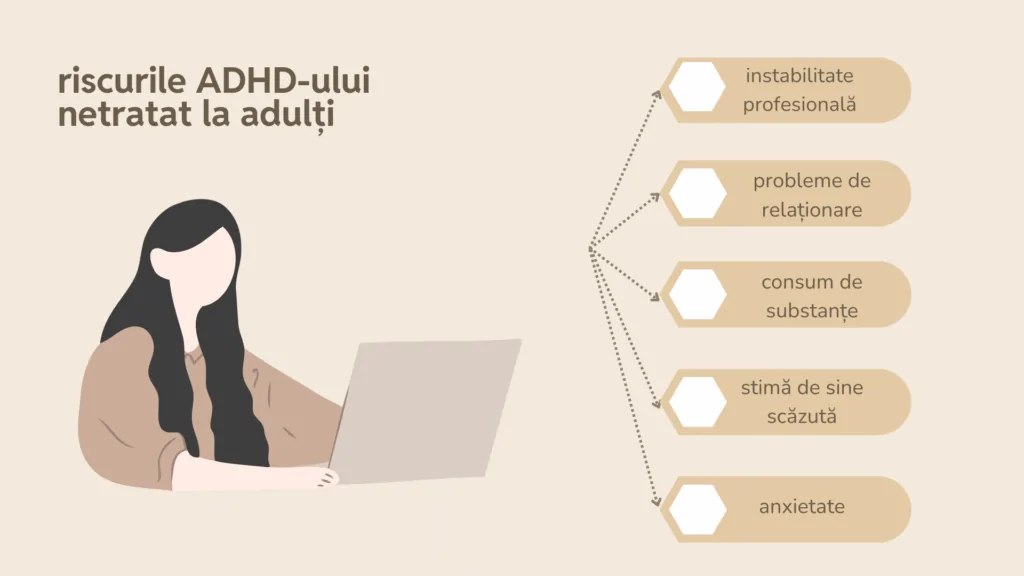
Complications associated with ADHD in adults
1. Relationship problems
Adults with ADHD often encounter difficulties in maintaining personal or professional relationships. Impulsivity, forgetfulness, inattention or the inability to listen actively can be wrongly interpreted as a lack of interest or respect. These behaviors can lead to tension within a couple, to conflicts with colleagues and to social isolation.
2. Decline in professional performance
ADHD can seriously affect a career. Difficulty in maintaining concentration, the tendency to procrastinate or poor organization can lead to delays, frequent mistakes or even the loss of a job. Many adults with ADHD feel undervalued, even if they are intelligent and creative, because they cannot function efficiently within a rigid framework.
3. Mood disorders (anxiety and depression)
Comorbidity with anxiety and depression is extremely frequent in adults with ADHD. The frustration accumulated from repeated failures, the difficulties of adapting or social pressure can lead to feelings of helplessness, uselessness or constant fear. In the absence of adequate treatment, these disorders can significantly worsen quality of life.
4. Sleep-related problems
Many adults with ADHD suffer from insomnia, difficulty falling asleep or restless sleep. Mental hyperactivity, racing thoughts and the lack of a stable rhythm can seriously disturb the sleep routine. Chronic sleep deprivation further affects attention, self-control and emotional state, amplifying ADHD symptoms.
5. Substance use disorders
People with ADHD have an increased risk of developing addictions - to alcohol, nicotine, drugs or even gambling. These behaviors can appear as a form of “self-medication” to reduce stress or to manage impulsivity. Without treatment and adequate support, these addictions can lead to serious medical and social complications.
6. Financial instability
ADHD can affect the ability to manage money. Inattention to spending, impulsivity in shopping or the postponement of important payments often lead to chronic financial difficulties. Many adults with ADHD do not manage to save, to plan a budget or to organize their financial responsibilities over the long term.
7. Low self-esteem
Repeated experiences of failure, the criticism received in childhood and in adult life, as well as constant comparisons with others, can lead to a negative self-image. Adults with ADHD often develop a deep feeling that they are “not good enough” or that they cannot cope with life. This can block initiative, motivation and openness to help.
8. Legal problems or risky behaviors
Increased impulsivity can lead to risky or even criminal decisions: reckless driving, failure to pay debts, aggressive reactions or a lack of control in tense situations. These behaviors do not appear in everyone, but the risk is higher if ADHD is not diagnosed and treated appropriately.
9. Social isolation
Adults with ADHD can avoid social interaction out of fear that they will not be understood or because of previous failures. Avoiding contact with others can lead to emotional isolation and even to a solitary life, although these people have an enormous potential for connection, creativity and empathy.
10. Mental exhaustion and burnout
The constant struggle to “keep up” with life, to compensate for the shortcomings linked to ADHD, often leads to exhaustion. Many adults feel mentally tired, without energy and without resources, especially if they carry this burden in silence and without specialized support.
Frequently asked questions about ADHD in adults
❓ Why do many adults not know that they have ADHD?
Many adults live for decades without knowing that the symptoms they face, such as lack of concentration, chronic procrastination, disorganization or impulsivity, are caused by ADHD. This happens for several reasons. In the past, ADHD was considered a disorder specific to childhood, and the adults who had it were not diagnosed, because there was not enough awareness. In addition, some people learn to “mask” their difficulties through their own compensatory strategies. Without a diagnosis, many people put the symptoms down to stress, a lack of willpower or their personality. A correct diagnosis can bring a lot of clarity and tailored solutions.
❓ When should you ask for help?
It is advisable to look for help if you feel that difficulties with concentration, time management, organization or emotional control interfere with your personal, professional or family life. If you constantly feel overwhelmed, if you have the sensation that you cannot finish what you start, or if you have gone through repeated failures despite your efforts, it is important to consult a specialist. ADHD in adults is treatable, and the right intervention can bring a significant improvement in quality of life.
❓ Does ADHD disappear in adulthood?
ADHD does not “disappear”, but it can transform. Hyperactivity symptoms can decrease with age, but difficulties with attention, impulsivity or organizational problems persist in many cases. Adults often learn strategies for coping better, but this does not mean that the condition has disappeared. Without support and treatment, ADHD can continue to affect a person’s life in adulthood as well, even if it is more subtle than in childhood.
❓ Does ADHD affect intelligence?
No. ADHD is not a disorder of intelligence. People with ADHD can have an intelligence quotient within normal limits or even above average. The difficulties appear mainly in the efficient application of cognitive abilities, not in their absence. ADHD affects the way attention, self-control and organization are managed, but it does not reduce intellectual potential. With appropriate support, many adults with ADHD can achieve excellent performance in creative, entrepreneurial or analytical fields.
❓ Does ADHD affect professional life or personal relationships?
Yes, significantly. Professionally, ADHD can lead to performance problems, procrastination, difficulty in meeting deadlines or in communicating efficiently with colleagues. On a personal level, conflicts, a lack of emotional involvement, forgotten responsibilities or sudden mood swings can appear. All of these can negatively affect close relationships. Nevertheless, awareness and appropriate treatment can turn these challenges into opportunities for growth.
❓ Is ADHD harder to diagnose in women?
Yes, it often is. ADHD symptoms can show themselves differently in women compared with men. For example, women tend to display inattention, anxiety and exhaustion more frequently than hyperactivity, which is easier to observe. Many women with ADHD are not diagnosed until adulthood, especially after they become mothers or take on many responsibilities. Gender stereotypes also contribute to the underdiagnosis of ADHD among women.
❓ At what age can ADHD be diagnosed in adults?
ADHD can be diagnosed at any adult age, as long as there is evidence that the symptoms were present since childhood (even if they were not recognized or diagnosed at the time). Many people receive the diagnosis after the age of 20, 30 or even 50, when the accumulated difficulties seriously affect their lives. The diagnosis involves a detailed psychological evaluation, a behavioral history and, sometimes, additional investigations such as the brainmap.
❓ How can I know that I have ADHD?
If you frequently face problems of attention, impulsivity, forgetfulness or procrastination, or if you have the feeling that you are functioning “on autopilot”, you may have ADHD. Other signals include emotional instability, irritability, chronic disorganization or difficulties in relationships. For a correct diagnosis, a specialized evaluation is necessary, which includes clinical interviews, standardized questionnaires and sometimes neurophysiological assessments (such as the brainmap).
❓ Is ADHD genetic?
Yes, in many cases ADHD has a significant genetic component. Studies show that this disorder can run in families. If one of the parents or siblings has ADHD, the probability of inheriting it is higher. However, genetic factors are not the only ones involved - the environment, early experiences and other biological factors can contribute to the development of the disorder.
❓ Can ADHD be caused by a vaccine?
No. There is no scientific evidence to support a link between vaccines and the appearance of ADHD. This idea has been disproved by numerous rigorous medical studies. ADHD is a neurodevelopmental disorder that appears as a result of a combination of genetic factors and prenatal or early influences in a child’s life. Vaccines are safe and do not cause ADHD.
Discover how your mind works!
Have a complete evaluation with BrainMap and start a personalized Neurofeedback program - a non-invasive, modern and effective method for managing ADHD symptoms.
👉 Book an evaluation session now!
🧠 How does your brain work?
Download the guide for FREE and find out what your brain map shows.
📖 Our books - Real case studies with brain maps
📖 Vindecarea Depresiei (Healing Depression, in Romanian) - 29.00 RON
📖 Vindecarea Anxietatii (Healing Anxiety, in Romanian) - 29.00 RON
📖 Eliminarea Atacurilor de Panica (Ending Panic Attacks, in Romanian) - 29.00 RON
Do you want to understand what is happening in your brain?
Book a call with the BrainMap Institute’s specialists and find out how a BrainMap and brain training can help you.