
ADHD treatment without medication,
what helps and what the studies say
Medication remains the first-line treatment for many children and adults with ADHD, and the decision to start it, change it or stop it is made by a psychiatrist or child psychiatrist together with you. There are also drug-free interventions with solid research behind them, used alongside medication and sometimes instead of it. For young children the guidelines actually put them first.
Maybe you want to hold off on pills for your child, maybe you tried them and couldn't tolerate them, or maybe you simply want to know what else you can do. Below you will find the options one by one, from parent training and school support to cognitive behavioural therapy for adults, exercise, sleep, diet and neurofeedback, each with what the studies show and where its limits lie. Start with the part that fits you.
Can ADHD be treated without medication?
The honest answer depends on age and on how much the symptoms get in the way of your life. There is no treatment after which ADHD disappears for good, but symptoms can be kept under control, and sometimes that works without medication.
For children aged 6 and over, the 2019 guideline of the American Academy of Pediatrics (AAP) recommends approved medication together with behavioural therapy. In 2018 The Lancet Psychiatry published an analysis of 133 double-blind trials, which concluded that methylphenidate in children and amphetamines in adults are the first choice once both efficacy and safety are taken into account.
The guidelines change when it comes to young children, though.
| Age | What guidelines recommend as the first step |
|---|---|
| Under 6 | A parent training programme (NICE for under 5s, AAP at ages 4 and 5). Medication comes only if the programme has not helped enough, and under 5 NICE also asks for a second specialist opinion |
| Ages 6 to 11 | Medication together with parent training and behavioural support in the classroom, plus adjustments at school |
| Ages 12 to 17 | Medication with the adolescent's agreement, plus behavioural interventions and support at school |
| Adults | Medication if symptoms still impair daily life after changes to the environment. Psychological treatment if you have made an informed choice not to take medication, cannot tolerate it or it has not helped |
For adults the British NICE guideline says drug-free treatment makes sense when you have made an informed choice not to take medication, when you find it hard to take it consistently, or when it has not worked or you could not tolerate it. The minimum it asks for is a structured psychological intervention for ADHD, with regular follow-up in person or by phone. The final word is still yours.
How we read the studies in this article. Many studies on drug-free treatments rely on the opinion of parents, who know which treatment their child is getting. The European expert group that works on ADHD guidelines (European ADHD Guidelines Group) therefore compares two kinds of assessment, one by the people closest to the treatment and one by raters who probably do not know what each child received. When the effect holds in the second case too, the evidence is much stronger.
In their 2013 meta-analysis of 54 trials, every treatment seemed to help when the people closest to the treatment did the rating. With probably blinded raters the effect stayed significant only for fatty acid supplements and for excluding artificial food colours, and the authors asked for better evidence for the rest.
Parent training and behavioural therapy for children
Parent training does not mean you have done something wrong as a parent. It is a group programme that lasts a few weeks, in which you learn techniques that have proved useful for children with ADHD and then use them at home every day.

- Immediate, specific praise right after the behaviour you want to see more often.
- Short instructions given one at a time, once your child is looking at you.
- A few clear rules written down and kept in sight, with the same consequences every time.
- Small, frequent rewards, for example a points chart for homework or for the morning routine.
- Planned ignoring of small behaviours that only seek attention, and a short, calm break when an important rule is broken.
- A predictable routine for mornings, homework and bedtime, with the same steps every day.
What the studies show is encouraging, with one nuance. A 2019 meta-analysis of 16 studies and 1,003 preschool children found a moderate drop in symptoms reported by parents, which held 3 to 12 months later. When symptoms were assessed by someone outside the family, the difference was no longer significant.
That does not make the programme useless. The 2014 European analysis of 32 trials found effects that hold even with probably blinded raters, and parents end up praising more often and using harsh punishment less, while children's behaviour problems decrease. For a family worn out by battles over homework or bedtime, the difference is felt quickly.
What ADHD looks like in children and which signs appear at each age is covered in our guide to ADHD in children.
School support for children with ADHD
For a pupil with ADHD, school is where the symptoms cost the most. The AAP guideline says educational interventions and individual support are a necessary part of any treatment plan for school-age children and adolescents. School is also where a lot can change.

The examples above come straight from the NICE guideline, and in Romania the first step is a talk with the class teacher and with the school counsellor, who can put many of them in place without any official paperwork. For formal support, such as a support teacher or an adapted service plan, families can ask for an assessment at the county educational resource and assistance centre (CJRAE, or CMBRAE in Bucharest), which decides whether the pupil receives a school guidance certificate.
One kind of support with good results is organisational skills training. In a US study of 158 children in grades 3 to 5, 20 sessions working on organising materials, time and homework led to large changes.
Abikoff and colleagues, Journal of Consulting and Clinical Psychology, 2013
The effects lasted into the following school year, and the children also did better with homework and grades.
ADHD treatment for adults without medication
In adults ADHD shows up less as restlessness and more as missed deadlines, forgotten bills and projects left half done. The drug-free option with the best evidence is cognitive behavioural therapy (CBT) adapted for ADHD. It works directly on everyday habits.
This is not a therapy where you only talk about the past. In sessions you learn to put your tasks into a single system, to break a big project into small steps, to keep distractions at bay and to recognise the thoughts that push you to put things off.

The most cited study was published in JAMA in 2010. It compared 12 sessions of CBT with 12 sessions of relaxation and education in 86 adults who were already on medication but still had symptoms, and the assessor did not know who had received which therapy.
Safren and colleagues, JAMA, 2010, on the ADHD symptom rating scale
The gains held at 6 and at 12 months. One detail is worth keeping in mind, though. The participants were already on medication, so the study shows what therapy adds, not what it does on its own. A 2017 meta-analysis of 32 studies found small to medium effects compared with control groups, and smaller ones when the comparison group also received something active.
What you work on in therapy for ADHD
- One calendar and one task list
- Projects broken into small steps, each with its own deadline
- Places and times for work with as few distractions as possible
- The thoughts that lead to procrastination and how to answer them
What NICE recommends for adults
- A structured psychological intervention focused on ADHD
- Regular follow-up, in person or by phone
- Elements of CBT or a full course of CBT
- Clear information about ADHD after diagnosis
Psychoeducation, meaning clear information about what ADHD is and how it affects your life, is recommended by NICE after any diagnosis, at any age. Coaching for organisation works on the same practical habits, but it does not replace psychotherapy, so ask what training the person you work with has.
The signs of ADHD in adulthood are described in detail in our article on ADHD in adults, and if you do not have a diagnosis yet, the path starts with an ADHD assessment with a psychiatrist.
Exercise, sleep and diet in ADHD
These are the things you can change from tomorrow morning. The NICE guideline asks doctors to tell families from the start that a balanced diet and regular exercise matter for children, adolescents and adults.
Exercise and sport
A 2015 meta-analysis of 8 randomised trials and 249 children showed that aerobic exercise had a moderate to large effect on attention, hyperactivity and impulsivity, and yoga also looked promising. But the studies were small and short, and the 2021 consensus statement of the World Federation of ADHD notes that other analyses found smaller or non-significant effects.
The practical conclusion is simple. Exercise does not replace treatment, but it is good for mood and for health in general, and a sport done with pleasure a few times a week is a gain for any child or adult with ADHD.

Sleep
Here there is a large, well-designed study. In 2015 the BMJ published the results for 244 children with ADHD aged 5 to 12, who received 2 consultations on sleep hygiene and behavioural techniques, plus a follow-up phone call. At 3 months 30% of the children in the programme had moderate or severe sleep problems, compared with 56% in the control group, and ADHD symptoms also went down a little, even though most of the children were already taking medication.
Roughly a third to a half of the effect on ADHD came from the better sleep itself. Fixed bedtimes, screens off an hour before bed and a calm evening routine are a good start, and for younger children you will find more in our guide to children's sleep.
Diet and supplements
When it comes to diet, the promises are big and the evidence is small. The NICE guideline asks doctors not to recommend fatty acid (omega-3) supplements as a treatment for children with ADHD, nor the removal of colourings and additives as a general rule.
The most recent Cochrane review came out in 2023 and pooled 37 trials with more than 2,374 children and adolescents, finding high-certainty evidence that omega-3 does not change the total symptom score reported by parents. The 2013 European analysis saw a small effect, and excluding colourings seemed to help mainly children chosen precisely because they were sensitive to certain foods.
Elimination diets are a separate story. In a study published in The Lancet in 2011 a very restrictive diet, followed for 5 weeks under strict supervision, clearly reduced symptoms in some of the 100 children aged 4 to 8. However, the same authors say that diets based on IgG blood tests should not be recommended, and NICE points out that for diets with very few foods there is no evidence on long-term effects or risks.
If you notice that a particular food seems to change your child's behaviour, NICE recommends a diary of what they eat and how they behave, and when the diary confirms the link the next step is a referral to a dietitian. Any elimination diet is done together with the dietitian and the doctor.
Cognitive training, mindfulness and digital therapies
This covers the apps and games that train memory or attention, and mindfulness techniques. They are appealing and easy to use at home, but the evidence is thinner than the adverts suggest.

The 2015 European meta-analysis of 16 trials and 759 children showed that cognitive training improves working memory measured in the lab, but with probably blinded raters the effect on ADHD symptoms was limited, and training working memory alone did not change symptoms at all. The child gets better at that particular exercise. The gain carries over poorly to the classroom or home, though.
For mindfulness the data are scarcer. A 2020 meta-analysis of 10 studies found a reduction in inattention and hyperactivity and speaks of possible benefits, but the 2019 AAP guideline places mindfulness, cognitive training and diet changes among the interventions with too little evidence to be recommended or with little benefit.
Neurofeedback for ADHD and what the studies show
Neurofeedback is a form of training in which sensors placed on the scalp record the brain's electrical activity, and a program shows you in real time when that activity moves in the trained direction, through a film, a game or a sound. A programme usually has 30 to 40 sessions, so that what has been learned can settle in.
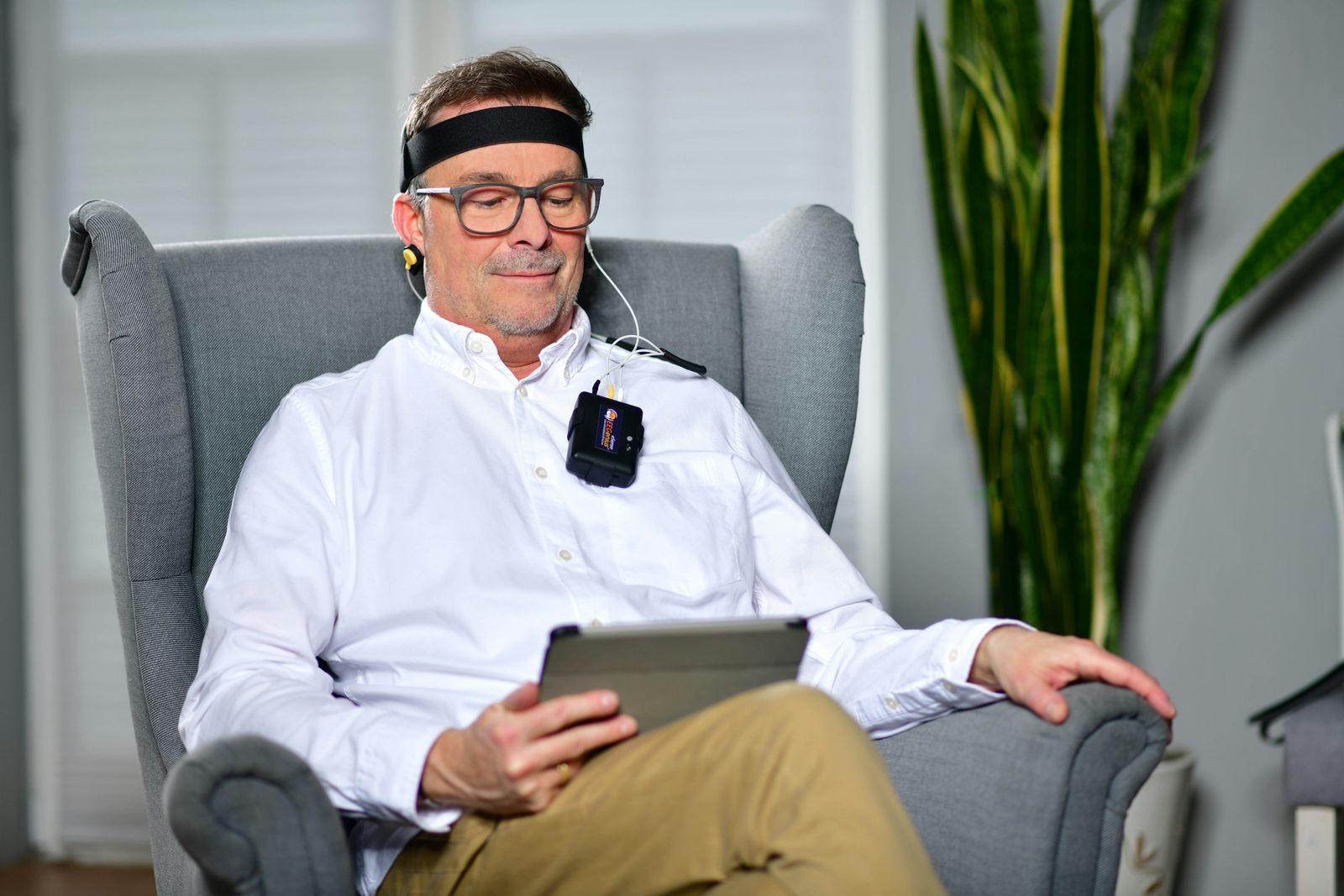
In ADHD three protocols considered standard are used most often. One lowers the ratio between slow theta waves and beta waves, another trains the sensorimotor rhythm (SMR), and the third works with slow cortical potentials (SCP).
What the favourable analyses show
- Large effects on inattention and impulsivity in a 2009 meta-analysis
- Medium to large effects for standard protocols, with remission in 32% to 47% of children
- Effects that last after 6 to 12 months
What studies with blinded raters show
- Effects that shrink a lot when raters do not know which treatment was given
- A small but significant effect for standard protocols
- Similar gains with real and with simulated training
A 2009 meta-analysis found large effects on inattention and impulsivity and a medium effect on hyperactivity. A 2020 review limited to standard protocols reported medium to large effects, remission rates between 32% and 47% and effects that hold after 6 to 12 months. And a 2019 meta-analysis of 10 studies showed that the effects on inattention not only held in the months after training but actually grew compared with control groups that received no active treatment.
The European expert group reached a more cautious conclusion. Their 2016 analysis of 13 trials and 520 children found a significant effect when parents did the rating, but not when the raters probably did not know which treatment the child had received. The 2025 analysis of 38 trials with 2,472 participants found no significant overall result with blinded raters, only a small but significant effect when standard protocols were used.
The most rigorous test so far is a double-blind US study of 144 children aged 7 to 10, who received either real theta/beta training or a simulated version that looked identical. Both groups improved a lot, but the difference between them was not significant at the end of treatment or after 13 or 25 months. At 13 months the children who had real training needed less medication, and at 25 months the difference pointed the same way without being significant any longer.
What stays with your doctor. Neurofeedback does not replace a consultation with a psychiatrist or child psychiatrist, and any change to medication is made only together with the doctor who prescribed it.
Studies have not reported adverse effects specific to neurofeedback. Some researchers consider it a well-established treatment when standard protocols are used, others ask for larger studies with blinded raters, so the decision is made case by case, knowing in advance what you can expect.
At the BrainMap Institute neurofeedback is part of the brain training programmes and starts from a qEEG assessment interpreted by Dr. Alina Diana Nemeș and Clinical Psychologist Alina Robu, and the specialist talks with you about whether it makes sense in your situation and how it fits with the treatment you already have. What the institute offers for children and adults is described on the page about ADHD treatment with neurofeedback, and for adults there is also the BrainMap assessment for adult ADHD.
What does not help with ADHD or can do harm
When you search for “natural ADHD treatment”, you quickly come across teas, drops and supplements sold as the solution. A few things are worth knowing before you spend money on them.

- Sugar does not make children hyperactive. In 1995 JAMA published a meta-analysis of 23 double-blind studies that found no effect of sugar on behaviour or attention, and the authors put parents' belief down to expectation. A small effect in some children could not be ruled out.
- Homeopathy has shown no effect. A Cochrane review of 4 studies and 168 participants found no significant effect on ADHD symptoms or on anxiety.
- CBD oil has no serious studies in ADHD. The AAP guideline says the idea of an effect rests only on anecdote.
- Diets built on IgG tests are not justified. In the INCA study the return of symptoms did not depend on IgG levels, and the authors explicitly advise against prescribing such diets.
- ADHD medication taken without a prescription or bought online is a risk, because you do not know what it contains and nobody is monitoring you.
- Stopping treatment abruptly without talking to your doctor, just because you read about an alternative.
The basic rule is simple. A product that promises to “cure” ADHD or to replace any treatment promises more than any study can show.
How to build a treatment plan with your doctor
The best plan is tailored to you and changes when your life changes. NICE asks for the plan to take into account how much the symptoms affect you by day and by night, your goals and any other related problems, and for decisions to be open to review at any time.

The plan is reviewed whenever something important changes
- Start from a clear diagnosis made by a psychiatrist or child psychiatrist, and from a list of the problems that matter most right now.
- Choose 2 or 3 concrete goals, for example homework finished without arguments or bills paid on time.
- Ask what the guidelines say for your age and what each option means in time, cost and effort.
- Write down what changes in a diary or in the questionnaires your doctor gives you, filled in by a teacher or partner too.
- Go back to your appointment at the agreed interval and decide together whether to keep, change or add something.
| Option | For whom | How strong the evidence is |
|---|---|---|
| Parent training | Preschool and school-age children | Recommended first step under 6. Helps the child's behaviour and the way parents respond |
| School support and adjustments | School-age children and adolescents | A necessary part of the plan according to the AAP. Organisational skills training shows good results |
| Cognitive behavioural therapy | Adolescents and adults | Small to medium effects, best data in adults who also take medication |
| Psychoeducation | All ages | Recommended by NICE after any diagnosis |
| Exercise | All ages | Promising in small studies, useful for health anyway |
| Sleep hygiene | Children and adults | One large study in children, modest effect on symptoms |
| Omega-3 | Children | Small or no effect, not recommended by NICE |
| Elimination diets | Carefully selected children | Only with a dietitian, no long-term data |
| Cognitive training | Children | Better performance on the exercise, limited transfer to symptoms |
| Mindfulness | Adolescents and adults | Preliminary evidence |
| Neurofeedback | Children and adults | Mixed results, better for standard protocols |
| EndeavorRx | Children and adolescents, in the US | Improves attention measured on a computer |
The table is not a prescription. It is a starting point for the conversation with your doctor, who knows your history and what has already been tried.
What do you want to discuss at your appointment? Tap what interests you
What you tap stays in your browser and is not sent anywhere.
Book a free callIf you have a child, bring the teachers' views to the appointment too. If you are an adult, you can ask a partner or a close friend to come with you, because NICE recommends that treatment discussions can include the people close to you.
When to go back to your doctor
A drug-free plan needs to be followed as closely as one with medication. Book an appointment sooner if you notice any of the signs below.

- After a few months of steady effort, the problems at school, at work or in the family have stayed the same.
- Risky behaviour appears, such as repeated accidents, serious conflicts or alcohol or drug use.
- Sadness, anxiety or irritability last and spoil your days.
- Sleep gets much worse or your child refuses to go to school.
- You want to start, stop or change a medication.
If you or your child are thinking about harming yourselves, call 112 or go to the nearest emergency department.
A good result does not mean ADHD has gone away. It means you have found the combination that gives you back control over your days, and that combination may change with age, with school or with work. If you want to understand the condition better from the ground up, read our article on what ADHD is, its symptoms, causes and diagnosis.
Would you like to talk through the options with a specialist?
Book a free 15-minute phone call with the BrainMap Institute’s specialists and find out which steps make sense in your situation.
The qEEG assessment (brain mapping) for adults with ADHD is carried out at our centers in Bucharest, Cluj-Napoca, Timișoara, Iași, Brașov, Constanța, Târgu Mureș, Bacău and Craiova. Prices are listed on our pricing page.
Frequently asked questions about ADHD treatment without medication
Can ADHD be cured?
There is no treatment after which ADHD disappears for good, but symptoms can be kept under control with the right plan, with or without medication. The plan is reviewed as a child grows or as your life changes.
Can ADHD be treated without medication?
Yes, in certain situations. For children under 6, guidelines recommend parent training as the first step, and for adults who make an informed choice not to take medication or who cannot tolerate it, NICE recommends a structured psychological intervention, for example cognitive behavioural therapy. For moderate or severe symptoms medication often remains the most effective option, and the decision is made with your doctor.
What is the treatment for ADHD in adults without medication?
The option with the best evidence is cognitive behavioural therapy adapted for ADHD, together with clear information about the condition, changes at work and at home, and regular follow-up with a doctor. The strongest results come from studies in adults who were also taking medication, so therapy works best as part of a plan.
Which supplements are recommended for ADHD?
No supplement is recommended as a treatment for ADHD. The NICE guideline says omega-3 fatty acid supplements should not be offered to treat ADHD in children, and the 2023 Cochrane review found no effect on symptoms reported by parents. For magnesium, zinc or iron, ask your doctor whether a blood test makes sense, because a supplement is justified when there is a proven deficiency.
Which sports suit children with ADHD?
Studies have mostly used aerobic exercise, meaning activity that raises the heart rate for several minutes, and yoga. The best choice is the sport your child enjoys and can do regularly, a few times a week.
Is there ADHD medication without a prescription?
There is not, because ADHD medication is dispensed only on prescription, after an assessment by a specialist doctor. Products sold over the counter as ADHD remedies are supplements or herbal preparations, and there is no evidence that they treat the condition.
Does neurofeedback work for ADHD?
Study results are mixed. Some meta-analyses have found medium effects for standard protocols that last for months, while analyses in which raters did not know which treatment a child received found small effects. If you are considering neurofeedback, discuss it with your doctor as part of a plan, alongside the recommended treatment.
Sources
- Wolraich, M.L., Hagan, J.F. Jr., Allan, C., Chan, E., Davison, D., Earls, M., et al. Clinical Practice Guideline for the Diagnosis, Evaluation, and Treatment of Attention-Deficit/Hyperactivity Disorder in Children and Adolescents. Pediatrics, 2019. [online] Available at: pubmed.ncbi.nlm.nih.gov/31570648.
- Cortese, S., Adamo, N., Del Giovane, C., Mohr-Jensen, C., Hayes, A.J., Carucci, S., et al. Comparative efficacy and tolerability of medications for attention-deficit hyperactivity disorder in children, adolescents, and adults: a systematic review and network meta-analysis. The Lancet Psychiatry, 2018. [online] Available at: pubmed.ncbi.nlm.nih.gov/30097390.
- National Institute for Health and Care Excellence. Attention deficit hyperactivity disorder: diagnosis and management (NG87). NICE, 2018, updated in 2019. [online] Available at: www.nice.org.uk/guidance/ng87.
- Sonuga-Barke, E.J., Brandeis, D., Cortese, S., Daley, D., Ferrin, M., Holtmann, M., et al. Nonpharmacological interventions for ADHD: systematic review and meta-analyses of randomized controlled trials of dietary and psychological treatments. American Journal of Psychiatry, 2013. [online] Available at: pubmed.ncbi.nlm.nih.gov/23360949.
- Rimestad, M.L., Lambek, R., Zacher Christiansen, H., Hougaard, E. Short- and Long-Term Effects of Parent Training for Preschool Children With or at Risk of ADHD: A Systematic Review and Meta-Analysis. Journal of Attention Disorders, 2019. [online] Available at: pubmed.ncbi.nlm.nih.gov/27179355.
- Daley, D., van der Oord, S., Ferrin, M., Danckaerts, M., Doepfner, M., Cortese, S., et al. Behavioral interventions in attention-deficit/hyperactivity disorder: a meta-analysis of randomized controlled trials across multiple outcome domains. Journal of the American Academy of Child and Adolescent Psychiatry, 2014. [online] Available at: pubmed.ncbi.nlm.nih.gov/25062591.
- Abikoff, H., Gallagher, R., Wells, K.C., Murray, D.W., Huang, L., Lu, F., et al. Remediating organizational functioning in children with ADHD: immediate and long-term effects from a randomized controlled trial. Journal of Consulting and Clinical Psychology, 2013. [online] Available at: pubmed.ncbi.nlm.nih.gov/22889336.
- Safren, S.A., Sprich, S., Mimiaga, M.J., Surman, C., Knouse, L., Groves, M., et al. Cognitive behavioral therapy vs relaxation with educational support for medication-treated adults with ADHD and persistent symptoms: a randomized controlled trial. JAMA, 2010. [online] Available at: pubmed.ncbi.nlm.nih.gov/20736471.
- Knouse, L.E., Teller, J., Brooks, M.A. Meta-analysis of cognitive-behavioral treatments for adult ADHD. Journal of Consulting and Clinical Psychology, 2017. [online] Available at: pubmed.ncbi.nlm.nih.gov/28504540.
- Cerrillo-Urbina, A.J., García-Hermoso, A., Sánchez-López, M., Pardo-Guijarro, M.J., Santos Gómez, J.L., Martínez-Vizcaíno, V. The effects of physical exercise in children with attention deficit hyperactivity disorder: a systematic review and meta-analysis of randomized control trials. Child: Care, Health and Development, 2015. [online] Available at: pubmed.ncbi.nlm.nih.gov/25988743.
- Faraone, S.V., Banaschewski, T., Coghill, D., Zheng, Y., Biederman, J., Bellgrove, M.A., et al. The World Federation of ADHD International Consensus Statement: 208 Evidence-based conclusions about the disorder. Neuroscience and Biobehavioral Reviews, 2021. [online] Available at: pubmed.ncbi.nlm.nih.gov/33549739.
- Hiscock, H., Sciberras, E., Mensah, F., Gerner, B., Efron, D., Khano, S., et al. Impact of a behavioural sleep intervention on symptoms and sleep in children with attention deficit hyperactivity disorder, and parental mental health: randomised controlled trial. BMJ, 2015. [online] Available at: pubmed.ncbi.nlm.nih.gov/25646809.
- Gillies, D., Leach, M.J., Perez Algorta, G. Polyunsaturated fatty acids (PUFA) for attention deficit hyperactivity disorder (ADHD) in children and adolescents. Cochrane Database of Systematic Reviews, 2023. [online] Available at: pubmed.ncbi.nlm.nih.gov/37058600.
- Pelsser, L.M., Frankena, K., Toorman, J., Savelkoul, H.F., Dubois, A.E., Pereira, R.R., et al. Effects of a restricted elimination diet on the behaviour of children with attention-deficit hyperactivity disorder (INCA study): a randomised controlled trial. The Lancet, 2011. [online] Available at: pubmed.ncbi.nlm.nih.gov/21296237.
- Cortese, S., Ferrin, M., Brandeis, D., Buitelaar, J., Daley, D., Dittmann, R.W., et al. Cognitive training for attention-deficit/hyperactivity disorder: meta-analysis of clinical and neuropsychological outcomes from randomized controlled trials. Journal of the American Academy of Child and Adolescent Psychiatry, 2015. [online] Available at: pubmed.ncbi.nlm.nih.gov/25721181.
- Cairncross, M., Miller, C.J. The Effectiveness of Mindfulness-Based Therapies for ADHD: A Meta-Analytic Review. Journal of Attention Disorders, 2020. [online] Available at: pubmed.ncbi.nlm.nih.gov/26838555.
- U.S. Food and Drug Administration. FDA Permits Marketing of First Game-Based Digital Therapeutic to Improve Attention Function in Children with ADHD. FDA, 15 June 2020. [online] Available at: www.fda.gov/news-events/press-announcements.
- Kollins, S.H., DeLoss, D.J., Cañadas, E., Lutz, J., Findling, R.L., Keefe, R.S.E., et al. A novel digital intervention for actively reducing severity of paediatric ADHD (STARS-ADHD): a randomised controlled trial. The Lancet Digital Health, 2020. [online] Available at: pubmed.ncbi.nlm.nih.gov/33334505.
- CHADD. Prescription Game-Based Therapy Approved for Adolescents with ADHD. CHADD, ADHD in the News, 2023. [online] Available at: chadd.org/adhd-in-the-news.
- Arns, M., de Ridder, S., Strehl, U., Breteler, M., Coenen, A. Efficacy of neurofeedback treatment in ADHD: the effects on inattention, impulsivity and hyperactivity: a meta-analysis. Clinical EEG and Neuroscience, 2009. [online] Available at: pubmed.ncbi.nlm.nih.gov/19715181.
- Arns, M., Clark, C.R., Trullinger, M., deBeus, R., Mack, M., Aniftos, M. Neurofeedback and Attention-Deficit/Hyperactivity-Disorder (ADHD) in Children: Rating the Evidence and Proposed Guidelines. Applied Psychophysiology and Biofeedback, 2020. [online] Available at: pubmed.ncbi.nlm.nih.gov/32206963.
- Van Doren, J., Arns, M., Heinrich, H., Vollebregt, M.A., Strehl, U., K Loo, S. Sustained effects of neurofeedback in ADHD: a systematic review and meta-analysis. European Child and Adolescent Psychiatry, 2019. [online] Available at: pubmed.ncbi.nlm.nih.gov/29445867.
- Cortese, S., Ferrin, M., Brandeis, D., Holtmann, M., Aggensteiner, P., Daley, D., et al. Neurofeedback for Attention-Deficit/Hyperactivity Disorder: Meta-Analysis of Clinical and Neuropsychological Outcomes From Randomized Controlled Trials. Journal of the American Academy of Child and Adolescent Psychiatry, 2016. [online] Available at: pubmed.ncbi.nlm.nih.gov/27238063.
- Westwood, S.J., Aggensteiner, P.M., Kaiser, A., Nagy, P., Donno, F., Merkl, D., et al. Neurofeedback for Attention-Deficit/Hyperactivity Disorder: A Systematic Review and Meta-Analysis. JAMA Psychiatry, 2025. [online] Available at: pubmed.ncbi.nlm.nih.gov/39661381.
- Neurofeedback Collaborative Group. Double-Blind Placebo-Controlled Randomized Clinical Trial of Neurofeedback for Attention-Deficit/Hyperactivity Disorder With 13-Month Follow-up. Journal of the American Academy of Child and Adolescent Psychiatry, 2021. [online] Available at: pubmed.ncbi.nlm.nih.gov/32853703.
- Neurofeedback Collaborative Group. Neurofeedback for Attention-Deficit/Hyperactivity Disorder: 25-Month Follow-up of Double-Blind Randomized Controlled Trial. Journal of the American Academy of Child and Adolescent Psychiatry, 2023. [online] Available at: pubmed.ncbi.nlm.nih.gov/36521694.
- Wolraich, M.L., Wilson, D.B., White, J.W. The effect of sugar on behavior or cognition in children. A meta-analysis. JAMA, 1995. [online] Available at: pubmed.ncbi.nlm.nih.gov/7474248.
- Coulter, M.K., Dean, M.E. Homeopathy for attention deficit/hyperactivity disorder or hyperkinetic disorder. Cochrane Database of Systematic Reviews, 2007. [online] Available at: pubmed.ncbi.nlm.nih.gov/17943868.