
Dyslexia: signs, causes and solutions
Is your child reversing letters or struggling to read? See the signs of dyslexia by age, what really causes it and the methods that actually work.
What dyslexia is
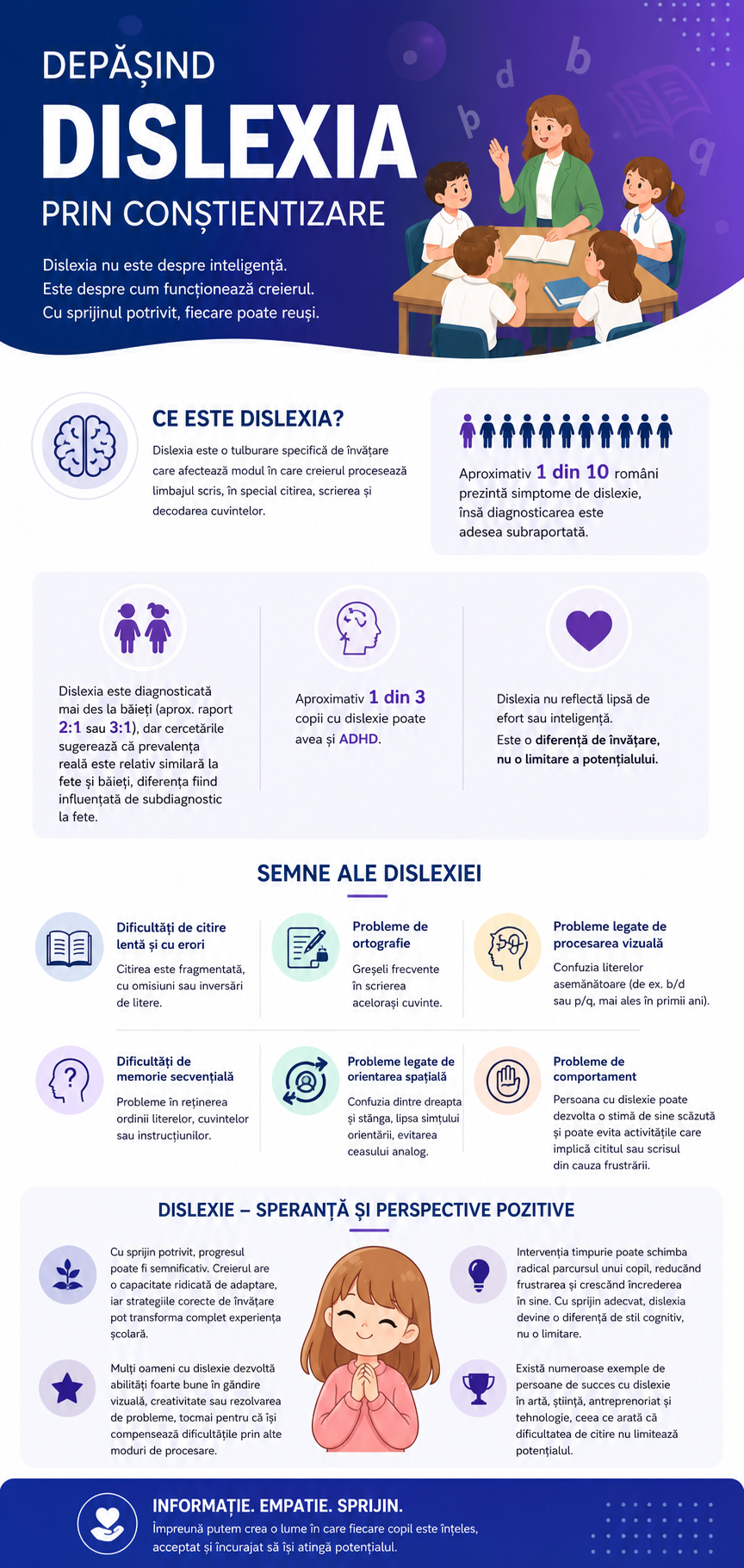
Dyslexia is a specific learning disorder that mainly affects the processing of written language, without being related to a person's general level of intelligence. People with dyslexia have difficulty recognising written words quickly and automatically, which makes reading slower, more tiring and sometimes inaccurate. These difficulties arise from the way the brain processes the sounds of language (phonology) and associates them with graphic symbols (letters), which leads to a less efficient connection between speech and writing.
As far as reading is concerned, dyslexia manifests itself through difficulties in decoding words, reversed letters, omissions or substitutions of sounds and a greater need for effort in order to understand a text. Even with practice, reading can remain slower than average, because the processing does not become automatic in the same way as in people without dyslexia. In some cases, overall comprehension of the text can be good, but it is affected by the slow pace and by the increased cognitive effort needed to decipher each word.
Writing is also significantly affected. People with dyslexia can have difficulties with spelling, can make frequent writing mistakes and can omit or reverse letters within words. This does not reflect a lack of knowledge, but difficulties in automating phonological and spelling rules. Oral expression is often far more fluent than written expression, which can create an imbalance between what the person thinks or says and what they manage to put down in writing.
From the perspective of language processing, dyslexia involves difficulty in analysing and manipulating the sounds within words, which affects both reading and writing. The brain processes linguistic information in a different way, requiring more time and more effort to carry out tasks involving letters, sounds and word structure. This can also influence the learning of foreign languages or the memorising of new words, although with appropriate strategies these abilities can develop significantly.
An essential and often misunderstood aspect is that dyslexia is not associated with low intelligence. On the contrary, many people with dyslexia have normal or even above-average intelligence and can excel in fields that do not depend exclusively on reading and writing, such as creative thinking, problem solving, visuospatial reasoning or innovation. Their difficulties are specific to the processing of written language, not to their general capacity to learn or think, which is why appropriate educational support is essential for making the most of their real potential.
How to recognise dyslexia in children
The preschool period
In the preschool period, dyslexia does not show up through reading as such, but through early signs related to the development of language and sound processing. Children can have difficulty learning rhymes, recognising the sounds within words or correctly repeating longer words. There may also be delays in speech development, a poorer vocabulary than that of children of the same age or difficulties in forming sentences. Another important sign is frequent confusion between similar sounds or difficulty in learning the alphabet and the names of the letters. These manifestations are not enough for a diagnosis, but they can indicate an increased risk and the need for an early assessment.
The school period
In the school period, dyslexia becomes more obvious once reading and writing are introduced. Children may read slowly, syllable by syllable, with a lot of hesitation, and may have difficulty recognising words automatically. Reading mistakes include reversed letters, omissions or substitutions, and comprehension of the text can be affected by the great effort put into decoding. In writing, persistent spelling mistakes frequently appear, even in simple words, as well as difficulties in organising ideas in writing. Although they can learn the rules, they apply them inconsistently. By contrast, many children with dyslexia can express themselves well orally and have normal or above-average intelligence, which makes their difficulties seem at times "inexplicable" in relation to their overall performance.
The causes of dyslexia
Dyslexia has a neurobiological and genetic basis, which means that it is not caused by educational factors or by a lack of intelligence. Research shows differences in the way the brain processes written language, especially in the connections between the areas responsible for phonological processing and those involved in the visual recognition of words. These differences result in slower automation of reading and writing, even though learning is possible through adapted methods.
Genetic factors
There is a significant hereditary component in dyslexia, which means it appears more often in families where one of the parents or a close relative has similar reading or writing difficulties. The genes involved do not cause dyslexia directly; they influence the way the neural circuits responsible for language develop. This genetic predisposition can affect phonological processing and how quickly reading becomes automatic, but whether it shows up also depends on environmental and educational factors. Dyslexia also often appears together with ADHD - about one child in three with dyslexia also has attention deficit symptoms, which is why the two should be assessed together.
Neurological factors
At brain level, dyslexia is associated with differences in the activation and connectivity of certain regions involved in language, especially in the left hemisphere. The areas responsible for phonological decoding and rapid word recognition work differently compared with people without dyslexia. This leads to a slower and less automated reading process. It is not a matter of a brain "lesion", but of a different organisation of the neural networks involved in language.
Language development factors
Delays in early language development can be a risk factor for dyslexia. Children who have had difficulties with speech, with learning new words or with processing the sounds of language can later have difficulty learning to read. These early problems often indicate weaker phonological processing, which underlies many of the difficulties specific to dyslexia.
Specific cognitive factors (phonological processing)
A central factor in dyslexia is difficulty with phonological processing, that is, the ability to identify, distinguish and manipulate the sounds within words. This function is essential for learning to read, because letters have to be correctly associated with the corresponding sounds. When this processing is slower or inefficient, difficulties in decoding words appear, even if general intelligence is normal or above average.
Educational and environmental risk factors
Although dyslexia is not caused by the environment, certain conditions can accentuate the difficulties. A lack of early intervention, rigid or unadapted educational methods and the absence of specialist support can make the difficulties more visible and harder to compensate for. Early intervention and adapted educational strategies, on the other hand, can significantly reduce the impact of dyslexia on school performance and self-confidence.
How it affects the child's life
Dyslexia can significantly influence a child's school experience, especially since reading and writing are fundamental to most subjects. The child may put in far greater effort than their classmates in order to complete the same tasks, which frequently leads to cognitive fatigue and frustration. Homework can take much longer, and written assessments become a source of stress. Over time, this imbalance between effort and result can make school feel like a difficult or even threatening environment, even when the child's level of intelligence is normal or above average.
Beyond the academic side, dyslexia can also affect a child's emotional and social life. Repeated difficulties with reading and writing can lead to constant comparisons with other children, which encourages feelings of inferiority or shame. A child who cannot read "as well as" the others may avoid reading aloud, taking part in school activities or even answering in class. In some cases, performance anxiety, frustration or social withdrawal can appear, especially if the difficulties are not properly understood by adults or are wrongly interpreted as a lack of effort.
In everyday life, the impact of dyslexia extends beyond school as well, influencing the way the child perceives learning in general. Seemingly simple activities, such as reading instructions, letter-based games or writing messages, can become challenging. Even so, many children with dyslexia develop strong compensatory skills, such as creativity, visual thinking or intuitive problem solving. If they are properly supported, they can develop harmoniously, but without support, repeated negative experiences can have a negative influence on how they perceive their own competence.
Why early diagnosis is important
Early diagnosis of dyslexia is essential because it makes it possible to intervene before the difficulties turn into repeated school failures and secondary emotional problems. When a child is identified early, adapted educational strategies can be put in place, such as multisensory learning methods, exercises for developing phonological awareness and individualised support. This significantly reduces frustration and helps the child build confidence in their own abilities. Without a diagnosis, the child risks being wrongly labelled "lazy" or "inattentive", which can deeply affect their self-esteem and their motivation to learn.
A correct diagnosis also helps prevent long-term emotional effects. Children who do not understand why they are struggling can develop anxiety, school avoidance or even mild depression over time. Understanding that their difficulties have a specific, neurological cause and are not a matter of intelligence, on the other hand, often brings relief and clarity. This allows a healthier relationship with the learning process and reduces the psychological pressure associated with school performance.
Treatment for dyslexia
Treatment for dyslexia does not mean a "cure" in the classic sense, but rather a process of educational and therapeutic intervention through which the child learns effective compensation strategies and develops their reading and writing skills in a way adapted to how they process information. The earlier the intervention begins and the better it is adapted to the child's individual profile, the more effective it is. There is no single universally valid method, because dyslexia manifests itself differently from one person to another, which is why personalising the intervention is essential for real and sustainable progress.
A central element in the treatment of dyslexia is structured educational intervention based on multisensory methods. These involve the simultaneous use of several learning channels - visual, auditory and kinaesthetic - in order to strengthen the link between sounds and letters. Phonological programmes, decoding exercises, guided and repeated reading, as well as training awareness of the sounds within words, are essential tools. These methods help the brain build new neural pathways, gradually making reading more automatic and reducing the cognitive effort required.
Personalised support plays a fundamental role in how effective the intervention is, because every child with dyslexia has a unique profile of difficulties and strengths. Some children have greater difficulty with decoding, others with fluency or spelling, and the intervention plan has to be adapted accordingly. Continuous assessment and the adjustment of strategies are essential for progress. In addition, the use of assistive technology, such as reading software or voice dictation, can support the learning process and reduce frustration in school tasks.
The role of the family is essential in the treatment of dyslexia, because the home environment strongly influences the child's motivation and confidence. Parents can help by creating a positive environment, free of excessive pressure, in which mistakes are seen as a normal part of learning. Reading together, encouraging progress, even small progress, and avoiding comparisons with other children all contribute significantly to developing a healthy attitude towards learning. At the same time, informing parents about the nature of dyslexia is crucial in order to avoid misinterpretations of the child's difficulties.
Teachers also have a decisive role in supporting a child with dyslexia. Educational adjustments, such as extra time in tests, oral instead of written assessments or adapted materials, can significantly reduce academic pressure. In addition, teachers can help raise the child's self-esteem through encouragement, constructive feedback and the recognition of strengths, not only difficulties. Close collaboration between family, teachers and specialists (psychologists, speech therapists) creates a coherent support system that maximises the chances of progress and helps the child make the most of their real potential, beyond the difficulties related to reading and writing.
Neurofeedback in dyslexia
Neurofeedback is a method of training brain activity that uses real-time feedback to help the brain regulate certain patterns of functioning more efficiently. In the context of dyslexia, the interest in neurofeedback comes from observations that some people show differences in the way the brain networks involved in language processing, attention and visual-verbal coordination work. By monitoring brain electrical activity (EEG) and providing visual or auditory feedback, the brain is encouraged to optimise its activity over time, which can support the processes needed for reading and writing.
In dyslexia, the difficulties are not a matter of intelligence, but of the way the brain processes written and phonological language. Neurofeedback does not "cure" dyslexia, but it can be used as a complementary tool for improving attention, self-regulation and the efficiency of information processing. Some protocols aim to reduce attentional instability or to optimise the brain rhythms associated with concentration, which can indirectly support the acquisition of written language.
An important aspect is integrating neurofeedback into a comprehensive therapeutic plan that includes speech therapy and structured educational intervention. Speech therapy remains the central element in dyslexia, because it works directly on phonological awareness, decoding, fluency and text comprehension. Neurofeedback can act as support, helping the child to be more receptive during speech therapy sessions and to keep their attention on learning tasks more easily.
For optimal results, the intervention has to be personalised, according to the child's cognitive profile, the neuropsychological assessment and the specific processing difficulties. Collaboration between the psychologist, the speech therapist, the teacher and the family is essential, because each of them contributes to consolidating progress. In this context, neurofeedback becomes a complementary tool within an integrated approach, not an isolated solution, supporting the development of learning skills and long-term adaptation at school.
If you want to understand the situation more clearly and find out what kind of support is suitable, you can fill in the contact form to book a talk with a specialist.
Together we will look at your needs or your child's needs and establish the right steps, in a structured and personalised way.
Do you want to understand what is happening in your brain?
Book a talk with the specialists of the BrainMap Institute and find out how a BrainMap and brain training can help you.