
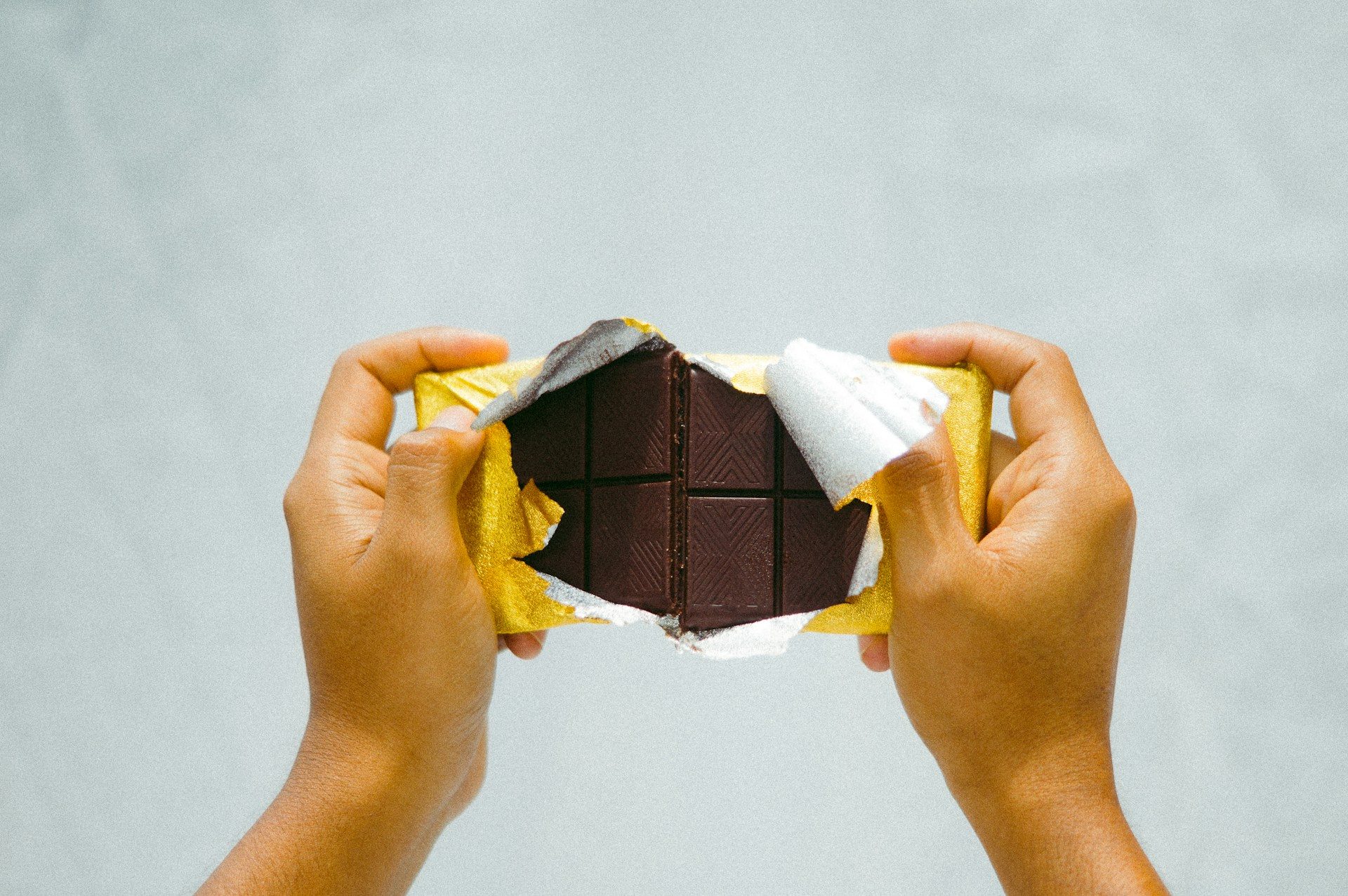
You walk past the chocolate on the desk and your hand reaches for it on its own, and you would say it is a matter of willpower. The people around you call it a craving, as if it were a whim. Things are a bit more complicated than that. They are worth telling one at a time.
A team of researchers in California ran a simple experiment, published in 2019. They took adolescents who drank at least 3 sweetened drinks a day and asked them to give them up for 3 days, with no other change. What the participants reported sounds familiar: headaches, an increasingly pressing craving for sweets, no desire to do anything and a concentration that kept slipping away from them. Anyone who has ever tried to go 3 days without sugar recognizes the list. Irritability on day 1. A heavy head and mental fog on day 2. And on day 3, the thought of sweets comes back on its own, like a toxic ex you know is bad for you, but your mind still goes there.
That is roughly how smokers describe their first days without a cigarette. The comparison has to be taken exactly that way, as a similarity of symptoms, not as proof that it is the same thing, because the mechanisms behind them are different. The practical difference lies elsewhere. Nobody puts warning labels on a croissant.
Sugar is everywhere. In bread, in sauces, in yogurt, in “natural” juice, in “healthy” cereals. A Romanian consumes, according to press estimates, around 30 kilograms a year, roughly double the European average, which means over 80 grams a day. The World Health Organization recommends under 50 grams of free sugars a day and says that under 25 would be even better. The brain you came into the world with was built for fruit from the tree and for honey found by chance. It wasn't built for this.
The rats that chose sweetness over cocaine
The most widely shared study on the subject is from 2007 and comes from a team in Bordeaux, which had rats choose, at each trial, between a sip of sweetened water and a dose of cocaine injected directly into a vein. 9 out of 10 chose the sweet water. The preference stayed the same even in animals that had already been exposed to cocaine. The detail that usually gets lost is that the water was sweetened with saccharin, which has no calories at all, so the brain was not responding to energy, but to the sweet taste itself.
From here came the headline that travels all over the internet, that sugar is supposedly “8 times more addictive than cocaine”. The study says no such thing anywhere. It says that, for a rat, an intense sweet taste beats cocaine as a reward, which is disturbing enough even without invented numbers.
Around the same time, a team at Princeton showed what happens to rats that get sugar for only a few hours a day, after periods without it. They end up eating in bouts. They seek out the sugar insistently. When their access is cut off, they show signs of withdrawal. The key word is “intermittent”: the loop appeared in the animals that alternated deprivation with excess, not in those with unlimited sugar all the time. If you recognize yourself in the pattern “good all week, chaos at the weekend”, this is exactly what it is about.
Now the part that internet articles skip. In 2016, a team from Cambridge went through all the literature, in animals and in humans, and concluded that the evidence for a “sugar addiction” in humans is thin and that the term is premature. In humans, the behaviors that resemble addiction appear rather around eating in general and around highly processed foods, not around sugar taken on its own. So yes, sweet taste pulls hard on the reward circuit, like any natural pleasure. But “sugar addict” is not a diagnosis. Anyone who gives it to you with certainty is selling something. We describe the same reward loop in the article on alcohol addiction, where the evidence, however, is entirely different.
The spike and the crash
What can be said with good grounds is the mechanism behind the craving. It is less spectacular than the drug metaphor and much more useful.
The refined sugar in today's foods is nothing like the fruit your great-grandparents got their sweetness from: it is concentrated, without fiber to slow it down, and it reaches the blood within minutes. What follows is a blood sugar spike and a matching insulin response. Then comes the drop, fast, sometimes below the level you started from. The brain, which feeds almost exclusively on glucose, reads that drop as an emergency and asks for fuel by the shortest route, that is, something sweet. At 4 in the afternoon, in front of the vending machine at the office, this is exactly what is happening.
Learning settles on top of this. Every quick fix for a craving is remembered by the reward system, and the brain also memorizes the context: the place, the time, the state you were in, even the emotion just before. From that moment on, you no longer need to be hungry to want chocolate. It is enough for it to be 4 o'clock.
The army in your gut
There is one more hypothesis, less often mentioned, that deserves to be told with all due caution. In 2014, 3 American researchers published an article with an uncomfortable question: could the bacteria in our gut be influencing our food choices in their own interest? The reasoning behind the question is evolutionary. Bacteria that feed on simple sugars thrive when we eat sweets, and they have at their disposal a direct channel to the brain, the vagus nerve, plus a few molecules that can change mood.
The image of a microscopic army lobbying for sweets is tempting and probably holds some truth. For now it remains a hypothesis with plausible mechanisms, not a conclusion demonstrated in humans. We mention it for 2 reasons. It explains why, for some people, the craving seems to come “from the stomach”. And it links the subject to something that can be measured and trained: the way the gut communicates with the brain, through the vagus nerve.
What a brain map shows
A brain map does not diagnose “sugar addiction”, because, as we have already said, no such diagnosis exists. The investigation records the electrical activity of the brain at rest, with the eyes closed and then open, and compares it with a normative database by age.
In someone who recognizes themselves in the lines above, the comparison usually brings a few things to light. The first is the background level of activation. A brain that stays on alert a little longer than it should looks more often for quick calming, and something sweet is the closest thing at hand. The second is what happens to attention during the recording, because attention fatigue and the afternoon craving often go together. The third is the reported sleep pattern, set next to the measured activity. After a short night, the craving for sweets is stronger the next day, as almost everyone has probably noticed firsthand.
These measurements don't say who you are or how much willpower you have. They describe the state your brain is in on that day, and nothing more. If you want to see concretely what it involves, we have described the BrainMap investigation in detail.
What training can do and where it stops
At the BrainMap Institute we don't give diets and we aren't nutritionists. What we work on is regulation. That is, how quickly the brain comes out of alert, how well you sleep and how hard 4 o'clock knocks you off balance. These are things that can be measured, trained and measured again at intervals, with the same method.
The training has a few components, and the plan is made according to the map, not according to a recipe. Neurofeedback trains the prefrontal areas, the ones involved in delaying an impulse, to work more steadily, and for compulsive eating there is a 2016 randomized study in women with binge eating episodes. Neurofeedback reduced the episodes more than a guided imagery technique with the same number of sessions. It is a promising result, in a small group. Its authors describe it as an addition to treatment, not as the treatment itself, and that is how we describe it too.
Vagal stimulation works on the gut-brain axis mentioned above, with gentle impulses, through an ear or neck device. The aim is for the nervous system to come out of “alert mode” more easily, and for satiety signals to no longer be drowned out by noise. At-home audio training, with binaural frequencies, is the daily routine between sessions. A few minutes with headphones on, during which the brain practices settling into slow rhythms. A lot is written online about serotonin and the “chemistry of happiness”. We stick to what we can measure before and after.
And now, where training stops. If the craving for sweets comes with episodes in which you eat a lot and fast, followed by shame, the subject is a different one. It is called an eating disorder, and the main path there is psychotherapy, with us alongside it, not instead of it. We have described the 5 eating disorders and their signs separately. If you have high blood sugar, diabetes in the family or you take medication, the first person you talk to is your doctor. What you put on your plate remains the job of a dietitian. Brain training is added on top of all this, never in place of it.
References
- Falbe, J. et al. Potentially addictive properties of sugar-sweetened beverages among adolescents. Appetite, 2019. [online] Available at: pubmed.ncbi.nlm.nih.gov/30385262.
- Lenoir, M., Serre, F., Cantin, L., Ahmed, S.H. Intense Sweetness Surpasses Cocaine Reward. PLoS ONE, 2007. [online] Available at: journals.plos.org/plosone/article?id=10.1371/journal.pone.0000698.
- Avena, N.M., Rada, P., Hoebel, B.G. Evidence for sugar addiction: behavioral and neurochemical effects of intermittent, excessive sugar intake. Neuroscience & Biobehavioral Reviews, 2008. [online] Available at: pmc.ncbi.nlm.nih.gov/articles/PMC2235907.
- Westwater, M.L., Fletcher, P.C., Ziauddeen, H. Sugar addiction: the state of the science. European Journal of Nutrition, 2016. [online] Available at: pmc.ncbi.nlm.nih.gov/articles/PMC5174153.
- Alcock, J., Maley, C.C., Aktipis, C.A. Is eating behavior manipulated by the gastrointestinal microbiota? Evolutionary pressures and potential mechanisms. BioEssays, 2014. [online] Available at: onlinelibrary.wiley.com/doi/10.1002/bies.201400071.
- Schmidt, J., Martin, A. Neurofeedback against binge eating: a randomized controlled trial in a female subclinical threshold sample. European Eating Disorders Review, 2016. [online] Available at: onlinelibrary.wiley.com/doi/10.1002/erv.2453.
- World Health Organization Guideline: Sugars intake for adults and children. WHO, 2015. [online] Available at: who.int/publications/i/item/9789241549028.
- Digi24 Românii, cei mai mari consumatori de zahăr din Europa. digi24.ro, 2019. [online] Available at: digi24.ro/stiri/actualitate/sanatate/romanii-cei-mai-mari-consumatori-de-zahar-din-europa-cu-ce-consecinte-1008320.
What the first step looks like
Come for an assessment, and that is all you commit to. We show you what your brain activity looks like, which areas are on alert and where the imbalance is. Then we decide together whether a plan makes sense and what it would look like. The recording takes 14 minutes and doesn't hurt.
Write to us at office@institutulbrainmap.ro or on WhatsApp at 0770 390 190.
The sweetness of life doesn't come from a wrapper. It comes from a brain that works in balance.
Frequently asked questions
Does sugar addiction exist as a diagnosis?
There is no “sugar addiction” in the diagnostic manuals. The researchers who reviewed the literature, in 2016, concluded that the evidence in humans is insufficient for this term. What does exist, and is treated, are eating disorders. A strong craving for sweets can be a sign of one of them or, more often, a learned habit kept going by stress and too little sleep.
Why do I get a headache when I give up sweets?
The most likely explanation is blood sugar dropping to a level the brain is no longer used to, and for many people there is also the missing caffeine from the sweetened drinks they cut out along with the sugar. The symptoms described in studies, headaches, irritability, poorer concentration, appear in the first days and then ease. If you have diabetes or take medication, make the changes together with your doctor.
Will brain training make me stop wanting sweets?
Training works on regulation, that is, on how quickly the brain comes out of alert and how well you sleep, and the craving for sweets is often linked to both. Results differ from person to person. They are measured before and after, with the same method. What you eat remains up to you and your dietitian, because training is added on, it does not replace.
Is dark chocolate any different?
Chocolate with over 70% cocoa has less sugar and a more bitter taste, which satisfies more quickly, so for many people it is an option that is easier to keep under control. It is still chocolate, after all. The mechanism in the article, a spike followed by a crash, is gentler, not absent.