
Neurofeedback therapy in the treatment of anxiety
Neurofeedback in the treatment of anxiety - an effective and natural method of regulating brain activity and reducing anxiety symptoms.

Anxiety is an increasingly common disorder, showing itself through persistent states of fear, restlessness and tension, which can significantly affect everyday life. In the context of the advances in neuroscience, the science that studies the brain and the nervous system, new treatment methods appear, more precise and more personalised.
One of them is Neurofeedback therapy, a non-invasive technique that uses the monitoring of brain activity in order to help the brain regulate its responses better. By training the brainwaves, people with anxiety can learn to control their emotions more effectively, gradually reducing the symptoms. Below we will discover how Neurofeedback works and what role it can play in the treatment of anxiety.
What is neuroscience?
Neuroscience is the science that studies the structure, the function and the development of the nervous system, especially of the brain. It is an interdisciplinary field that combines biology, psychology, chemistry, physics and technology in order to understand how we think, how we feel, how we behave and how mental disorders appear. Neuroscience is the basis of many modern therapies and it gives us a deeper understanding of the way the brain influences mental and emotional health.
What is neurofeedback therapy?
Neurofeedback is a form of therapy based on the self-regulation of brain activity. It is a non-invasive method that uses the electroencephalogram (EEG) in order to monitor brainwaves and to provide feedback in real time.
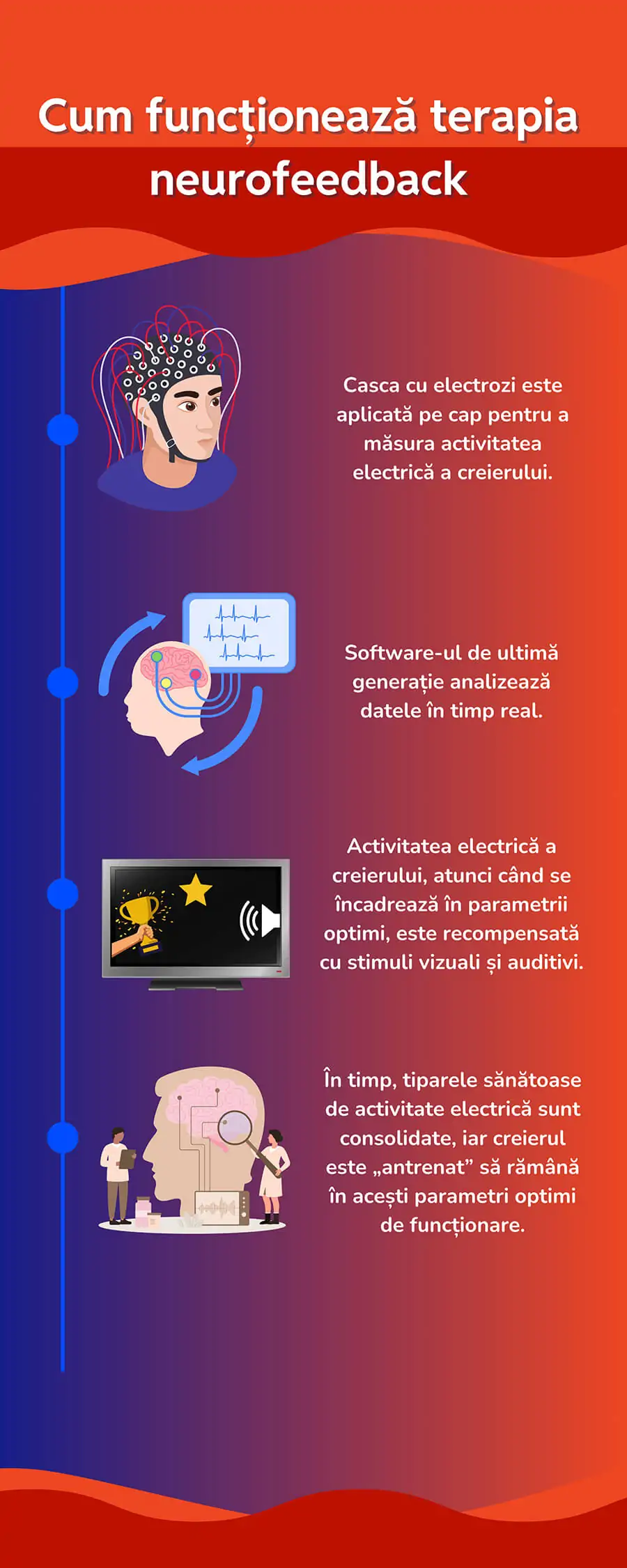
How does it work?
- Electrodes placed on the scalp measure brain activity.
- Software translates these signals in real time (visual, tactile or auditory stimuli).
- The brain learns, through conditioning, to regulate its brainwaves.
What is brain training?
Brain training is an advanced form of neurofeedback that integrates additional technologies in order to increase the effectiveness of the therapy. The additional components are:
1. Photobiomodulation (PBM)
- The controlled exposure of the brain to red or infrared light.
- It stimulates the mitochondria and increases the production of ATP (cellular energy).
- It can improve brain circulation and neuronal plasticity and it reduces inflammation.
2. Heart-brain coherence
- The measurement and the regulation of heart rate variability (HRV).
- It promotes coherence between the autonomic nervous system and brain activity.
- It induces a state of calm, clarity and emotional balance.
Differences between Neurofeedback and Brain training
| Simple Neurofeedback | Brain training | |
|---|---|---|
| Basis | EEG and feedback in real time | EEG + feedback in real time + additional technologies |
| Method | Training the brainwaves | Brain training + mitochondrial activation + HRV regulation |
| Objective | Regulating brain activity | Brain regulation + energy balance + autonomic balance |
| Benefits | Treating a wide range of conditions, improving performance | Faster results, greater emotional and physiological depth |
How does brain training therapy work in the treatment of anxiety?
In anxiety, the brain often works in a state of imbalance: hyperactivity in areas such as the prefrontal cortex or the amygdala, and difficulties with self-regulation.
Brain training therapy acts on several levels:
- Neurofeedback helps the brain “learn” a new way of functioning, through exercises based on feedback in real time.
- Photobiomodulation supports neuronal regeneration and reduces the brain inflammation that is often present in anxiety disorders.
- Heart-brain coherence training (HRV) calms the autonomic nervous system, reducing the state of “continuous alert” typical of anxiety.
What is a BrainMap (the map of the brain) and why is it needed?
Before the therapy starts, a BrainMapis carried out, which is a detailed map of the electrical activity of the brain, obtained through a multi-channel electroencephalogram (EEG). It allows the identification of:
- Imbalances between the hemispheres
- The area or the areas that are hyperactive or underactive
- The predominant type of brainwaves (e.g. beta, theta, alpha)
Why is it important?
The BrainMap offers an objective picture of the way each patient’s brain works, which allows:
- The precise personalisation of the therapy
- The choice of the suitable neurofeedback protocols
- The monitoring of progress over time
In this way, the BrainMap turns the therapy from a generic process into a personalised and effective treatment. Find out more about this assessment from our specialists.
The advantages of treating anxiety through neurofeedback
- 🧠 Natural regulation of the brain
- Anxiety decreases through neuronal self-regulation, without chemical intervention.
- 💊 No medication and no medication
- A non-invasive alternative for those who do not tolerate or do not want medication.
- 📊 Personalisation based on the BrainMap
- The treatment is adapted exactly to the brain pattern of each patient.
- 🔄 Lasting results
- The brain learns to work in a balanced way in the long term, not only for as long as the therapy lasts.
- 🌿 Non-invasive and comfortable
- It involves no pain, no medical procedures and no major discomfort.
- 🕒 Visible effects in a short time
- Many patients notice improvements after 8-10 sessions.
- 🌟 Multiple improvements
- Besides the reduction in anxiety, beneficial effects can also appear in sleep, concentration, mood and energy.
- 👨⚕️ It can be combined with other therapies
- Compatible with psychotherapy, medication and complementary therapies for a synergistic effect.
Neurofeedback vs. other treatment methods for anxiety
| Method | Description | Advantages | Limitations |
|---|---|---|---|
| Neurofeedback | Training brain activity through EEG feedback for self-regulation | • Non-invasive, without medication • Personalised through the BrainMap • Lasting results • It also improves other functions, treats other possible conditions and increases performance | • It requires multiple sessions • Available in specialised centres |
| Psychotherapy (e.g. CBT) | Therapy through talking and cognitive behavioural techniques | • It teaches coping strategies • Without pain | • It requires motivation, involvement, openness and time • Variable response between people |
| Medication (e.g. anxiolytics, antidepressants) | It changes brain chemistry in order to reduce the symptoms | • Fast effect • Easily accessible | • Possible side effects • It does not treat the cause • Risk of dependence in some cases |
| Physical exercise | Regular physical activity that reduces stress and regulates the brain neurochemically | • Benefits for general health • It increases endorphins | • It does not directly address the mental causes • It requires discipline |
The complications of leaving an anxiety disorder untreated
An untreated anxiety disorder does not go away on its own and can lead in time to a deep deterioration of physical and mental health and of quality of life. Here are the main consequences:
Psychological and emotional complications
- Depression
Chronic anxiety can develop into depression, especially when the person feels that they no longer have control over their own life. - Sleep disturbances
Insomnia, frequent waking, shallow sleep, all of which worsen tiredness and irritability. - A drop in self-esteem
The person starts to perceive themselves as “helpless” or “faulty”, which leads to social withdrawal. - Isolation
The fear of judgement or emotional overload leads to avoiding relationships and usual activities. - Concentration and performance difficulties
It affects professional and educational life, by reducing the ability to concentrate and to make decisions. - An increased risk of substance use
Some people resort to alcohol, nicotine or other substances in order to “calm” the symptoms.
Physiological (somatic) complications
- Cardiovascular disorders
Chronic anxiety overloads the autonomic nervous system, increasing the risk of high blood pressure, palpitations and heart conditions. - Effects on the digestive system
Disorders such as irritable bowel, nausea, gastritis or ulcers can be worsened or triggered by prolonged stress. - Lowered immunity
Chronic stress affects the immune response, increasing the risk of infections and slowing down healing. - Hormonal imbalances
The disruption of the hypothalamic-pituitary-adrenal (HPA) axis leads to endocrine dysfunction, chronic tiredness or menstrual disorders. - Chronic muscle tension and pain
Those with untreated anxiety can frequently suffer from headaches, neck pain, back pain or a clenched jaw.
Ignoring anxiety does not make it go away. On the contrary, in time it gets worse and can deeply affect the whole body and everyday functioning. Early intervention is the key to an effective and lasting recovery. Contact us now to talk to a specialist.
Do you want to understand what is happening in your brain?
Book a conversation with the specialists of the BrainMap Institute and find out how a BrainMap and brain training can help you.