
5 Truths About Depression That People Find Out Too Late

Depression is one of those problems almost everyone has heard about, but which many people only come to understand after it has already affected their life far too much.
For some it feels like a heavy, oppressive sadness. For others it shows up more subtly: a tiredness that seems to stick to the body, no drive, irritability, disrupted sleep, isolation, the feeling of living on autopilot or difficulty doing things that used to come naturally.
Below you will find 5 rarely discussed truths about depression, which many people find out late, after months or even years lived without clarity about this condition.
1. Roughly 6 in 10 people with depression do not know they have it
A study published in BMJ Public Health estimates that 64% of people with clinical signs of depression are undiagnosed. In other words, more than 6 in 10 people who show signs of depression live without knowing exactly what is happening to them.
And it makes sense, because depression can feel in many different ways, and most of them are easily mistaken for things that seem normal in everyday life: tiredness after a busy period, a lack of drive blamed on stress, irritability for no obvious reason, sleeping too much or too little, a foggy mind or the feeling that all the ordinary things have gradually become too heavy to carry.
That is why functional depression is so hard to spot. You can seem present on the outside, while on the inside you fight a constant battle with lack of energy, lack of meaning, repetitive thoughts and the effort of appearing fine.
2. Depression appears in children too and is more common than you think
Depression also appears in children, including at ages where many parents think rather of “fussiness”, “tantrums”, “laziness”, “shyness” or “difficult behaviour”.
CDC data show that 4% of children between 3 and 17 years old have diagnosed depression. It is a condition many parents find harder to consider when it comes to children, so a great many can remain undiagnosed in childhood.
That is because, in children, depression looks different from depression in adults. An adult can describe the inner emptiness, the lack of motivation or the loss of joy more clearly, whereas a child finds it much harder to understand these states and to put them into words.
Instead, a child may cry more often, may become irritable, may refuse to go to school, may say their tummy or head hurts, may sleep badly, may avoid other children, may lose interest in play, may do worse at school or may seem “difficult”, when in fact they are overwhelmed.
The clinical literature on depression in children often mentions irritability, social withdrawal, sleep problems and a drop in school performance, but also some physical symptoms, such as stomach aches or headaches.
3. There are “tests” for depression that show you exactly what causes it in the brain
When we hear the word “tests”, we usually think of blood, hormones, vitamins, inflammation or laboratory work. In depression we are talking about a different kind of investigation: an assessment of brain activity.
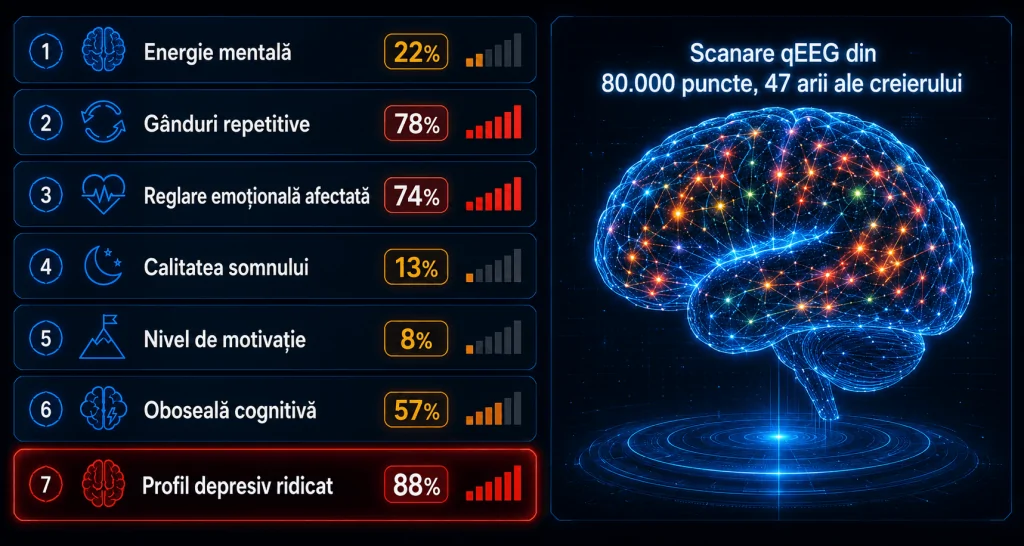
It is called Brain Mapping and it is a qEEG scan that measures the electrical activity of the brain. It is the most precise way to see depression in the brain as something visible, mapped out in data.
When you go to a therapist, they look at your emotions, your thoughts and your life patterns in order to identify the signs of possible depression. At the psychiatrist you are assessed through specific tests and questionnaires, on the basis of which a possible diagnosis is established.
Brain Mapping does not guess and does not assume: it shows you exactly which brain networks are working out of balance, reveals the cause behind your states and tells you precisely how and where to intervene in order to address the problem at its source.
In Romania, you can have this scan done at our institute, where the most advanced Brain Mapping in Europe is used. Our team has so far worked with more than 20,000 patients with depression, anxiety, ADHD, autism, insomnia, burnout and other neuropsychological difficulties.
It also offers free consultations with the institute's specialists for anyone who needs more clarity before booking the BrainMap scan.
4. Untreated depression comes back on average 6 times in a lifetime
Many people believe depression is an isolated episode: it appears, it passes, and then life goes on.
In reality, this condition is recurrent by nature. The specialist literature says that, over a lifetime, the average number of major depressive episodes ranges between 4 and 8. Put simply, we are talking about an average of roughly 6 episodes over a lifetime.
Other clinical sources show the same thing: major depression is a recurrent condition and the risk of it returning grows after each episode. StatPearls mentions a recurrence rate of roughly 50% after the first episode, 70% after the second and 90% after the third.
This happens because, very often, people treat only the depressive episode, while the cause of the depression remains active.
For some people, psychotherapy helps them understand the emotional and relational patterns involved in depression, so that they can build habits that reduce the risk of a new episode. For others, medication can greatly help reduce the impact the symptoms have on everyday life.
And for people whose depression has a visible neurofunctional component, brain training sessions can add a different direction: working directly with the brain networks involved in regulation, sleep, energy, calm and focus.
What matters to understand here is that, although it may seem episodic, depression is a serious condition with a major risk of recurrence when the cause is left unaddressed and not enough work is done on it.
5. Depression can raise the risk of other problems, including dementia or diabetes
This condition affects far more than mood. It can influence sleep, appetite, energy levels, immunity, movement, relationships, work, the body and the way the brain handles stress.
That is why untreated depression can increase the risk of other serious problems. Most often we are talking about anxiety, insomnia, addictions or burnout, but depression can also be associated with physical problems.
For example, one meta-analysis reported that people with depression have an increased risk of developing diabetes, including type 2 diabetes. The study mentions a 41% higher risk of diabetes mellitus and a 32% higher risk of type 2 diabetes in people with depression.

The link with dementia is just as important. A meta-analysis published in 2024 indicated a 1.82 times higher risk of dementia in people who had had or were having a depressive episode.
That does not mean that, if you have depression, you will automatically develop one of these conditions. It rather means that depression can be part of a wider circle of vulnerability, in which the body gradually becomes more fragile and more susceptible to developing other problems.
This is the part many people find out too late: depression deserves to be taken seriously early on, because it can influence far more than your emotional state.
Seen correctly, this condition deserves to be treated seriously
Depression can stay hidden. It can appear as early as childhood and you can carry it with you for decades into adult life. It can come back several times over a lifetime. And when it is ignored or treated incompletely, it can increase the risk of other emotional, cognitive or physical problems.
⚠️ If you or someone dear to you is going through depressive states, it is important to seek help as early as possible and to pay attention to the signals your body and mind are sending you.
Tiredness can mean more than a busy period. Inner emptiness can point to more than a passing state. Irritability, withdrawal, lack of drive or the feeling that you are living on autopilot may seem like normal episodes at first, but when they come back often, intensify or change your everyday life, they deserve a closer look.
At times like these, clarity matters: look for support, ask for an assessment and check what is really happening behind these states.
Want to find out more?
Book now a free 15-minute phone call with one of our specialists to see which assessment or therapy suits your situation.
The call comes with no obligations and is purely informative, so we can help you make the best decision for your physical and mental health.